Usage-Based Insurance for Cars: Complete 2026 Guide
Usage-based insurance (UBI) is transforming how car insurance premiums are calculated. Instead of demographics, your premium reflects how you actually drive. Here's everything you need to know about pay-as-you-drive and pay-how-you-drive models in 2026.
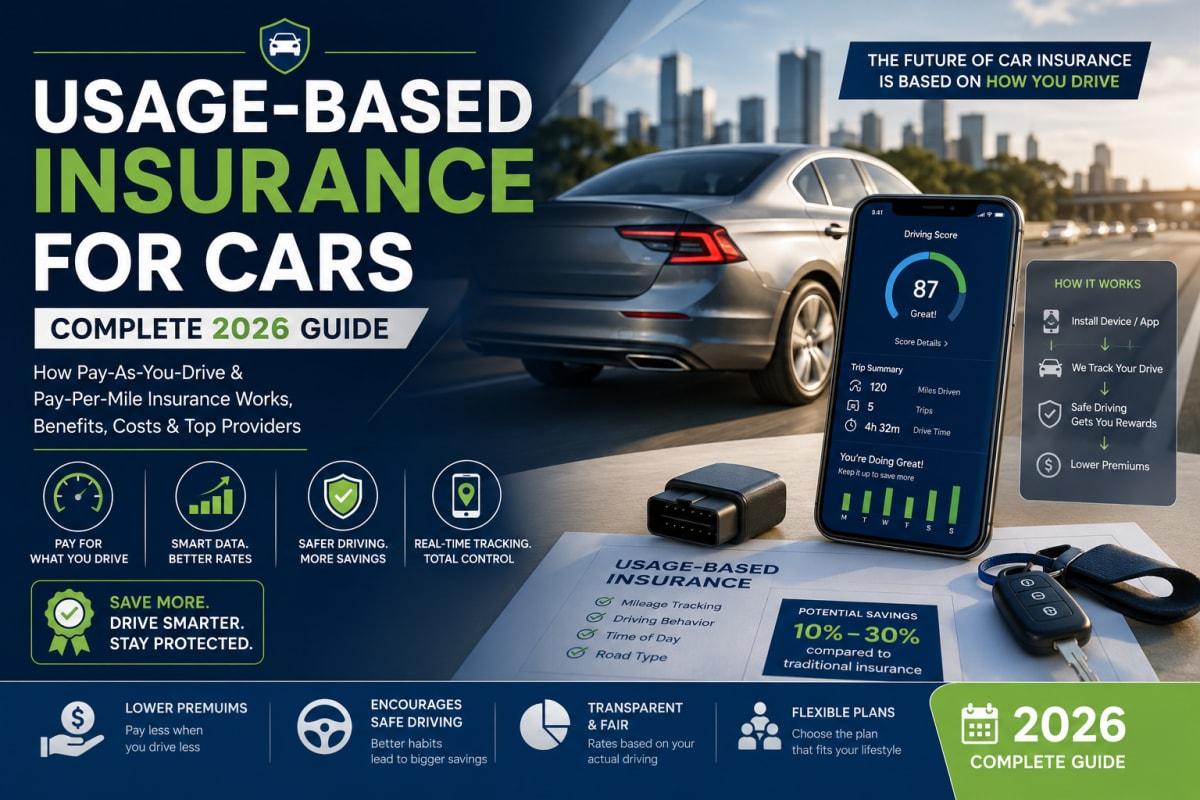
Usage-Based Insurance for Cars: Complete 2026 Guide
What if your car insurance premium actually reflected how you drive—not how people like you drive?
That's the promise of usage-based insurance (UBI), also known as telematics insurance. Instead of relying on demographics, credit scores, and statistical averages, UBI uses real-time data about your driving behavior to price your policy. If you're a safe driver or only drive short distances, you could pay significantly less.[reference:0]
The market is growing fast. The global usage-based insurance market was valued at USD 33.16 billion in 2025 and is projected to reach USD 99.72 billion by 2032, growing at a 17.03% CAGR.[reference:1] Consumer acceptance is at an all-time high—82% of policyholders now view telematics apps positively, and 60% are open to switching to usage-based insurance.[reference:2][reference:3]
Here's everything you need to know about usage-based car insurance in 2026—how it works, who it's for, and whether it can actually save you money.
What Is Usage-Based Car Insurance?
Usage-based car insurance (UBI) determines your premium based on how, when, and how much you drive, rather than traditional factors like age, location, driving history, and credit-based insurance scores.[reference:4]
Think about it. Traditional auto insurance relies on actuarial analysis of data like driving records, credit scores, personal characteristics, and vehicle types.[reference:5] You're grouped with people who share similar demographics, even if your driving habits are nothing like theirs. UBI flips that model, pricing your policy based on your individual behavior behind the wheel.[reference:6]
The technology behind UBI is called telematics—a system that collects and analyzes driving data using GPS, motion sensors, and wireless communication.[reference:7] This data is then used to calculate a more accurate risk profile, allowing safe and low-mileage drivers to potentially pay less.[reference:8]
Why This Matters Right Now
Here's the thing: insurance costs are rising. Between July and September 2024, Canadian auto insurance rates increased 9.6% year-over-year due to inflation, higher claims, and rising repair costs.[reference:9] Many drivers are looking for smarter alternatives to traditional policies.[reference:10]
At the same time, consumer attitudes are shifting. Gen Z and millennial buyers are driving a clear shift toward digital-first, transparent, and personalized insurance, moving away from one-size-fits-all policies.[reference:11] The data shows that 52% of drivers would share their driving scores to receive personalized pricing.[reference:12]
Key Facts About Usage-Based Car Insurance
Here are the essential facts that define usage-based car insurance in 2026.
- Real-Time Tracking — UBI tracks driving behavior through devices installed in vehicles, smartphone apps, or built-in technology in newer cars. The devices can measure miles driven, time of day, location, rapid acceleration, hard braking, hard cornering, cell phone usage, and even airbag deployment.[reference:13]
- Two Primary Models — There are two main types of UBI: pay-as-you-drive (based on mileage) and pay-how-you-drive (based on driving behavior and safety).[reference:14] Some insurers offer both options.
- Potential Savings — Safe drivers can earn discounts up to 25% from many insurers.[reference:15] Some programs offer even more—Farm Bureau's Driveology program offers up to 50% off for safe driving.[reference:16] Westfield's MissionSafe program saves participating customers an average of 20%, with some seeing discounts up to 40%.[reference:17]
- Privacy Trade-Off — Insurers tracking mileage and monitoring behavior raises privacy concerns. The technology is still relatively new, and not everyone qualifies for discounted rates.[reference:18]
- Growing Adoption — 82% of policyholders view telematics apps positively, and 60% are open to switching to usage-based insurance.[reference:19][reference:20] The market is projected to grow from USD 33.16 billion in 2025 to USD 99.72 billion by 2032.[reference:21]
What the Industry Data Shows
Industry data consistently shows that usage-based insurance is gaining mainstream acceptance. A 2026 survey by the IoT Insurance Observatory and Arity found that consumer acceptance of telematics is widening, creating opportunities for insurers who can cater to tech-driven drivers.[reference:22]
Research indicates that telematics apps could make auto insurers more competitive if they can cater to forward-thinking drivers ready to save.[reference:23] Telematics programs resonate because drivers want premiums that make sense for their lifestyles and reflect how they actually drive—not just how people like them drive.[reference:24]
The behavioral impact is also significant. Studies show that drivers in UBI programs improve their overall safety scores, reducing rates of speeding, hard braking, and rapid acceleration.[reference:25]
Types of Usage-Based Car Insurance
There are two primary types of usage-based car insurance. Availability varies by insurer and state, and some insurers offer both options.[reference:26]
- Pay-As-You-Drive (PAYD) — Your premium is based on the number of miles you drive. Most insurers charge a base rate plus a per-mile fee. This option is ideal for low-mileage drivers, remote workers, or households with a second vehicle used only occasionally.[reference:27] If your mileage increases, your insurance costs can rise quickly.[reference:28]
- Pay-How-You-Drive (PHYD) — Your premium is based on how safe of a driver you are. Insurers consider driving behavior and consistency, looking for patterns that may indicate risk, including total miles driven, speed and speeding frequency, hard braking or rapid acceleration, time of day you drive, and phone use while driving.[reference:29]
How the Technology Works
To participate in a UBI program, your real-time driving information is shared with the insurance company in one of three ways: a mobile app on your smartphone, a plug-in device installed on your vehicle's OBD-II port, or built-in technology available in some newer cars.[reference:30]
The data is collected over weeks or months, and insurers then use this information to adjust your insurance premium.[reference:31] Some programs give you a discount upfront just for enrolling, while others adjust your rate at renewal based on your driving performance.
Best Usage-Based Insurance Providers in 2026
Yahoo Finance analyzed 20 major insurers to determine the best usage-based insurance programs. Here are the top performers.[reference:32]
| Provider | Program | Max Discount | Rates for Risky Driving |
|---|---|---|---|
| Farm Bureau | Driveology | Up to 50% | Does not raise rates |
| USAA | SafePilot | Up to 30% | Does not raise rates |
| Travelers | IntelliDrive | Up to 30% | Can raise rates (exceptions in some states) |
Farm Bureau earned 5 out of 5 stars for its high maximum discount and policy of not raising rates for risky driving.[reference:33] USAA followed with 4.6 stars.[reference:34] Travelers scored 4.5 stars with a 10% enrollment discount and up to 30% off at renewal, though it can raise rates for risky driving in most states.[reference:35]
Who Should Actually Consider Usage-Based Insurance?
UBI isn't for everyone. But for some drivers, it can be a game-changer. Here's who benefits most.[reference:36]
- Safe Drivers — If you have safe driving habits, you could earn discounts up to 25% from many insurers.[reference:37]
- Low-Mileage Drivers — Remote or hybrid workers, carpoolers, or public transit users who drive under 12,000 kilometers (about 7,500 miles) a year are ideal candidates.[reference:38]
- Young Drivers — Gen Z and millennial buyers are driving the shift toward digital-first, transparent insurance, and UBI models appeal to low-mileage young drivers.[reference:39]
- Second Vehicle Owners — Households with a car that's used only occasionally can save significantly with pay-as-you-drive policies.[reference:40]
Mistakes Most People Make
A common mistake is assuming UBI guarantees savings. The commercials promote discounts, but UBI can also lead to higher premiums if your driving habits are considered risky.[reference:41] Before making the jump, honestly evaluate your driving habits.[reference:42]
Another mistake is not understanding what data is collected. Make sure you trust your insurer with your information. Research what devices will be used to monitor your driving and fully understand what behaviors will be tracked.[reference:43]
Some drivers also assume all UBI programs are the same. They're not. Programs vary significantly in how they calculate discounts, whether they can raise rates for risky driving, and what data they collect.
What Most Articles Won't Tell You
Most coverage focuses on the savings, but here's what gets overlooked: UBI is becoming the future of auto insurance. As tracking technology develops, UBI may become the most common way to determine auto insurance premiums.[reference:44] If there are flaws in your driving habits, you should start trying to correct them now.[reference:45]
Also worth noting: not all drivers are eligible for savings. Because your premiums under a UBI policy are based on your driving habits, not every policyholder will save on insurance costs.[reference:46] Some may actually pay more.
Advanced Moves Worth Knowing
For drivers looking to maximize savings, consider combining UBI with other discounts. Many insurers offer multi-policy, good student, and defensive driving discounts that can stack with UBI savings.
Another advanced move: use the real-time feedback from UBI apps to improve your driving. Studies show that drivers in UBI programs reduce their rates of speeding, hard braking, and rapid acceleration.[reference:47] Better driving habits mean lower risk—and lower premiums over time.
Frequently Asked Questions
What is usage-based car insurance?
Usage-based car insurance (UBI) uses real-time driving information to calculate your premium instead of traditional factors like age, location, and credit score.[reference:48] It's often called telematics insurance because it uses technology to track your driving behavior.
How does usage-based insurance work?
Your driving data is collected through a smartphone app, a plug-in device, or built-in vehicle technology. Insurers track miles driven, speed, braking, acceleration, time of day, and sometimes phone use. This data is then used to adjust your premium—safe, low-mileage drivers typically pay less.[reference:49]
Can usage-based insurance raise my rates?
Yes, in most programs. If your driving habits are considered risky—frequent hard braking, rapid acceleration, speeding, or late-night driving—your premium can increase.[reference:50] However, some insurers like Farm Bureau and USAA do not raise rates for risky driving.[reference:51][reference:52]
Is usage-based insurance cheaper?
It can be—if you're a safe, low-mileage driver. Safe drivers can earn discounts up to 25% or more.[reference:53] Westfield customers save an average of 20%, with some seeing up to 40% off.[reference:54] But if your driving habits are risky, you could end up paying more.[reference:55]
Is usage-based insurance worth it?
It depends on your driving habits. If you're a safe driver with low mileage, UBI can save you significant money. If you frequently drive at night, brake hard, or accelerate rapidly, you may be better off with a traditional policy. Honestly evaluate your driving before enrolling.[reference:56]
The Bottom Line on Usage-Based Car Insurance
Usage-based car insurance is transforming how auto insurance is priced. Instead of grouping you with people like you, it prices you based on how you actually drive. For safe, low-mileage drivers, the savings can be substantial.
The key takeaway is to know yourself before you enroll. Honestly evaluate your driving habits. If you brake hard, accelerate quickly, or drive late at night, UBI might not be your best option. But if you're a safe, consistent driver who doesn't log many miles, UBI could save you hundreds of dollars a year.
Consumer acceptance is growing—82% of policyholders now view telematics positively.[reference:57] The technology is here to stay. The question isn't whether UBI will become mainstream; it's whether you're ready to benefit from it.
Read Next

Life Insurance Explained: How to Protect Your Family

FDA Warning: Infant Botulism Surge Linked to Powdered Formula

Rural Health Crisis: UAMS Launches Lifeline for Arkansans

FDA’s Surprising Move: New Sunscreen Ingredient Revealed

Nvidia's AI Healthcare Boom: Secret Project With Abridge Revealed