Government Health Insurance in Australia Explained
How Medicare actually works, what it covers, where private cover fills the gaps, and how to avoid the tax penalty that catches so many Australians off guard.
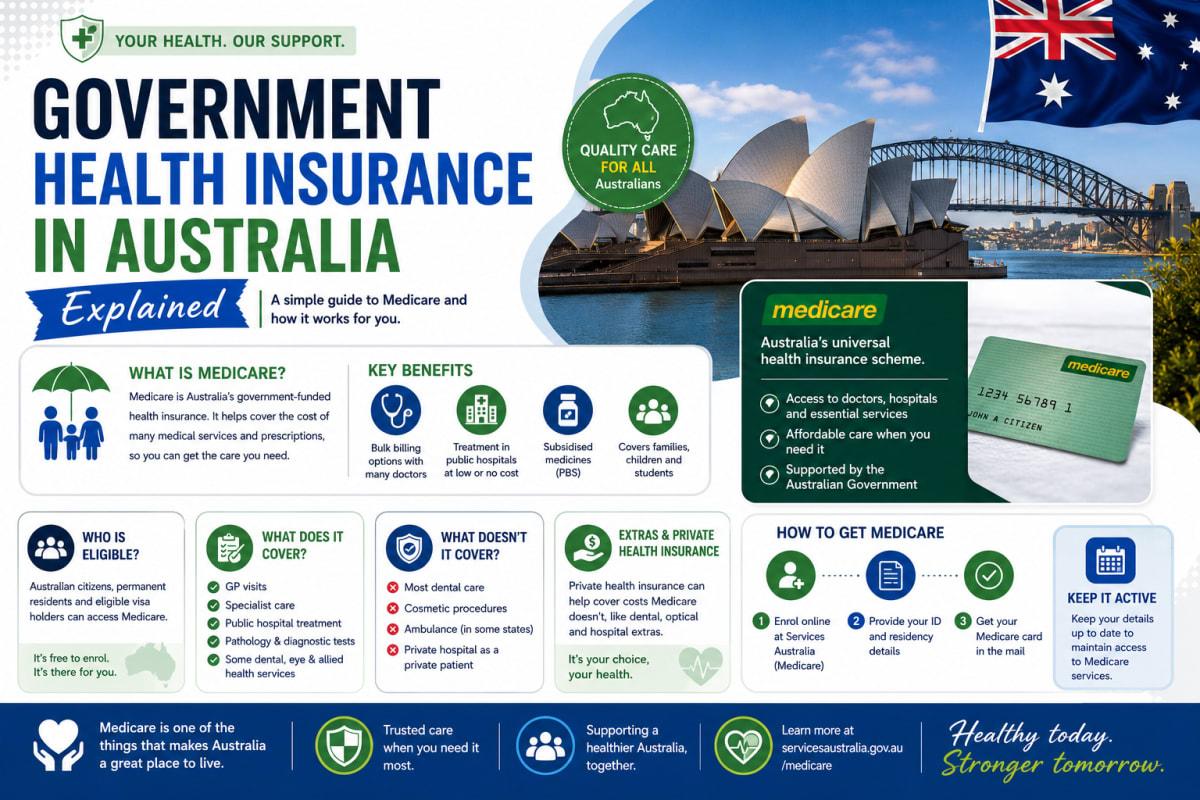
Government Health Insurance in Australia Explained
Most Australians pay for healthcare through their taxes without ever seeing a bill for a doctor's visit. That's Medicare at work, and understanding how it fits with private cover can save you thousands of dollars a year.
Government health insurance in Australia centers on Medicare, a universal system that covers a wide range of medical services for citizens and permanent residents. This guide walks you through what Medicare actually pays for, where the gaps are, how private insurance interacts with it, and the penalty that pushes many people toward private cover earlier than they expect.
Government Health Insurance in Australia — What It Is and Why It Matters
Government health insurance in Australia refers to Medicare, the country's universal healthcare system funded through general taxation and a dedicated Medicare levy. It gives citizens and permanent residents access to free or subsidized medical care, including public hospital treatment, and reduced costs for many out-of-hospital services.
Medicare exists alongside a private health insurance market, and the two systems are designed to work together rather than compete directly. Knowing where one ends and the other begins is the key to avoiding unexpected bills.
Why This Is Important Right Now
Picture someone who assumes Medicare covers everything, only to discover a large gap payment after seeing a specialist who doesn't bulk bill. That surprise is common, and it usually comes from not understanding how Medicare rebates actually work.
With private health premiums rising most years and cost-of-living pressures affecting household budgets across the country, knowing exactly what Medicare does and doesn't cover has become more important for financial planning, not just health planning.
Key Facts About Government Health Insurance in Australia
Before deciding whether you need private cover on top of Medicare, it helps to understand the basic structure of the system. These facts form the foundation for every decision that follows.
- Medicare covers public hospital treatment as a public patient — including accommodation, treatment, and after-care at no cost.
- Medicare provides rebates for many out-of-hospital services — covering a set schedule fee, though doctors can charge above that amount.
- The Medicare levy funds part of the system — most taxpayers pay this as a percentage of their taxable income.
- Medicare does not typically cover dental, optical, or most allied health services — these gaps are where private extras cover usually applies.
- Private hospital cover affects tax outcomes — higher earners without it may face an additional tax charge known as the Medicare Levy Surcharge.
What the Industry Data Shows
Industry data suggests that a meaningful share of Australians hold some form of private hospital cover specifically to avoid the Medicare Levy Surcharge, rather than purely for health reasons. That distinction matters when comparing the true cost and benefit of a policy.
Analysis from outlets covering Australian healthcare policy has repeatedly noted that public hospital wait times for non-urgent elective procedures tend to be longer than private hospital wait times for the same procedures. That gap is one of the main reasons people choose to supplement Medicare with private cover.
Benefits and Real Opportunities
Understanding how Medicare and private insurance work together opens up real savings and better care choices, whether you're relying on Medicare alone or pairing it with private cover.
- No-cost public hospital care — Medicare removes financial barriers to essential hospital treatment for residents.
- Choice of doctor and hospital with private cover — private patients can often choose their treating specialist and admission timing.
- Reduced tax burden — appropriate private hospital cover can help higher earners avoid the Medicare Levy Surcharge.
- Access to extras cover — dental, optical, and physiotherapy benefits fill gaps Medicare doesn't reach.
Costs and What to Expect
The standard Medicare levy is calculated as a percentage of taxable income for most taxpayers, with exemptions and reductions available for lower-income earners. The Medicare Levy Surcharge applies as an additional percentage on top of that for higher-income individuals and families without private hospital cover, and it scales upward at higher income tiers.
Private hospital cover premiums vary widely depending on your age, cover level, and insurer, often ranging from modest monthly amounts for basic cover to significantly more for comprehensive policies. Extras cover for dental and optical typically costs less but comes with annual benefit limits and waiting periods for major services.
Out-of-pocket gap payments for specialists who don't bulk bill can add up quickly, since Medicare only rebates a scheduled fee rather than the full amount a specialist chooses to charge.
Medicare Only vs Medicare Plus Hospital Cover vs Medicare Plus Extras Cover: Which One Is Right for You?
| Option | Best For | Pros | Cons |
|---|---|---|---|
| Medicare Only | Younger, lower-income individuals with minimal health needs | No premium costs and full access to public hospital care | Longer wait times for non-urgent procedures and no choice of doctor |
| Medicare Plus Hospital Cover | Higher earners and those wanting faster elective care | Avoids the Medicare Levy Surcharge and shortens wait times | Ongoing premium costs and possible waiting periods for some conditions |
| Medicare Plus Extras Cover | People needing regular dental, optical, or physio care | Covers common services Medicare excludes entirely | Annual limits and waiting periods can restrict major claims |
Who Should Actually Care About Government Health Insurance in Australia?
This matters for every Australian resident, but the stakes differ by life stage. Higher-income earners need to understand the Medicare Levy Surcharge before it costs them at tax time. Young families should know what Medicare covers for children's care. And anyone with ongoing dental or allied health needs should weigh whether extras cover pays for itself.
Mistakes Most People Make
These missteps come up constantly, and each one is avoidable with a bit of planning.
Assuming Medicare covers all specialist visits leads to unexpected gap payments. Asking whether a specialist bulk bills before the appointment avoids that surprise entirely.
Delaying private hospital cover until you actually need it often means facing waiting periods right when you need treatment most. Taking out cover before a health issue arises avoids this trap completely.
Ignoring the Medicare Levy Surcharge threshold each financial year can result in an unwelcome tax bill for higher earners who assumed they were exempt. Checking your income bracket annually keeps this from catching you off guard.
Buying extras cover without checking annual limits means discovering too late that your policy barely covers a fraction of a major dental bill. Reading the benefit schedule before committing prevents that disappointment.
What Most Articles Won't Tell You
Most guides mention bulk billing but skip how inconsistent it's become by location and specialty. Checking bulk billing rates for your specific area and specialist type, rather than assuming national averages apply, gives a far more accurate picture of your likely costs.
There's also a detail often missed: choosing a public hospital as a private patient can sometimes combine no-cost public treatment with some of the choice benefits of private cover, depending on the hospital and your policy. It's worth asking your hospital directly about this option before assuming private always means a private facility.
Advanced Moves Worth Knowing
Reviewing your private health cover annually against your actual claims history often reveals you're paying for extras you rarely use. Downgrading unused extras while keeping strong hospital cover can lower premiums without sacrificing meaningful protection.
Comparing policies through the government's official comparison tools, rather than relying solely on insurer marketing, tends to surface better value options that aren't always the most heavily advertised.
Frequently Asked Questions
Does Medicare cover private hospital treatment in Australia?
No, Medicare primarily covers treatment as a public patient in a public hospital. If you're treated privately, even in a public hospital, Medicare provides only a partial rebate and private insurance or out-of-pocket payment typically covers the rest.
Do I have to pay the Medicare Levy Surcharge if I have private extras cover only?
Yes, extras cover alone doesn't exempt you from the surcharge. You generally need appropriate private hospital cover specifically to avoid the Medicare Levy Surcharge if your income is above the relevant threshold.
How much does private health insurance typically cost in Australia?
Costs vary significantly based on age, cover level, and insurer, with basic hospital cover starting relatively low and comprehensive combined cover costing considerably more per month. Comparing several insurers directly is the best way to get an accurate estimate for your situation.
Is Medicare available to visitors and temporary residents in Australia?
Generally, no, unless a reciprocal healthcare agreement exists between Australia and the visitor's home country. Most temporary visa holders need separate overseas visitor health cover instead.
What's the difference between bulk billing and a gap payment?
Bulk billing means the doctor accepts the Medicare rebate as full payment, so you pay nothing out of pocket. A gap payment happens when the doctor charges more than the Medicare rebate, leaving you to cover the difference yourself.
The Bottom Line on Government Health Insurance in Australia
Government health insurance in Australia gives every resident a genuine safety net through Medicare, but it isn't designed to cover everything. Knowing where the gaps are, from specialist fees to dental care, is what lets you make a smart decision about private cover instead of guessing. Check your income against the Medicare Levy Surcharge threshold this year, and compare hospital cover options if you're relying on Medicare alone. A little research now can save you from a costly surprise later.
Read Next

FDA Warning: Infant Botulism Surge Linked to Powdered Formula

Rural Health Crisis: UAMS Launches Lifeline for Arkansans

FDA’s Surprising Move: New Sunscreen Ingredient Revealed

Nvidia's AI Healthcare Boom: Secret Project With Abridge Revealed

Medicare Advantage Denials Shock Seniors Needing Rehab Care