How Much Life Insurance Do You Need? 2026 Calculator Guide
Skip the generic "10x your salary" advice. Here's exactly how to calculate the life insurance coverage your family actually needs in 2026.
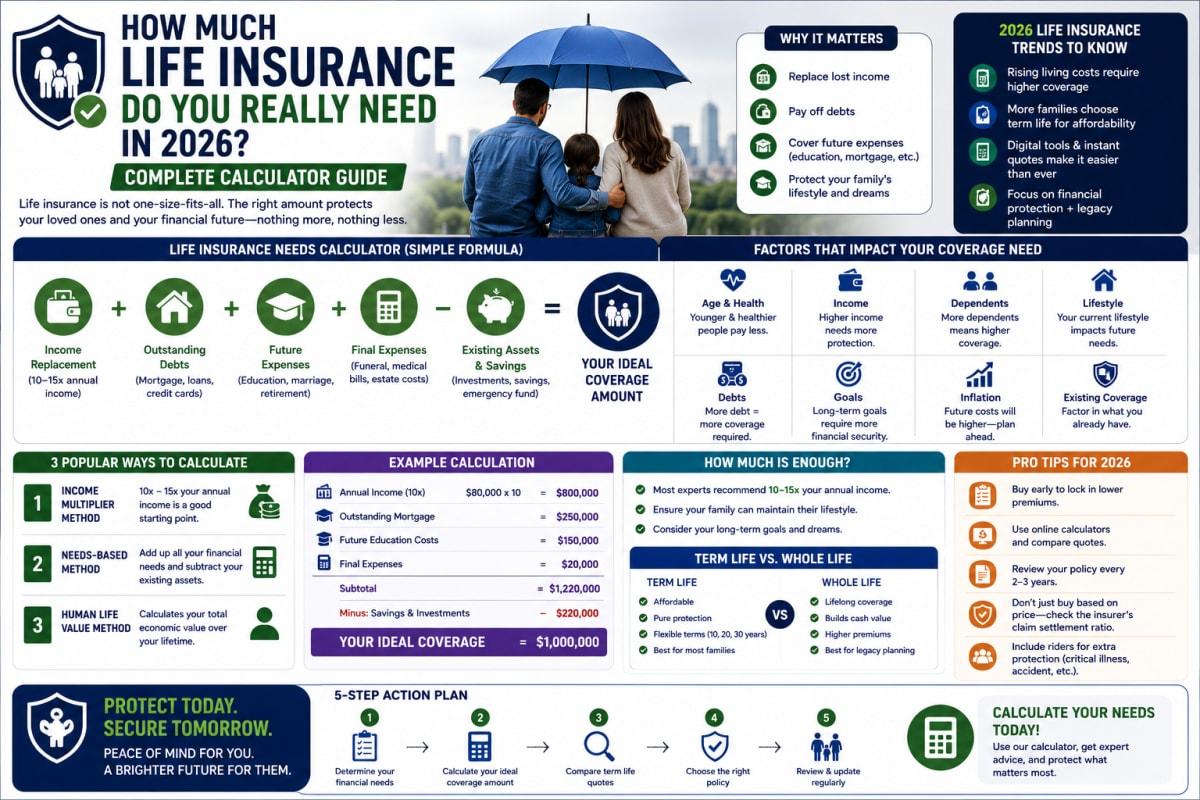
How Much Life Insurance Do You Need? 2026 Calculator Guide
Ask five people how much life insurance you need, and you'll get five different numbers, most of them guesses. The right answer isn't a round figure like $500,000. It's a calculation based on your actual debts, income, and family situation.
Figuring out how much life insurance you really need in 2026 means moving past generic rules of thumb and into a real calculation that reflects your specific life. This guide walks through the exact methods financial professionals use, shows you how to run the numbers yourself, and flags the mistakes that lead people to end up underinsured or overpaying for coverage they don't need.
Life Insurance Coverage — What It Is and Why It Matters
Life insurance coverage is the death benefit amount your policy pays to your beneficiaries if you pass away while the policy is active. The right coverage amount replaces your financial contribution to your household, covers outstanding debts, and funds future obligations like a mortgage or your children's education.
Getting this number right matters because being underinsured leaves your family financially exposed exactly when they can least afford it, while being significantly overinsured means paying for coverage that doesn't add real protective value.
Why This Is Important Right Now
Picture a parent with a $300,000 mortgage, two young kids, and a policy from years ago that only covers $150,000. That gap might have felt fine when the policy was purchased, but rising home values, childcare costs, and general inflation have quietly eroded what that coverage actually protects.
Life circumstances change fast: a new mortgage, a second child, a career change, or simply years of rising costs since your last policy review. Recalculating your needs periodically, not just once at the start, is what keeps your coverage genuinely useful.
Key Facts About Calculating Life Insurance Needs
A few core facts shape how coverage calculations actually work, and understanding them makes every method below far easier to apply correctly.
- Flat multiples like "10x your income" are a starting estimate, not a final answer — they ignore debt, existing savings, and family-specific costs.
- The DIME method covers four core categories — Debt, Income replacement, Mortgage, and Education, added together for a more precise total.
- Existing assets and savings offset your needed coverage — retirement accounts, existing life insurance, and liquid savings reduce the gap you need to fill.
- Stay-at-home parents need coverage too — replacing childcare, household management, and related services carries a real financial cost often overlooked.
- Term life insurance is generally the most cost-effective way to cover a calculated need — since it provides a large death benefit for a specific period at a lower premium than permanent policies.
What the Industry Data Shows
Industry data suggests that a significant share of American households with life insurance are underinsured relative to their actual financial obligations, often because their coverage was purchased years earlier and never adjusted for a new mortgage, additional children, or income growth.
Research from organizations like LIMRA and coverage in outlets such as Forbes have consistently found that people frequently underestimate how many years of income replacement their family would actually need, often defaulting to a round number rather than calculating based on time until children reach financial independence or debts are paid off.
Benefits and Real Opportunities
Running an accurate calculation instead of guessing creates real financial benefits for your household, both now and for your beneficiaries later.
- Right-sized premiums — an accurate number prevents overpaying for coverage beyond what your family genuinely needs.
- Real financial protection — properly calculated coverage actually replaces lost income and pays off debts instead of falling short.
- Clarity for major life decisions — knowing your true coverage need helps when comparing term lengths and policy types.
- Peace of mind grounded in real numbers — confidence that your family's specific situation, not a generic guess, shaped your coverage decision.
Costs and What to Expect
Term life insurance premiums vary significantly based on age, health, coverage amount, and term length, but a healthy person in their 30s can often secure a substantial term policy for a relatively modest monthly premium. Premiums rise with age and any health conditions, so locking in coverage earlier in life typically costs meaningfully less over time.
Permanent life insurance policies, which combine a death benefit with a cash value component, typically cost several times more per month than a comparable term policy, since part of the premium builds savings rather than solely funding the death benefit. For most people calculating a need based on temporary obligations like a mortgage or years until retirement, term coverage is the more cost-effective match.
Riders like disability waiver of premium or accelerated death benefits typically add a modest amount to your premium but can provide valuable additional protection depending on your circumstances.
Income Multiple Method vs DIME Method vs Human Life Value Method: Which One Is Right for You?
| Option | Best For | Pros | Cons |
|---|---|---|---|
| Income Multiple Method | People wanting a fast, rough starting estimate | Quick and simple, requiring almost no calculation | Ignores debt, assets, and family-specific circumstances entirely |
| DIME Method | Most households wanting a balanced, realistic number | Accounts for debt, income, mortgage, and education costs together | Requires gathering more detailed financial information upfront |
| Human Life Value Method | High earners or those with complex long-term income projections | Captures full lifetime earning potential, not just current obligations | More complex to calculate and often requires professional input |
Who Should Actually Care About Calculating Life Insurance Needs?
This matters most for parents of dependent children, anyone carrying a mortgage or significant debt, and the primary or sole income earner in a household. It's equally relevant for stay-at-home parents, since replacing their unpaid household labor and childcare responsibilities carries a real cost that's easy to overlook when calculating coverage.
Mistakes Most People Make
A handful of errors show up repeatedly when people estimate their coverage needs.
Relying only on a flat income multiple without adjusting for debt or existing savings often leads to a number that's disconnected from actual household obligations. Running a DIME calculation alongside the quick multiple gives a much more accurate picture.
Assuming employer-provided life insurance is sufficient overlooks that most workplace policies only cover a small multiple of salary and typically end when you leave the job. Treating employer coverage as a supplement, not your primary policy, avoids a dangerous gap.
Forgetting to account for a stay-at-home parent's contribution means underinsuring a household that would otherwise face real childcare and household management costs if that parent passed away. Calculating a replacement cost for those responsibilities closes that gap.
Buying coverage once and never revisiting it means your policy can become outdated within a few years as your mortgage, income, or family size changes. Reviewing your coverage every few years, or after a major life event, keeps it aligned with reality.
What Most Articles Won't Tell You
Most guides mention the DIME method but skip explaining how to actually subtract your existing assets from the total. Adding up your debt, income replacement need, mortgage balance, and education costs, then subtracting savings and existing coverage, gives a genuinely tailored final number rather than an inflated one.
There's also a detail often missed: term length matters just as much as coverage amount. Choosing a term that only covers a few years when your real obligation, like a mortgage or years until your youngest child turns eighteen, extends much longer defeats the purpose of calculating the right coverage amount in the first place.
Advanced Moves Worth Knowing
Laddering multiple term policies with different end dates, one matching your mortgage payoff and another matching your youngest child's expected financial independence, can match your coverage more precisely to your actual timeline while potentially lowering total premium costs.
Recalculating your coverage need immediately after a major life event, like a new mortgage, a new child, or a significant income change, rather than waiting for an annual review, ensures you're never carrying a meaningfully outdated policy.
Frequently Asked Questions
What is the DIME method for calculating life insurance?
DIME stands for Debt, Income replacement, Mortgage, and Education. You add up your total debt, the years of income your family would need replaced, your remaining mortgage balance, and future education costs, then subtract existing savings and coverage to reach a target amount.
Does a stay-at-home parent need life insurance?
Yes, generally. While they don't draw a salary, their household and childcare responsibilities carry a real replacement cost that a working spouse would otherwise have to pay for out of pocket, which coverage can help offset.
Is employer-provided life insurance enough coverage?
Usually not on its own. Most employer policies only cover a modest multiple of your salary and typically end if you leave the job, so it's generally treated as a supplement to an individual policy rather than your sole coverage.
How often should I recalculate how much life insurance I need?
Recalculating every few years is reasonable, but it's especially important after major life events like a new mortgage, a new child, marriage, or a significant change in income.
Should I choose term or permanent life insurance?
For most people calculating a need tied to specific obligations like a mortgage or years until children are financially independent, term life insurance offers the most cost-effective match. Permanent policies suit different goals, like estate planning or lifelong coverage, and are worth discussing with a financial professional if those apply to you.
The Bottom Line on How Much Life Insurance You Need in 2026
The right amount of life insurance isn't a number you guess or borrow from a generic rule of thumb. It's a calculation built from your actual debt, income, mortgage, and family obligations, minus what you've already saved. Run the DIME method against your real numbers instead of defaulting to a flat multiple of your salary. Revisit that number after any major life change, and you'll carry coverage that actually protects the people who depend on you.
Read Next

States Face Medicaid Crisis: Urgent Provider Revalidation Plans Due Now!

Shocking Reveal: What Medicare Part B Won't Cover Costs You!

Shock: Child Medicaid Enrollment Plummets Ahead of HR 1 Policies!

Oklahoma House's Shocking Medicaid Change Sparks Urgent Financial Crisis

Surge in Medicaid Drug Costs: What You Need to Know Now!