Best Health Insurance for Self-Employed Americans 2026
ACA subsidies dropped sharply on January 1, 2026. Here's how self-employed Americans can still find affordable coverage, plus a calculator to estimate your real cost.
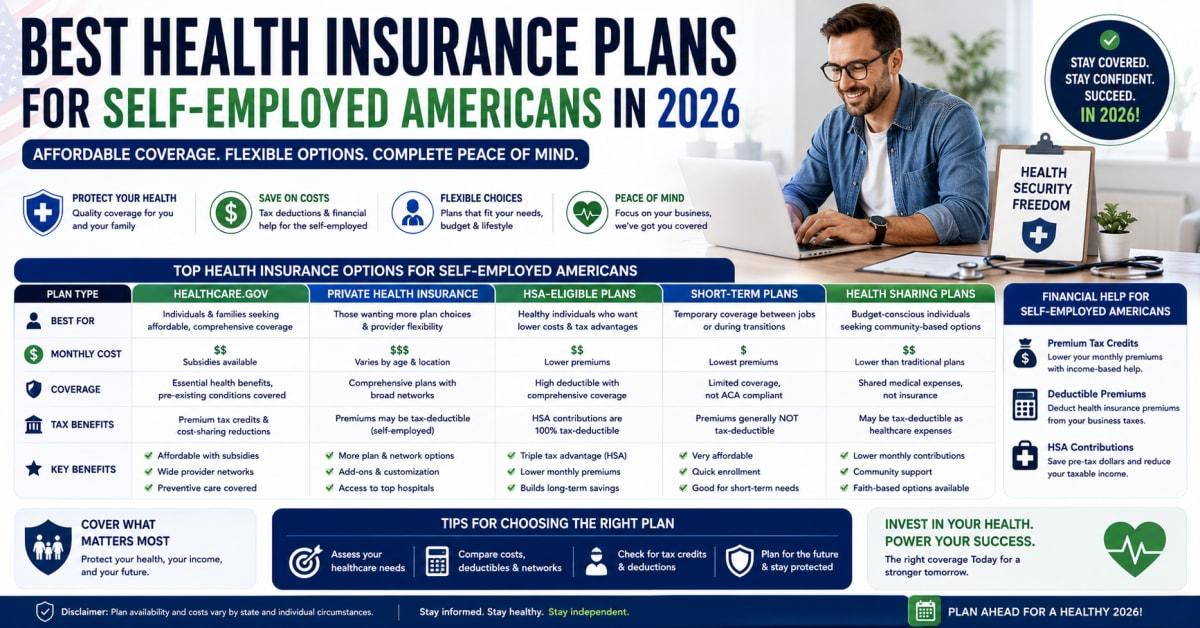
Best Health Insurance for Self-Employed Americans 2026
The enhanced ACA premium subsidies that kept millions of Americans' health insurance affordable expired on January 1, 2026. For subsidized enrollees nationally, average annual premium payments are projected to more than double, from about $888 in 2025 to roughly $1,904 in 2026.
Finding the best health insurance as a self-employed American in 2026 means navigating a genuinely different landscape than just a year ago. This guide breaks down what actually changed, which plan tiers still make sense at the new subsidy levels, and how to use the self-employed health insurance deduction to soften the real cost increase.
Health Insurance for Self-Employed Americans — What Changed and Why It Matters
Self-employed Americans without access to employer-sponsored coverage typically buy insurance through the ACA Marketplace, where premium tax credits reduce costs based on estimated household income. Those credits didn't disappear entirely in 2026, but the enhanced version, in place since 2021, expired at the start of the year, reverting subsidies to their original, less generous pre-2021 structure.
This matters because self-employed people already face a harder version of this decision than W-2 employees: no employer contribution, fluctuating income, and now a smaller subsidy cushion than they may have budgeted around based on last year's numbers.
Why This Is Important Right Now
Picture a freelancer who budgeted around a $74 monthly premium in 2025, the average subsidized enrollee payment that year, only to find their 2026 renewal notice showing a payment closer to double that amount, even with identical income and the same plan.
The 2026 benchmark Silver plan now averages $625 a month in gross premium before any subsidy, and the lowest-cost Bronze plan averages $456 a month gross. With the enhanced credits gone, the gap between what you pay and what the government covers has narrowed significantly for most income levels.
2025 vs 2026: What Subsidized Enrollees Actually Pay
Here's the national average shift in one visual, based on KFF's analysis of the subsidy expiration's impact.
Average payment among subsidized Marketplace enrollees nationally, per KFF analysis. A 114% increase overall. Your actual figure depends on income, age, location, and plan tier.
Key Facts About Self-Employed Health Insurance in 2026
A few core facts define how self-employed people should actually approach coverage this year.
- ACA subsidies are based on net income, not gross revenue — meaning legitimate business deductions lower your countable income and can meaningfully increase your subsidy eligibility.
- Self-employed people can deduct 100% of health insurance premiums — as an above-the-line deduction on Schedule 1, though if you receive premium tax credits, you can only deduct the portion you actually paid out of pocket, reconciled on Form 8962.
- Silver plans remain the only tier eligible for cost-sharing reductions — extra savings on deductibles and copays available to households between 100% and 250% of the federal poverty level.
- Bronze HSA-eligible plans suit healthy, higher-income self-employed people — pairing a lower premium with the ability to fund a tax-advantaged Health Savings Account.
- 2026 open enrollment runs November 1 through January 15 — outside this window, you generally need a qualifying life event to enroll or change plans.
What the Industry Data Shows
Industry data suggests that the expiration of enhanced premium tax credits is expected to push several million people out of subsidized Marketplace coverage entirely in 2026, according to Urban Institute estimates, as the higher out-of-pocket cost becomes unaffordable for some households.
Analysis from health policy researchers has found that the increase hits differently across income levels, with older, middle-income enrollees facing a particularly steep subsidy cliff, since they previously qualified for meaningful assistance that has now shrunk or disappeared entirely at their income level.
Case Study: Two Freelancers, Same Income, Different Strategies
Here's how two self-employed people with identical $55,000 net incomes might end up with very different 2026 costs, based purely on how they approach their plan and deductions.
Freelancer A: Tomas. Tomas reports his net income accurately but doesn't track every eligible business deduction, overpaying slightly on his tax return and reporting a higher net income to the Marketplace than necessary. He enrolls in a Silver plan without checking his cost-sharing reduction eligibility and pays the full premium out of pocket without adjusting his estimated income mid-year when a slow quarter hits.
Freelancer B: Aisha. Aisha works with her accountant to track every legitimate business deduction, lowering her reported net income and increasing her premium tax credit eligibility. She specifically chooses a Silver plan to access cost-sharing reductions, deducts her out-of-pocket premium portion on Schedule 1, and updates her income estimate with the Marketplace when a slow month changes her projected annual total.
Same income, same industry, meaningfully different real cost. The difference wasn't luck. It was Aisha treating her subsidy eligibility as an active, ongoing calculation rather than a one-time enrollment decision.
Step-by-Step: How to Find the Right Plan This Year
Follow this sequence during open enrollment or after a qualifying life event.
Step 1: Calculate your realistic net self-employment income. Use last year's actual net profit as a starting point, adjusted for any known changes, rather than guessing from gross revenue.
Step 2: Check your subsidy eligibility at that income level. Use an ACA subsidy calculator to see your estimated premium tax credit under the new, non-enhanced 2026 structure.
Step 3: Compare Bronze, Silver, and Gold at your actual expected usage. If you're between 100% and 250% of the federal poverty level, price out Silver specifically, since it's the only tier with cost-sharing reductions.
Step 4: Confirm your premium deduction strategy with a tax professional. Understand how much of your premium you can actually deduct if you're also receiving a subsidy, since only your out-of-pocket portion qualifies.
Step 5: Set a reminder to update your income estimate mid-year. A significant income change should be reported to the Marketplace promptly to keep your subsidy accurate and avoid a surprise reconciliation at tax time.
Estimate Your 2026 Real Cost
Get a rough sense of your annual premium cost after accounting for the self-employed premium deduction on your out-of-pocket portion. This is a simplified estimate, not a substitute for a licensed advisor or your actual Marketplace quote.
Benefits and Real Opportunities
Despite the subsidy reduction, self-employed people still have real, meaningful advantages available to them in 2026.
- Guaranteed-issue coverage regardless of medical history — ACA Marketplace plans can't deny you or charge more based on preexisting conditions.
- Subsidies based on net income give self-employed people real control — accurate expense tracking directly lowers your reportable income and can meaningfully increase your credit.
- The premium deduction stacks on top of any subsidy — reducing your real out-of-pocket cost further, even in a year with smaller subsidies overall.
- HSA-eligible Bronze plans offer a tax-advantaged savings angle — appealing for healthy, self-employed people who want to build tax-free medical savings alongside lower premiums.
Costs and What to Expect
Typical 2026 monthly premiums for a single self-employed adult before any subsidy range roughly from $170 to $430 depending on age, location, and plan tier, though your actual after-subsidy cost depends heavily on your net income relative to the federal poverty level. The 2026 benchmark Silver plan averages $625 a month gross nationally, and the cheapest available Bronze plan averages $456 a month gross.
Beyond the monthly premium, deductibles vary significantly by tier: Bronze plans carry the highest deductibles paired with the lowest premiums, while Gold and Platinum plans reverse that tradeoff with higher premiums but lower out-of-pocket costs when you actually use care. The 100% premium deduction only applies to the portion you paid yourself, not any amount covered by an advance premium tax credit, a distinction reconciled on Form 8962 at tax time.
Missing the November 1 to January 15 open enrollment window generally locks you out of enrolling or switching plans until the next window, unless you experience a qualifying life event like a significant income change, marriage, or loss of other coverage.
Bronze HSA-Eligible Plans vs Silver Plans With Cost-Sharing Reductions vs Gold Plans: Which One Is Right for You?
| Option | Best For | Pros | Cons |
|---|---|---|---|
| Bronze HSA-Eligible Plans | Healthy self-employed people with higher income wanting tax-advantaged savings | Lowest premiums plus HSA contribution eligibility | Highest deductibles, riskier if you have frequent medical needs |
| Silver Plans With Cost-Sharing Reductions | Self-employed people between 100% and 250% of the federal poverty level | Only tier eligible for extra deductible and copay reductions | Reductions phase out and disappear above the income threshold |
| Gold Plans | Self-employed people who use healthcare frequently and value predictable costs | Lower deductibles and copays when you actually need care | Meaningfully higher monthly premium than Bronze or Silver |
Who Should Actually Care About This?
This matters for freelancers, consultants, sole proprietors, and small business owners without access to employer-sponsored coverage, especially anyone who budgeted their 2026 premium based on 2025's subsidy levels. It's especially urgent for older, middle-income self-employed people, since this group faces the steepest relative increase from the subsidy cliff, and for anyone whose income fluctuates enough that mid-year updates to the Marketplace genuinely matter.
Mistakes Most People Make
A handful of habits are costing self-employed people real money this year specifically.
Assuming your 2025 subsidy amount still applies in 2026 without re-checking your eligibility under the new, non-enhanced structure can lead to a significant premium surprise at enrollment. Running your numbers through a current subsidy calculator, not last year's memory, avoids that shock.
Reporting gross revenue instead of net income to the Marketplace, as Tomas did in the case study above, overstates your income and can needlessly shrink your subsidy eligibility.
Forgetting that only your out-of-pocket premium portion, not any subsidized amount, qualifies for the self-employed health insurance deduction can lead to an inflated deduction claim that gets caught at tax time.
Failing to update your income estimate with the Marketplace after a significant business change can result in an inaccurate subsidy that gets reconciled, sometimes unfavorably, when you file your taxes.
What Most Articles Won't Tell You
Most coverage of the subsidy expiration focuses on the national average increase, but self-employed people have a genuine lever most W-2 employees don't: legitimate business expense tracking directly lowers the net income the Marketplace uses to calculate your subsidy, which matters more now that the enhanced cushion is gone.
There's also a detail worth knowing: Congress has continued debating whether to revive some version of the enhanced credits even after their expiration, meaning the subsidy landscape could still shift again within 2026 depending on legislative action, so it's worth checking for updates before assuming this year's structure is permanent.
Advanced Moves Worth Knowing
Working with a CPA to maximize legitimate business deductions before estimating your Marketplace income can meaningfully improve your subsidy eligibility, since ACA credits are based on net profit, not gross revenue.
Pairing a Bronze HSA-eligible plan with maximum HSA contributions lets healthy, higher-income self-employed people offset some of the reduced subsidy through additional tax-advantaged savings, rather than through the ACA credit alone.
Frequently Asked Questions
Why did my ACA premium go up so much for 2026?
The enhanced premium tax credits in place since 2021 expired on January 1, 2026, causing subsidies to revert to their original, smaller structure. National averages show subsidized enrollee payments roughly doubling as a result.
Are ACA subsidies gone entirely in 2026?
No, the original ACA premium tax credit structure still exists and applies based on your income relative to the federal poverty level. It's specifically the enhanced version, which expanded eligibility and increased credit amounts, that expired.
Can self-employed people still deduct their health insurance premiums?
Yes, self-employed individuals can generally deduct 100% of their health insurance premiums as an above-the-line deduction, though if you receive a premium tax credit, only the portion you paid out of pocket qualifies for the deduction.
Should I choose Bronze, Silver, or Gold as a self-employed person?
It depends on your income and expected healthcare use. Silver is often the best value if you qualify for cost-sharing reductions, Bronze suits healthy people prioritizing the lowest premium, and Gold suits those who use healthcare frequently and want predictable costs.
What happens if my self-employment income changes mid-year?
You should report significant income changes to the Marketplace promptly, since this adjusts your ongoing subsidy amount and helps avoid an unexpected reconciliation, positive or negative, when you file your taxes.
The Bottom Line on Health Insurance for Self-Employed Americans in 2026
The expiration of enhanced ACA subsidies has genuinely changed the math for self-employed Americans in 2026, roughly doubling average premium payments for subsidized enrollees nationally. But the tools to soften that increase, accurate net income reporting, the right plan tier for your situation, and the stacked premium deduction, are all still fully available. Run your actual numbers through a current subsidy calculator rather than relying on last year's figures, and consider working with a CPA to make sure your business deductions are working as hard as possible for your coverage costs this year.