How to Build an Emergency Fund in 2026: Step-by-Step
A clear, step-by-step plan to build a real emergency fund in 2026, even on a tight budget, so a surprise expense never turns into a debt spiral.
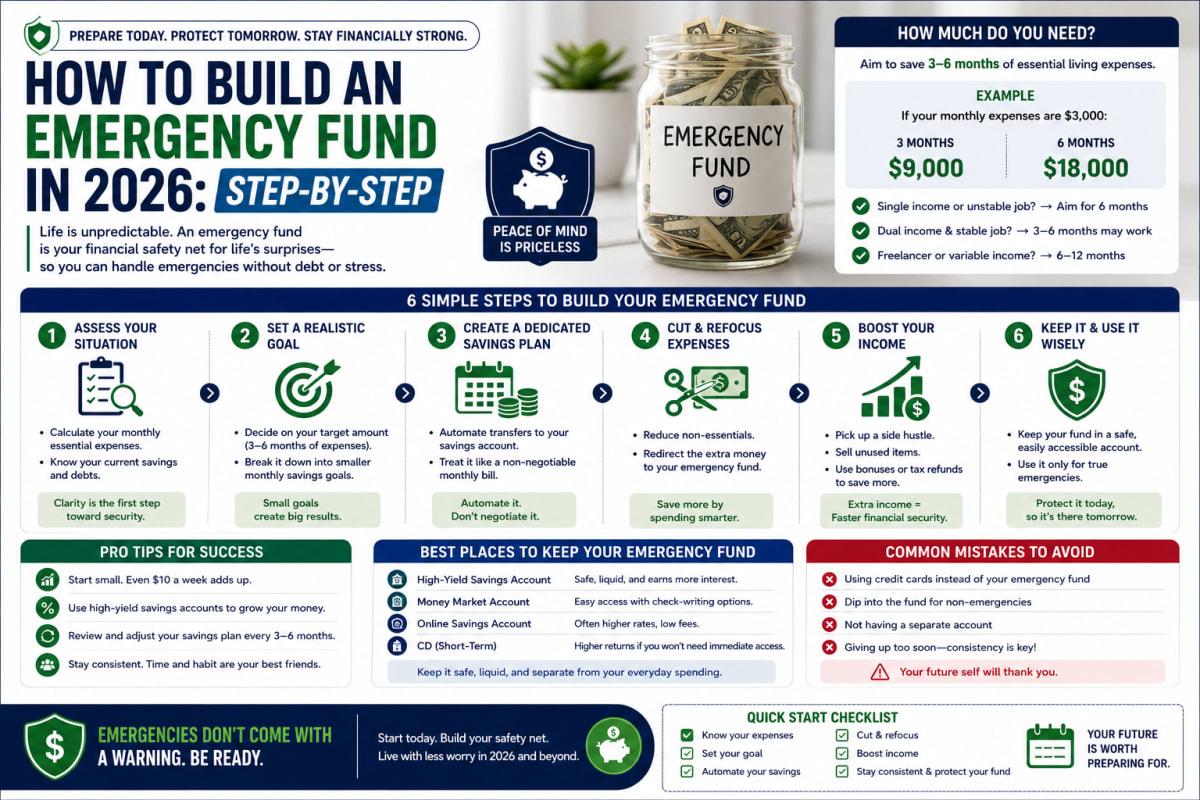
How to Build an Emergency Fund in 2026: Step-by-Step
Most financial emergencies aren't actually financial disasters. They're a car repair, a broken appliance, or a missed shift, and they only become disasters when there's no cushion to absorb them.
Building an emergency fund is one of the most talked-about pieces of financial advice, yet most guides skip the actual mechanics of how to do it on a real budget. This step-by-step guide walks you through exactly how much to save, where to keep it, and how to build it consistently in 2026, even if you're starting from zero. We'll cover the common mistakes that stall people halfway through, and a few advanced moves that speed up the process without adding risk.
Emergency Fund — What It Is and Why It Matters
An emergency fund is money set aside specifically for unexpected expenses or income loss, kept separate from your everyday spending and long-term investments. It's not a vacation fund or a general savings account. Its only job is to absorb a shock without forcing you onto a credit card or into a loan.
Without one, even a manageable setback like a $600 car repair can spiral into months of high-interest debt. That's why financial advisors consistently rank this as one of the first priorities before investing or aggressive debt payoff.
Why This Is Important Right Now
Picture someone living paycheck to paycheck whose car breaks down right before a work shift. Without savings, that repair either goes on a credit card at a high interest rate or gets delayed, risking their job entirely. An emergency fund turns that same situation into a minor inconvenience instead of a crisis.
With living costs still elevated in 2026 and many households carrying tighter monthly margins than a few years ago, having even a partial cushion matters more than ever. The gap between having some savings and having none is often the difference between a bad week and months of financial recovery.
Key Facts About Building an Emergency Fund
Before diving into the steps, it helps to understand the basic principles that make an emergency fund actually work. These facts shape every decision in this guide.
- Most experts recommend three to six months of essential expenses — though even one month's worth provides meaningful protection while you build further.
- Liquidity matters more than returns for this money — an emergency fund needs to be accessible within a day or two, not locked away for growth.
- High-yield savings accounts are the standard choice — offering meaningfully better interest than a traditional checking account while staying fully liquid.
- Automation outperforms willpower — automatic transfers on payday build savings more consistently than manual, end-of-month deposits.
- Starting small still counts — even $500 covers many common emergencies and prevents the very first slide into debt.
What the Industry Data Shows
Industry data suggests that a significant share of households would struggle to cover a several-hundred-dollar unexpected expense without borrowing, which highlights just how thin many family budgets remain even when income looks stable on paper.
Financial researchers and outlets like Forbes and Bankrate have repeatedly found that households with even a modest emergency cushion report significantly lower financial stress than those without one, regardless of overall income level. That points to peace of mind, not just dollar amount, as a real measurable benefit.
Benefits and Real Opportunities
Building this fund pays off in ways that go beyond simply having cash available. It changes how you handle every financial decision going forward.
- Avoids high-interest debt — a cash cushion means emergencies no longer default to a credit card balance.
- Reduces financial stress — knowing you can handle a surprise expense removes a constant source of background anxiety.
- Protects your other financial goals — retirement contributions and debt payoff plans don't get derailed by every unexpected bill.
- Builds better financial habits overall — the discipline required to build this fund often carries over into other areas of budgeting.
Costs and What to Expect
There's no direct cost to building an emergency fund itself, but the real investment is consistency. Saving even $20 to $50 per week adds up to $1,000 to $2,600 over the course of a year, which covers many common emergencies outright.
High-yield savings accounts typically require no minimum balance and no monthly fee at most online banks, though some traditional brick-and-mortar banks may charge a maintenance fee if your balance drops below a set threshold. Interest earned on these accounts fluctuates with broader rate conditions, so the exact yield will vary depending on when you open the account and which bank you choose.
The biggest "cost" for most people is opportunity cost: money sitting in an emergency fund isn't invested for higher long-term growth. That tradeoff is intentional, since this money needs to stay safe and accessible, not maximized for returns.
High-Yield Savings Account vs Standard Savings Account vs Money Market Account: Which One Is Right for You?
| Option | Best For | Pros | Cons |
|---|---|---|---|
| High-Yield Savings Account | Most people building an emergency fund from scratch | Strong interest with full liquidity and typically no fees | Often requires an online-only bank without in-person branches |
| Standard Savings Account | People who want in-person banking access | Convenient if paired with an existing checking account | Interest rates are typically much lower than online alternatives |
| Money Market Account | People who want check-writing access to their emergency fund | Competitive interest with added withdrawal flexibility | May require a higher minimum balance than a basic savings account |
Who Should Actually Care About Building an Emergency Fund?
This matters for anyone without at least one month of essential expenses saved, which includes a wide range of income levels, not just lower earners. It's especially urgent for freelancers and gig workers with variable income, renters without a financial safety net from family, and anyone currently relying on credit cards to cover routine surprises.
Mistakes Most People Make
A few habits consistently derail emergency fund progress, and each is fixable.
Waiting to save until "there's money left over" almost always means never starting, since discretionary spending tends to expand to fill available cash. Automating a transfer the same day you get paid removes that temptation entirely.
Setting an intimidating goal like six months of expenses right out of the gate can feel so far away that people give up early. Starting with a $500 or one-month goal first builds momentum and proves the habit works.
Keeping emergency savings in the same account as everyday spending money makes it far too easy to dip into for non-emergencies. A separate, clearly labeled account creates a psychological barrier that protects the fund.
Investing emergency savings in stocks to "earn more" exposes this money to the exact market risk it's supposed to protect against. This fund needs to be safe and liquid, not growth-focused.
What Most Articles Won't Tell You
Most guides repeat the three-to-six-months rule without mentioning that the right target actually depends on job stability and household income sources. A dual-income household with stable jobs may need less cushion than a single-income freelancer with unpredictable monthly earnings.
There's also a psychological trick worth knowing: naming your savings account something specific, like "Car Repair Fund" or "Job Loss Cushion," rather than a generic "Savings," measurably reduces the temptation to spend from it on non-emergencies.
Advanced Moves Worth Knowing
Splitting your emergency fund across a highly liquid high-yield account for the first month of expenses and a slightly less liquid but higher-yielding option for the remainder can boost returns without sacrificing access to your most urgent cushion.
Redirecting windfalls, like tax refunds or bonuses, directly into your emergency fund before they hit your regular checking account can accelerate your timeline by months without changing your everyday budget at all.
Frequently Asked Questions
How much should I actually save in my emergency fund?
Most experts recommend three to six months of essential expenses, though starting with a smaller goal like $500 to $1,000 provides real protection while you work toward the larger target. The right number depends on your job stability and household income sources.
Where's the best place to keep an emergency fund?
A high-yield savings account is generally the best fit, since it offers meaningfully better interest than a checking account while keeping your money fully accessible within a day or two.
How long does it typically take to build a full emergency fund?
This varies widely based on income and expenses, but saving $50 to $100 per week can build a $1,000 starter fund in a matter of months, with a full three-to-six-month cushion often taking one to two years depending on your target amount.
Should I pay off debt or build an emergency fund first?
Most financial advisors recommend building a small starter emergency fund, often around $500 to $1,000, before aggressively paying down debt, so a new emergency doesn't force you back into borrowing while you're trying to get out of debt.
Is it okay to use my emergency fund for a planned expense, like a vacation?
No, using it for planned or discretionary expenses defeats its purpose and leaves you exposed when a genuine emergency happens. Planned expenses deserve their own separate savings goal.
The Bottom Line on Building an Emergency Fund in 2026
Building an emergency fund in 2026 doesn't require a huge income or a complicated strategy. It requires a clear target, a separate account, and an automatic transfer you don't have to think about every payday. Start with $500 if six months feels overwhelming, and let the habit build from there. The goal isn't a perfect number. It's making sure the next surprise expense is an inconvenience, not a crisis.
Read Next

S&P 500 and Nasdaq Soar Amid Chip Stock Boom and Jobs Data Surge

Shock Warning: What Toyota's Earnings Reveal About Tesla's Stock Boom

Intel Stock Surges to Shocking New High as Apple Excitement Booms!
Amazon Stock Faces Crisis: Another Outage Raises Urgent Concerns!

Tesla Stock Shock: Toyota Earnings and AI Trade Impact Revealed!