Best Checking Accounts in 2026: Fees, Rewards Compared
The average checking account fee runs about $188 a year. Here's how the best no-fee, rewards, and high-yield checking accounts of 2026 actually compare.
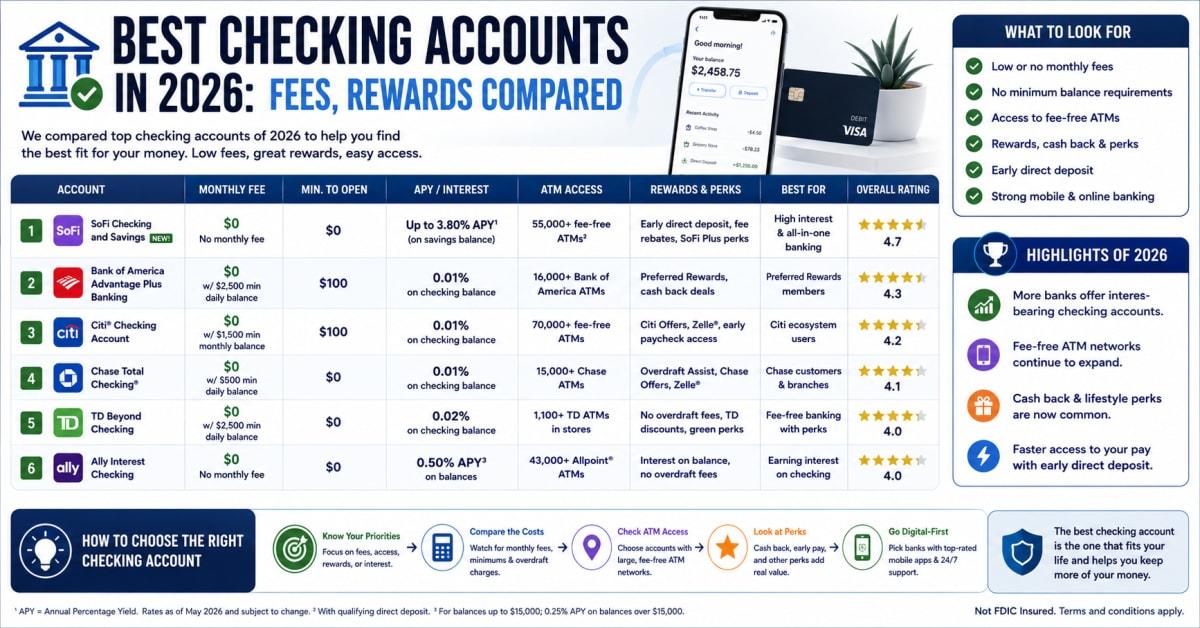
Best Checking Accounts in 2026: Fees, Rewards Compared
The average checking account maintenance fee adds up to roughly $188 a year, and most people paying it have no idea a genuinely free alternative exists. That's money leaving your account for absolutely nothing in return.
Choosing the best checking account in 2026 comes down to matching the account type to how you actually bank, whether that's chasing cash back, earning interest on your everyday balance, or simply avoiding fees entirely. This guide compares the leading account types, breaks down what "free" really means in the fine print, and walks through exactly how to pick the right one for your situation.
Best Checking Accounts — What Actually Defines "Best" in 2026
A checking account is your everyday financial hub for direct deposit, bill pay, debit purchases, and ATM access. What separates a strong account from a mediocre one in 2026 comes down to four things: monthly fees, ATM network size, overdraft handling, and whether the account pays you anything back through interest or cash back.
Modern banking has shifted heavily toward digital-first accounts that skip the cost of physical branches, which is exactly why many of the strongest options now come from online banks and neobanks rather than traditional institutions.
Why This Is Important Right Now
Picture someone who's had the same checking account for a decade, quietly paying a $12 monthly fee without ever checking whether a genuinely free alternative exists. Over ten years, that's well over a thousand dollars spent for a service now widely available at no cost.
New or increased fees remain one of the top reasons people switch banks, according to recent industry surveys, and 2026's leading accounts have specifically responded by building "truly free" models with no maintenance fees or minimum balance traps at all.
Key Facts About the Best Checking Accounts in 2026
A few core facts explain what actually separates the strongest checking accounts from the rest of the market this year.
- The strongest free accounts require no minimum deposit and no minimum balance — including standout options like Chime, Zynlo Bank, and NBKC's Everything Account.
- Some checking accounts now pay real interest — with top rates reaching up to roughly 4.50% APY at accounts like Connexus Credit Union's Xtraordinary Checking, though usually with requirements attached.
- Cash-back checking accounts reward debit spending directly — Discover Cashback Debit and Upgrade's Rewards Checking both offer roughly 1% to 2% cash back on qualifying purchases, often capped monthly.
- Large ATM networks now often exceed 55,000 to 90,000 locations — through partnerships like Allpoint and MoneyPass, making online-only banks nearly as convenient as branch-based ones for cash access.
- Checking account interest rates are less sensitive to Fed rate cuts — unlike savings accounts and CDs, so a Fed rate cut is unlikely to significantly change your checking account's APY.
What the Industry Data Shows
Industry data suggests that accounts built around a "truly free" model, with no monthly fee and no minimum balance requirement under any circumstance, are increasingly winning top rankings over accounts that simply waive fees conditionally. That shift reflects a broader consumer preference for simplicity over conditional perks.
Comparison sites including NerdWallet, Bankrate, and Forbes Advisor have consistently highlighted that online banks and credit unions now frequently outperform large traditional banks on fees and APY, while still matching them on ATM access through shared networks.
Benefits and Real Opportunities
Picking the right checking account creates ongoing value well beyond just avoiding fees.
- Meaningful annual savings — avoiding an average $188 yearly fee is money that stays in your pocket with zero effort.
- Extra income from interest or cash back — the right account can pay you a small but real amount just for using it normally.
- Early access to your paycheck — many leading accounts now offer direct deposit up to two days early at no cost.
- Fee-free overdraft protection — several top accounts have replaced traditional overdraft fees with grace-based or no-fee protection programs.
Costs and What to Expect
The strongest checking accounts in 2026 charge no monthly maintenance fee and require no minimum opening deposit at all. Traditional banks that still charge a fee typically average around $12 to $15 per month, which can often be waived by meeting a direct deposit or minimum balance requirement, though it's worth confirming those terms carefully before assuming the waiver applies to you.
Overdraft fees at traditional banks commonly run $30 to $35 per occurrence, while many of the newer, top-ranked accounts have eliminated this fee entirely, replacing it with either a decline-and-protect model or a grace-based buffer that covers small overdrafts without charging anything. Out-of-network ATM fees, when they apply, typically run $2.50 to $5, though the leading accounts increasingly reimburse these charges or provide access to large fee-free networks instead.
Foreign transaction fees vary meaningfully by account, ranging from none at all on some rewards-focused accounts to around 2.7% on others, which matters if you travel internationally and plan to use your debit card abroad.
No-Fee Checking vs Interest-Bearing Checking vs Cash-Back Checking: Which One Is Right for You?
| Option | Best For | Pros | Cons |
|---|---|---|---|
| No-Fee Checking (e.g., Chime, Capital One 360) | People who want maximum simplicity with zero fees | No monthly fee, no minimum balance, and often large ATM networks | Little to no interest earned on your balance |
| Interest-Bearing Checking (e.g., SoFi, Zynlo, Connexus) | People who want their everyday balance to earn something | Real APY, sometimes up to around 4.50% with requirements met | Top rates often require multiple conditions like direct deposit or debit spend |
| Cash-Back Checking (e.g., Discover, Upgrade, Axos) | People who spend consistently on their debit card each month | Cash back on everyday purchases, sometimes up to 1-2% | Rewards are usually capped monthly and may require a minimum direct deposit |
Who Should Actually Care About This Checking Account Comparison?
This matters for anyone currently paying a monthly maintenance fee at a traditional bank, frequent debit card spenders who could be earning cash back for free, and savers who want their everyday balance to earn a little interest without moving money into a separate account. It's also relevant for frequent travelers who need to compare foreign transaction fees and ATM access before choosing where to bank.
Mistakes Most People Make
A handful of habits keep people from getting the most out of their checking account.
Assuming a "free" checking account has no conditions at all can lead to surprise fees if a minimum balance or direct deposit requirement isn't met. Reading the specific waiver conditions, not just the word "free" in an ad, avoids that trap.
Sticking with a fee-charging account out of loyalty or inertia costs real money every single month. Comparing your current fee against current top offers takes a few minutes and often reveals an easy switch worth making.
Choosing a cash-back account without checking the monthly spending cap can lead to disappointment once your rewards stop accruing partway through the month. Estimating your typical monthly debit spend against the cap beforehand avoids that mismatch.
Ignoring foreign transaction fees until an international trip is already underway can turn an otherwise great account into an expensive one abroad. Checking this fee before traveling, not during, prevents an unwelcome surprise.
What Most Articles Won't Tell You
Most comparisons rank accounts by a single headline feature, but the account that actually saves you the most money depends entirely on your specific spending pattern. Someone who spends heavily on groceries, which several cash-back accounts exclude, may earn far less than the advertised rate suggests.
There's also a detail worth knowing: some rewards checking accounts, like American Express Rewards Checking, are only available to existing customers of that bank's other products, which means eligibility itself can rule out an otherwise attractive account before you even apply.
Advanced Moves Worth Knowing
Pairing a no-fee, interest-bearing checking account for your main balance with a separate cash-back checking account for discretionary spending lets you capture both benefits without paying for two full-fee accounts.
Checking whether your current bank will match or beat a competitor's offer before switching can sometimes get you a better deal without the hassle of moving your direct deposit and automatic payments to a new institution.
Frequently Asked Questions
Are online-only checking accounts as safe as traditional bank accounts?
Yes, as long as the account is FDIC-insured, or NCUA-insured for credit unions, your deposits are protected up to $250,000, the same coverage as any traditional brick-and-mortar bank.
Can I really avoid all checking account fees?
Yes, several accounts in 2026 charge no monthly fee, no minimum balance requirement, and no overdraft fee at all, with no conditions attached. It's worth confirming these terms directly on the bank's website before opening an account.
Do checking accounts pay as much interest as savings accounts?
Generally not. Most checking accounts pay a modest APY, often under 1%, though a handful of standout accounts reach rates closer to what a savings account offers, usually with specific requirements to qualify.
What should I look for in a checking account if I travel internationally?
Prioritize accounts with no foreign transaction fees and a large international ATM network. Some rewards checking accounts charge a foreign exchange fee of around 2.7%, while others waive this entirely, so it's worth comparing before you travel.
Is it worth switching checking accounts to avoid a monthly fee?
In most cases, yes. Since the average maintenance fee runs close to $188 a year, and several genuinely free alternatives exist with comparable features, the switch usually takes less time than the fee costs you annually.
The Bottom Line on Best Checking Accounts in 2026
The best checking account in 2026 isn't necessarily the one with the flashiest advertised rate. It's the one whose fee structure and rewards actually match how you bank day to day. Compare your current account's fee against a genuinely free alternative, and check whether an interest-bearing or cash-back option fits your spending pattern better. A quick comparison today could save you the equivalent of a full year's fees, with almost no downside to switching.
Read Next
Shocking Prediction: Micron Stock Could Surge to $1,500 in Just 1 Year!
Trump’s 3,711 Trades Reveal Shocking Stock Strategies That Could Boom or Collapse

Ford Stock Surges to Highest Close in 3 Years—What You Need to Know!
Surge Savings: 40 Hidden Amazon Memorial Day Kitchen Deals Revealed!

Will Summer Stocks Collapse Before Midterm Elections? Shocking History Revealed!