OpenAI, Google & Anthropic 2026: Best AI for Everyday Use
ChatGPT, Gemini, and Claude each dominate different everyday tasks. Here's a balanced, honest breakdown of which one actually fits your needs in 2026.
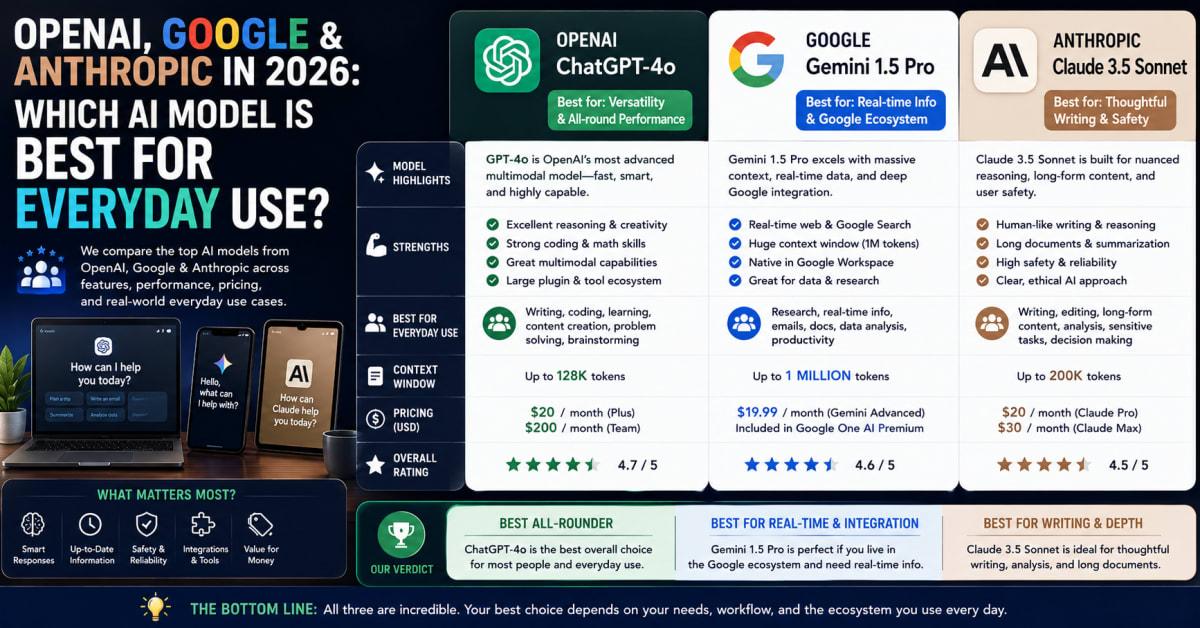
OpenAI, Google & Anthropic 2026: Best AI for Everyday Use
Ask ten people which AI assistant is "best" and you'll likely get three different answers, and all three might be right. ChatGPT, Gemini, and Claude have each carved out genuinely different strengths in 2026, which means the best model depends far more on what you're actually doing than which brand has the most name recognition.
Choosing the best AI for everyday use in 2026 means matching the tool to your actual tasks, writing, research, coding, or everyday questions, rather than picking whichever one you've heard about most. This guide breaks down where each of the three leading assistants genuinely excels, what they cost, and how to decide which one deserves your subscription.
Best AI for Everyday Use — Why There's No Single Winner in 2026
OpenAI's ChatGPT, Google's Gemini, and Anthropic's Claude represent the three most widely used AI assistants for everyday consumer and business use in 2026. Each is built on a different underlying model family, and each company has made distinct choices about what to optimize for, broad feature integration, multimodal capability, or writing and reasoning consistency.
This matters because these three tools aren't interchangeable despite surface-level similarity. Picking based on brand recognition alone, rather than your actual daily tasks, often means missing out on real capability advantages one model has over the others for your specific needs.
Why This Is Important Right Now
Picture someone drafting a long report who defaults to whichever assistant they signed up for first, without realizing a competing model might produce a more structurally consistent, less repetitive draft for that exact task. That gap in awareness is common, since most people pick one AI tool and stick with it out of habit rather than genuine comparison.
All three companies have shipped meaningfully newer flagship models multiple times within 2026 alone, which means any specific version comparison risks going stale within weeks. Understanding each company's consistent, underlying strengths matters more than memorizing a specific model number.
Key Facts About the Leading AI Models in 2026
A few consistent patterns emerge across independent comparisons of these three assistants, even as specific version numbers keep shifting.
- All three offer a genuinely usable free tier — with paid subscription tiers commonly priced around $20 a month across ChatGPT Plus, Claude Pro, and Google's AI subscription plans.
- Claude is consistently rated strongest for writing quality and long-form consistency — multiple independent testers note it produces more structurally coherent output over long documents and avoids repetitive phrasing patterns more than competitors.
- Gemini leads on multimodal understanding and context window size — with native image, video, and audio processing plus deep integration into Google Workspace, Photos, and YouTube.
- ChatGPT maintains the broadest third-party ecosystem and plugin integration — making it a strong general-purpose choice for users who want the widest range of connected tools and features.
- Model version numbers change frequently within a single year — meaning any specific comparison should be treated as a snapshot in time rather than a permanent ranking.
What the Industry Data Shows
Industry data suggests that enterprise adoption has largely consolidated around ecosystem fit rather than raw model capability alone, with organizations already invested in Microsoft's tools gravitating toward ChatGPT and Copilot, while those built around Google Workspace lean toward Gemini and Vertex AI.
Independent testers who've compared all three models across writing, coding, research, and daily use consistently describe the decision as task-dependent rather than one model being universally superior, with many experienced users reporting they actively use more than one assistant depending on the specific task at hand.
How the Three Leading AI Assistants Compare
Each platform has developed genuinely distinct strengths worth understanding before choosing where to spend your subscription budget.
- ChatGPT (OpenAI) — Best for general-purpose versatility, web browsing, image analysis, and the broadest plugin and third-party integration ecosystem. A strong default choice if you want one tool that touches the widest range of tasks.
- Claude (Anthropic) — Consistently rated strongest for long-form writing quality, coding on large codebases, and maintaining logical consistency across long conversations without contradicting itself.
- Gemini (Google) — The clear choice for multimodal tasks, images, video, and audio, plus the largest context windows for processing very long documents, and the deepest integration with Google's existing product ecosystem.
Benefits and Real Opportunities
Understanding each model's genuine strengths, rather than picking based on brand alone, creates real practical value.
- Better output quality for your specific task — matching the model to the job, writing, research, or multimodal analysis, produces noticeably better results than a mismatched default choice.
- Competitive, narrowing pricing across all three — the gap between free and paid tiers has narrowed significantly, giving genuinely capable free options regardless of which ecosystem you choose.
- Freedom to use more than one tool strategically — many experienced users maintain subscriptions to multiple assistants specifically to capture each one's distinct strength for different tasks.
- Existing ecosystem value — if you're already paying for Google One or Microsoft 365, the AI assistant bundled into that ecosystem often represents the most cost-efficient upgrade rather than an entirely new subscription.
Costs and What to Expect
All three platforms offer genuinely usable free tiers, with meaningful capability even without a paid subscription, though free tiers typically carry usage limits or access to a slightly less capable model version than the paid tier. Paid subscriptions across ChatGPT Plus, Claude Pro, and Google's AI subscription plans commonly run around $20 per month for individual users.
Higher usage tiers exist above the standard $20 plans for users who want access to the most capable "max" or "pro" model versions, sometimes running $100 per month or more, generally aimed at power users or professionals with heavy daily usage. API pricing for developers building on top of these models varies by token cost, with Google's models generally positioned as the most cost-efficient per token and Anthropic's models often cited as offering strong value specifically for complex, reasoning-heavy tasks.
It's worth noting that one major provider introduced advertising into its free tier in 2026, a business model shift worth being aware of if ad-free usage matters to you specifically.
ChatGPT vs Claude vs Gemini: Which One Is Right for You?
| Option | Best For | Pros | Cons |
|---|---|---|---|
| ChatGPT (OpenAI) | General-purpose users wanting the broadest feature set | Widest third-party plugin ecosystem and versatile everyday use | Free tier now includes advertising, per a 2026 business model change |
| Claude (Anthropic) | Long-form writing, coding, and complex, multi-step reasoning | Strong consistency over long documents and conversations | Less multimodal breadth than Gemini for images and video |
| Gemini (Google) | Multimodal tasks and existing Google Workspace users | Largest context windows and deep integration with Google's ecosystem | Writing quality rated slightly behind Claude in several independent tests |
Who Should Actually Care About This Comparison?
This matters for anyone deciding which AI subscription to actually pay for, professionals choosing a tool for a specific recurring task like writing, coding, or research, and businesses evaluating which ecosystem, Microsoft, Google, or a standalone provider, best fits their existing tools. It's also relevant for casual users simply wondering whether their current free tier is genuinely the best fit for how they actually use AI day to day.
Mistakes Most People Make
A handful of habits lead people to a mismatched choice in this space.
Assuming whichever tool you signed up for first remains the best fit indefinitely overlooks how quickly this space evolves, with all three companies shipping meaningfully new capabilities multiple times within a single year. Revisiting the comparison periodically avoids sticking with an outdated assumption.
Choosing based on brand recognition alone, rather than your actual primary use case, often means missing a genuine capability advantage another model offers for your specific tasks, like long-document writing or multimodal analysis.
Assuming you need to pick just one tool ignores that many experienced users maintain subscriptions to more than one assistant specifically to capture each one's distinct strength for different tasks.
Ignoring existing ecosystem investment, like an existing Google One or Microsoft 365 subscription, when choosing an AI tool can mean paying for a redundant new subscription when a bundled option might already cover your needs more cost-efficiently.
What Most Articles Won't Tell You
Most comparisons present a single "winner," but the more accurate picture is that experienced, heavy users typically maintain more than one AI subscription specifically because no single model excels at everything. Treating this as a multi-tool decision rather than a single winner-take-all choice reflects how the space actually gets used in practice.
There's also a detail worth knowing: because all three companies ship new flagship models frequently within a single year, any specific comparison, including this one, should be read as a snapshot of relative strengths rather than a permanent ranking that will hold indefinitely.
Advanced Moves Worth Knowing
Testing the free tier of each assistant against your own actual recurring tasks, a real email draft, a real research question, a real coding problem, gives a far more useful comparison than relying solely on third-party benchmark scores.
Reassessing your AI tool choice every few months, rather than assuming your initial pick remains optimal, helps you catch a meaningful capability shift before a competitor's model quietly becomes the better fit for your specific needs.
Frequently Asked Questions
Is ChatGPT, Claude, or Gemini definitively the best AI in 2026?
No, there's no single universal winner. Independent comparisons consistently find each model excels at different tasks, ChatGPT for broad versatility, Claude for writing and coding consistency, and Gemini for multimodal and Google-integrated work.
Do I need to pay for a subscription, or is the free tier good enough?
All three offer genuinely usable free tiers, and the gap between free and paid has narrowed in 2026. Casual users may find the free tier sufficient, while frequent or professional use often justifies the roughly $20 monthly subscription for higher usage limits and more capable model access.
Which AI model is best for coding?
Claude is consistently rated among the strongest for coding across large codebases in independent testing, though ChatGPT also performs well for quicker, smaller coding tasks and data analysis.
Which AI model handles images and video best?
Gemini generally leads in multimodal understanding, with native image, video, and audio processing plus integration into Google's broader ecosystem like Photos and YouTube.
Should I use more than one AI assistant?
Many experienced users do, specifically to capture each model's distinct strength for different tasks, since no single assistant currently dominates every category equally well.
The Bottom Line on OpenAI, Google, and Anthropic in 2026
There's no single best AI model for everyday use in 2026, only the one that fits your specific tasks. ChatGPT offers the broadest general-purpose ecosystem, Claude consistently leads on writing quality and coding consistency, and Gemini dominates multimodal work and Google integration. Rather than picking based on brand alone, test each free tier against your own real, recurring tasks, and don't rule out using more than one, since that's exactly what many experienced users already do to get the best of all three.
Read Next

Shocking Surge: Perplexity's PC for Mac Now Available to Everyone!

OpenAI’s Shocking Codex Plugin for Chrome Could Change Everything!
Shock! AirPods with Cameras Near Launch - What This Means for You
Shock Warning: Apple May Collapse $599 MacBook Neo Amid Cost Surge!
Apple's Shocking New AirPods with Cameras Near Production – What You Need to Know!