Open Banking in 2026: How It Works & What's Next
The US open banking rule is legally enjoined in 2026, yet banks are still building the infrastructure anyway. Here's how open banking actually works right now.
Open Banking in 2026: How It Works & What's Next
The federal rule meant to guarantee your right to share your own financial data is currently blocked by a court, unenforceable, and being rewritten. And yet banks are building the exact infrastructure that rule would have required anyway.
Open banking in 2026 sits in a strange, unresolved moment in the United States: the regulatory framework is legally paused, but the underlying technology and market momentum haven't slowed down at all. This guide explains how open banking actually works today, the real benefits and risks worth understanding, and where the regulatory picture is headed next.
Open Banking — What It Is and Why the Current Status Matters
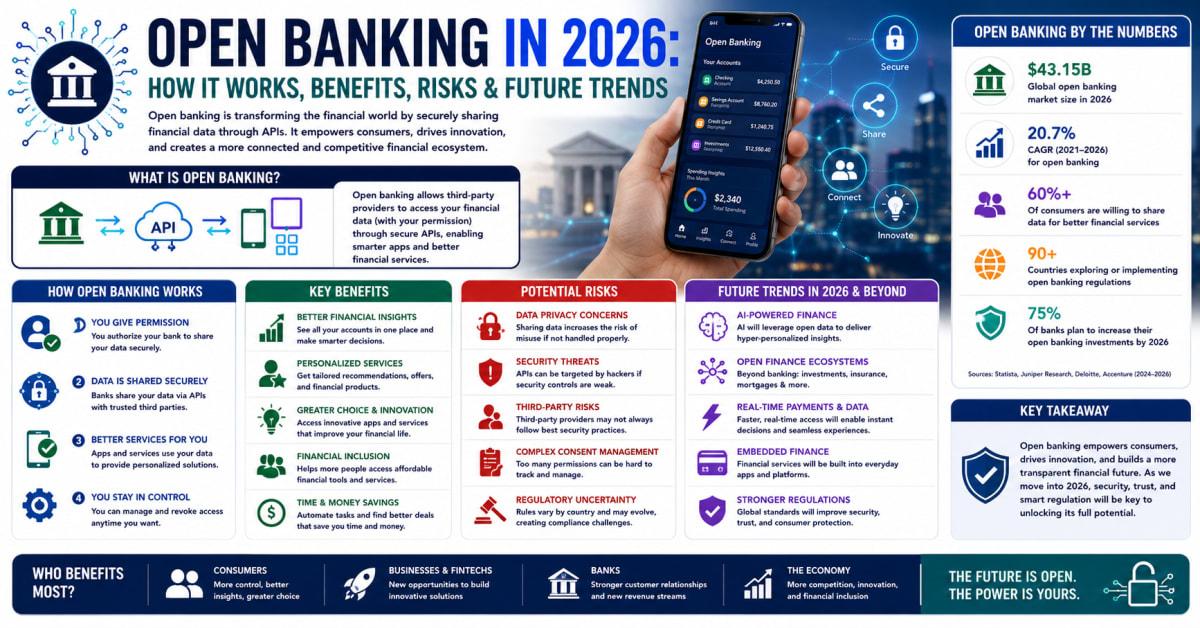
Open banking is the system that lets you securely share your financial account data, like transaction history and balances, with third-party apps of your choosing, such as a budgeting tool or a lending platform. Instead of manually entering account numbers or handing over your bank login credentials directly, secure APIs let approved apps access exactly the data you've consented to share.
Understanding the current legal status matters because the framework meant to guarantee this right in the United States, a CFPB rule under Section 1033 of the Dodd-Frank Act, remains codified in federal regulations but is not actually being enforced right now, which changes what protections consumers and fintechs can actually rely on.
Why This Is Important Right Now
Picture a fintech startup that spent the past two years building compliance infrastructure around a rule that was supposed to take effect for the largest institutions on April 1, 2026, only to see that deadline pass without becoming a binding enforcement trigger, since a federal court had already blocked the CFPB from enforcing it.
That kind of regulatory whiplash matters because it leaves both banks and the fintech apps that depend on data access in a genuinely uncertain position, even as the underlying technology and consumer demand for these connected financial tools keeps growing regardless.
Key Facts About Open Banking in 2026
A few core facts explain the current, unusual state of open banking regulation and technology in the United States.
- The CFPB's open banking rule is legally blocked, not repealed — a federal court in Kentucky enjoined the CFPB from enforcing it, finding it likely exceeded the agency's statutory authority.
- The rule is currently being rewritten — the CFPB is reconsidering key aspects, including whether banks can charge fees for data access, a provision not included in the original 2024 rule.
- State-level legislation is emerging as an alternative path — New York introduced bills in 2026 that could establish open banking data-sharing rights at the state level, potentially becoming a template for other states.
- The industry is converging on the FDX API standard anyway — market momentum toward secure, standardized data-sharing technology continues regardless of the rule's uncertain legal status.
- Regulatory standards mandating open banking are already common in other countries — several European nations have had functioning open banking mandates for years, giving the U.S. real precedent to observe.
What the Industry Data Shows
Industry data suggests that many of the largest banks and data providers had already invested heavily in data-sharing APIs and developer infrastructure well before the rule's legal status became uncertain, meaning that early design work isn't disappearing even as enforcement remains paused.
Reporting from legal and financial industry trackers has noted that reaction to the original rule was sharply divided: fintechs largely supported it as a step toward consumer choice and competition, while many banks opposed it over unresolved liability questions and security oversight gaps, a divide that's likely to shape whatever revised rule eventually emerges.
Benefits and Real Opportunities
Despite the regulatory uncertainty, open banking technology already creates real value for both consumers and the broader financial industry.
- More personalized financial tools — budgeting apps, robo-advisors, and lending platforms can offer more accurate insight when they can securely see your actual account data.
- Reduced reliance on risky screen scraping — modern API-based data sharing is generally more secure than older methods that required handing over bank login credentials directly to a third party.
- Greater competition among financial service providers — easier data portability makes it simpler to switch providers or use specialized tools alongside your primary bank.
- Faster loan and account approvals — lenders and fintechs can verify income and account history more quickly when data sharing is standardized and secure.
Costs and What to Expect
For consumers, using open banking-connected apps typically carries no direct cost, since the fee structure, where one exists, usually sits between the financial institution and the third-party app rather than the individual user. That said, one of the most contested points in the CFPB's ongoing rule rewrite is whether banks should be permitted to charge fees for providing data access at all, a provision reconsideration could meaningfully change.
For banks and fintechs, building and maintaining compliant data-sharing infrastructure represents a significant technology investment, regardless of whether a federal mandate is actively enforced, since consumer demand and competitive pressure are pushing this convergence independently of regulation. Smaller institutions face a longer runway before any tiered compliance deadline would apply to them under the original rule's structure, giving them more time to build this infrastructure gradually.
The bigger "cost" consideration right now is uncertainty itself: businesses building around open banking data access face real planning risk, since the rules governing fees, liability, and consumer consent could shift meaningfully once a revised rule is finalized.
API-Based Data Sharing vs Screen Scraping vs State-Level Regulation: Which Approach Is Shaping the Market?
| Option | Best For | Pros | Cons |
|---|---|---|---|
| API-Based Data Sharing (FDX Standard) | Consumers and fintechs wanting secure, modern data access | More secure than older methods and increasingly the industry standard | Not yet universally adopted across every institution |
| Screen Scraping | Legacy apps still using older data access methods | Doesn't require the institution to build a formal API | Generally considered less secure, often requiring your bank login credentials |
| State-Level Regulation (e.g., New York's proposed bills) | Consumers in states pursuing data-sharing rights independent of federal action | Could establish enforceable rights even if federal rules stay stalled | Currently still in committee, with no guarantee of passage |
Who Should Actually Care About Open Banking Right Now?
This matters for anyone using budgeting apps, robo-advisors, or lending platforms that connect to their bank account, since the security and reliability of that connection depends on how the underlying data-sharing technology works. It's especially relevant for fintech businesses and banks navigating genuine planning uncertainty, and for policy-watchers tracking how state-level legislation might reshape data rights independent of federal action.
Mistakes Most People Make
A handful of misunderstandings show up often when people discuss open banking's current status.
Assuming the federal open banking rule is currently in effect because it was formally finalized overlooks that a court injunction has made it unenforceable in practice, even though it remains codified in federal regulations. Checking the current enforcement status, not just whether a rule was finalized, gives a more accurate picture.
Assuming open banking is dead because the federal rule is stalled misses that banks and fintechs are still converging on shared technical standards anyway, driven by market demand rather than regulatory mandate alone.
Connecting financial accounts to an older app still using screen scraping, without checking whether a more secure API-based connection is available, unnecessarily exposes bank login credentials to a third party. Confirming how an app connects to your accounts is a simple but important check.
Ignoring state-level developments while only tracking federal news can mean missing meaningful changes, since state legislation like New York's proposed bills could establish enforceable data rights well before any federal rule is finalized.
What Most Articles Won't Tell You
Most coverage treats this as a simple "rule in effect or not" story, but the more accurate picture is a technology and market shift proceeding largely independent of the regulatory outcome. Banks that built compliance infrastructure before the injunction aren't tearing it down. That investment shapes what compliance will look like whenever enforcement resumes or a revised rule is issued.
There's also a detail worth knowing: one of the most contested unresolved questions in the rule's rewrite is whether banks can charge fees for data access at all, a provision that could significantly reshape the economics of the entire open banking ecosystem depending on how it's ultimately decided.
Advanced Moves Worth Knowing
Checking whether a financial app you use connects via a modern API standard like FDX, rather than older screen scraping methods, gives you a more accurate sense of how securely your data is actually being shared, regardless of the regulatory environment.
Following both federal CFPB developments and relevant state legislation, rather than federal news alone, provides a more complete picture of where enforceable open banking rights might actually emerge first.
Frequently Asked Questions
Is open banking legally required in the United States right now?
No, not currently enforceable. The CFPB's Section 1033 rule was finalized but is under a federal court injunction, meaning it remains on the books but isn't actively being enforced while the CFPB reconsiders and potentially revises it.
Is it safe to connect my bank account to a third-party finance app?
Apps using modern, API-based connections are generally considered more secure than older screen scraping methods, since they don't require sharing your actual bank login credentials with the third party. Checking which method an app uses is a reasonable step before connecting.
Why did a court block the federal open banking rule?
A federal court in Kentucky found that the CFPB's rule likely exceeded the agency's statutory authority and was arbitrary and capricious, leading to an injunction blocking its enforcement while the case remains stayed and the CFPB reconsiders the rule.
Could states create their own open banking rules?
Yes, this is actively happening. New York introduced legislation in 2026 focused on open banking data-sharing rights, which, if passed, could function similarly to the stalled federal rule and potentially serve as a template for other states.
Will banks be allowed to charge fees for sharing customer data?
This remains unresolved. It's one of the specific provisions the CFPB is reconsidering as part of rewriting the rule, and the outcome could significantly affect the broader economics of open banking in the U.S.
The Bottom Line on Open Banking in 2026
Open banking in 2026 exists in an unusual gap between technology and law. The federal rule meant to guarantee it is legally blocked and under active reconsideration, yet banks, fintechs, and consumers keep moving toward the same secure, API-based data sharing that rule was designed to require. Whether the next chapter comes from a revised federal rule or state-level legislation like New York's proposed bills, the underlying shift toward standardized, secure financial data access looks unlikely to reverse. Stay alert to both federal and state developments, and check how any finance app you use actually connects to your accounts in the meantime.
Read Next
Apple shock: Siri AI locked to newer devices—full list revealed

Huawei’s HarmonyOS Revealed to Run on a Single Dry Cell Battery for a Year
Telegram Surges Back to Wear OS with Chats & Voice – What You Missed

Why Apple's Silence on AI Is a Smart Move (For Now)

Apple’s Siri AI shockingly learns when to stay silent