Best AI Writing Tools for Students & Professionals 2026
The best AI writing tools of 2026, organized by what you're actually writing, from academic essays to business content, with honest notes on where each one fits.
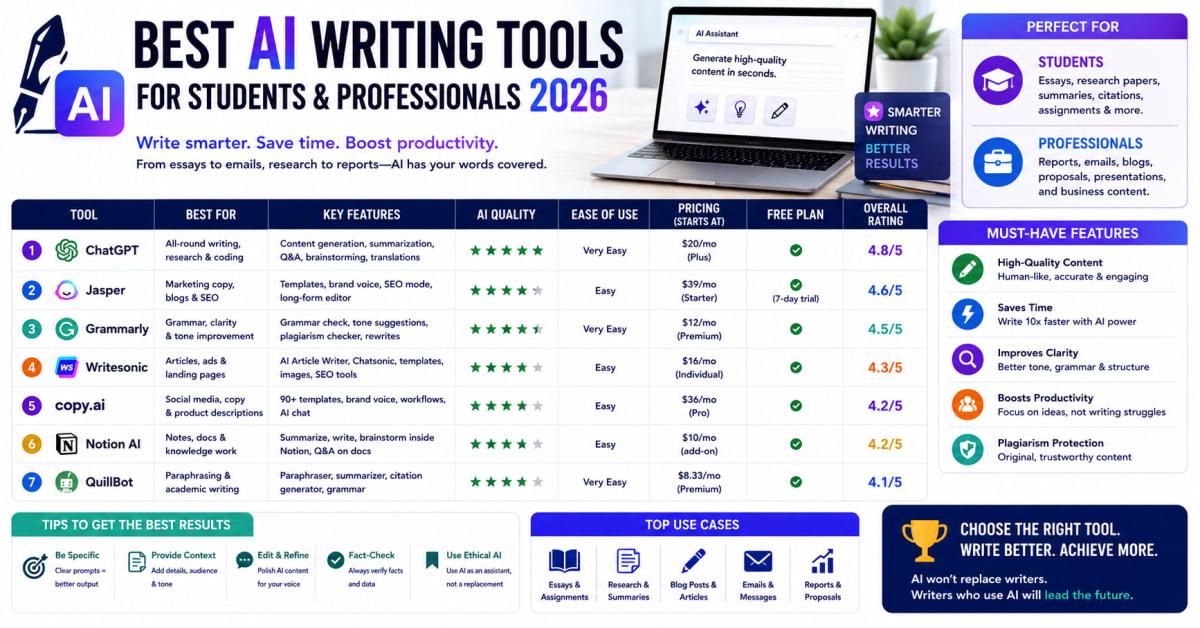
Best AI Writing Tools for Students & Professionals 2026
There are well over a hundred AI writing tools competing for your attention right now, and most of them do the same basic thing dressed up differently. The real question isn't which tool is "best" overall. It's which one actually fits the specific writing you're doing.
This guide organizes the strongest AI writing tools of 2026 by use case, academic writing, business content, creative work, and everyday editing, so you can skip the tools that don't apply to you. We'll also cover an honest, important distinction that gets glossed over in most roundups: the difference between using AI as a genuine writing aid versus using it as a ghostwriter, which matters enormously for students in particular.
AI Writing Tools — What They Are and Why the Right Fit Matters
AI writing tools range from general-purpose chatbots that can brainstorm and draft almost anything, to highly specialized tools built for a single job, like academic citation accuracy or business brand voice consistency. The gap in quality between these approaches for their specific use case is often larger than the gap between competing tools in the same category.
Getting this right matters because a mismatched tool doesn't just waste time. For students specifically, using a general chatbot to generate finished paragraphs instead of using it for brainstorming crosses a real academic integrity line that many universities now explicitly define and detect for.
Why This Is Important Right Now
Picture a student who pastes an entire essay prompt into a general chatbot and submits the output nearly unedited, only to have it flagged by AI-detection software built into their university's submission portal. That risk is real and growing as institutions adopt more sophisticated detection tools.
Universities have shifted from banning AI outright to expecting students to use it as a structured thinking partner, which means understanding the acceptable boundaries matters as much as picking a good tool. For professionals, meanwhile, the risk is different: using a tool that fabricates citations or sources can quietly damage credibility in published or client-facing work.
The Best AI Writing Tools, Organized by Use Case
Rather than one ranked list, these tools are grouped by what you're actually trying to accomplish, since the right pick depends heavily on your specific writing task.
For Academic Research and Citations
- Elicit — Built specifically for literature search and evidence synthesis, pulling sentence-level citations directly from real indexed papers rather than generating plausible-sounding but unverified references.
- Consensus — Focused on fast evidence checks against published research, useful for quickly verifying a claim against the academic literature.
- Paperpal — Laser-focused on academic writing from high school through doctoral level, offering language polish tuned to academic register rather than general web text.
- Writefull — Trained on published journal articles, giving it a stronger grasp of academic tone than general-purpose grammar tools.
For Business and Marketing Content
- Jasper — Widely used by larger brands for its Brand Voice feature, which learns from your existing content to keep tone and messaging consistent across a team.
- Surfer — Focused specifically on SEO content optimization, analyzing top-ranking articles to guide keyword and structure decisions.
- Claude — Strong for long-form business writing and document analysis, particularly useful when a piece requires synthesizing a lot of source material coherently.
For Everyday Grammar and Editing
- Grammarly — The most widely used general editing assistant, strong for catching grammar, clarity, and tone issues, though it's not trained on academic corpora specifically.
- QuillBot — A go-to for paraphrasing and rewriting existing text while preserving meaning, popular among students reworking drafts.
- ProWritingAid — Offers over 20 distinct writing improvement reports, appealing to professional writers and academics who want deeper structural feedback than a quick grammar pass.
For Brainstorming and Idea Generation
- ChatGPT — Remains the most widely used tool for brainstorming topics, generating outlines, and explaining complex concepts conversationally.
- NotebookLM — Strong for synthesizing large sets of uploaded sources into organized notes and summaries, useful for research-heavy projects on a budget.
For Creative Writing
- Sudowrite — Built specifically for fiction writers, from hobbyists to professional authors, with tools tuned for narrative and creative prose rather than academic or business tone.
Benefits and Real Opportunities
Using the right combination of these tools creates real value beyond simply writing faster.
- Fewer fabricated citations — research-specific tools that pull from verified academic databases avoid the citation hallucination problem general chatbots are prone to.
- Stronger, more consistent tone — brand voice and academic register features help writing sound appropriately professional or scholarly rather than generic.
- Faster editing passes — dedicated grammar and clarity tools catch errors far faster than manual proofreading alone.
- Better source organization — tools built around uploaded documents keep research grounded in your actual materials instead of the model's general training data.
Costs and What to Expect
Most tools in this category offer a usable free tier, though limits vary widely, from a handful of daily uses to a generous monthly word allowance. Paid plans for general writing assistants commonly range from around $10 to $30 per month, while specialized research tools built for professionals or academics, like deep citation-verification platforms, can run higher.
Students should specifically check for education discounts, since many tools in this category offer 40% to 60% off standard pricing for verified school email addresses, and annual billing frequently costs meaningfully less per month than paying monthly. It's worth noting that at least one major tool's premium "expert review" feature was pulled following a legal dispute earlier in 2026, a reminder that features and pricing in this space can shift with little notice.
Some workflow-integrated tools, like AI features built directly into Google Docs or Microsoft Word, come bundled into existing subscriptions many students and professionals already pay for, which can reduce the need for a separate standalone tool entirely.
General-Purpose Chatbots vs Specialized Academic Tools vs Business Content Platforms: Which One Is Right for You?
| Option | Best For | Pros | Cons |
|---|---|---|---|
| General-Purpose Chatbots (e.g., ChatGPT, Claude) | Brainstorming, outlining, and explaining complex ideas | Extremely versatile across almost any writing task | Can fabricate citations if used for research without verification |
| Specialized Academic Tools (e.g., Elicit, Paperpal, Writefull) | Students and researchers needing verified sources and academic tone | Grounded in real academic databases with far fewer fabricated citations | Narrower scope, less useful outside academic writing tasks |
| Business Content Platforms (e.g., Jasper, Surfer) | Marketing teams and professionals producing branded content at scale | Strong brand voice consistency and SEO-focused features | Overkill and costly for casual or individual writing needs |
Who Should Actually Care About These Tools?
This matters for students working on essays, research papers, and theses who need both writing support and citation accuracy, and for business professionals and marketers producing consistent branded content at volume. It's equally relevant for freelance writers, bloggers, and researchers preparing manuscripts, since each of these groups benefits from a different corner of this tool landscape.
Mistakes Most People Make
A handful of habits undermine what these tools can actually offer.
Pasting an entire assignment prompt into a general chatbot and submitting the output with minimal editing crosses from writing assistance into ghostwriting, which most universities now explicitly classify as academic dishonesty. Using AI for brainstorming and structural feedback, then writing the actual content yourself, keeps the work genuinely yours.
Trusting AI-generated citations without verification is a serious risk, since research has found chatbots can fabricate references in a significant share of cases. Cross-checking every citation against the actual source, especially with general-purpose tools, is a non-negotiable step.
Using a general grammar tool for highly technical or academic writing overlooks that it may flag intentional, discipline-specific phrasing as an error, or fail to recognize that a claim needs stronger academic hedging language. Matching the tool to the register of your writing avoids these mismatched corrections.
Subscribing to a premium plan before testing the free tier often means paying for features you don't actually need. Testing the free version against a real piece of your own writing reveals whether the upgrade is worth it.
What Most Articles Won't Tell You
Most roundups rank tools by feature count, but the more useful distinction is which stage of the writing process each tool actually serves, brainstorming, research, outlining, drafting, editing, or citing. Most experienced writers use two or three tools together across those different stages rather than expecting one tool to do everything well.
There's also a detail worth knowing: most current university policies now require a "Statement of GenAI Use" describing how AI was used, rather than treating AI assistance as something to hide or ignore entirely. Understanding your specific institution's disclosure policy matters as much as which tool you pick.
Advanced Moves Worth Knowing
Building a defined multi-stage workflow, brainstorm with one tool, research with a citation-verified tool, write the draft yourself, then edit with a grammar assistant, produces stronger, more original results than any single all-in-one tool.
Checking a tool's website footer for an "Education" or student discount link before subscribing can meaningfully lower the cost, since many platforms offer 40% to 60% off for verified school email addresses without advertising it prominently.
Frequently Asked Questions
Is it plagiarism to use ChatGPT to write my essay?
Using AI to generate finished paragraphs you submit as your own original work is widely considered academic dishonesty under most institutional policies. Using it to brainstorm ideas or get structural feedback, while writing the actual content yourself, is generally considered acceptable, though policies vary by school.
Do AI writing tools fabricate citations?
General-purpose chatbots can fabricate plausible-looking but nonexistent references in a significant share of cases. Specialized academic research tools that pull from verified, indexed databases largely avoid this problem, which is why they're recommended for serious research work.
What's the best free AI writing tool for a student on a budget?
A combination of free tiers, ChatGPT or Claude for brainstorming, Perplexity for sourced research, and Grammarly or QuillBot for editing, covers most core writing needs without any paid subscription.
Are business-focused AI writing tools worth it for individual freelancers?
It depends on volume and need. Brand voice and team collaboration features built into business platforms often go unused by solo writers, so a simpler, less expensive general writing assistant may offer better value for individual work.
How do I disclose AI use in academic work?
Most current university policies require a brief statement describing how AI was used, such as noting it helped structure an outline, rather than treating AI assistance as something to conceal. Checking your specific institution's current policy is the most reliable way to stay compliant.
The Bottom Line on AI Writing Tools for Students and Professionals
The best AI writing tool in 2026 isn't a single universal winner. It's whichever specialized tool actually matches the stage of writing you're working on, paired thoughtfully with one or two others rather than relying on a single chatbot for everything. Students in particular should treat these tools as a thinking partner, not a replacement for the actual work, both for academic integrity and for the long-term writing skill that AI can't substitute for. Identify your biggest writing hurdle first, brainstorming, research, or polish, and choose the tool built specifically for that job.
Read Next
Shock Reveal: Flipper's Linux Gadget Sparks Boom for Hackers and Tinkerers!

Apple TV Shocks Fans with First Live Pro Sports Event Filmed on iPhone 17 Pro!
Shocking iOS 27 Feature Reveals Siri's Major Upgrade Is Coming!

Google's Shocking AI Tool Boom: Android Version of Vibe Code Revealed!

Samsung Shocks Gamers: New 6K, 5K, and 4K OLED Monitors Unveiled!