Australia AI Regulation: What the Rules Actually Say
Australia has no dedicated AI Act. Here's what actually governs AI in 2026, why mandatory rules got scrapped, and what businesses need to track next.
Australia AI Regulation: What the Rules Actually Say
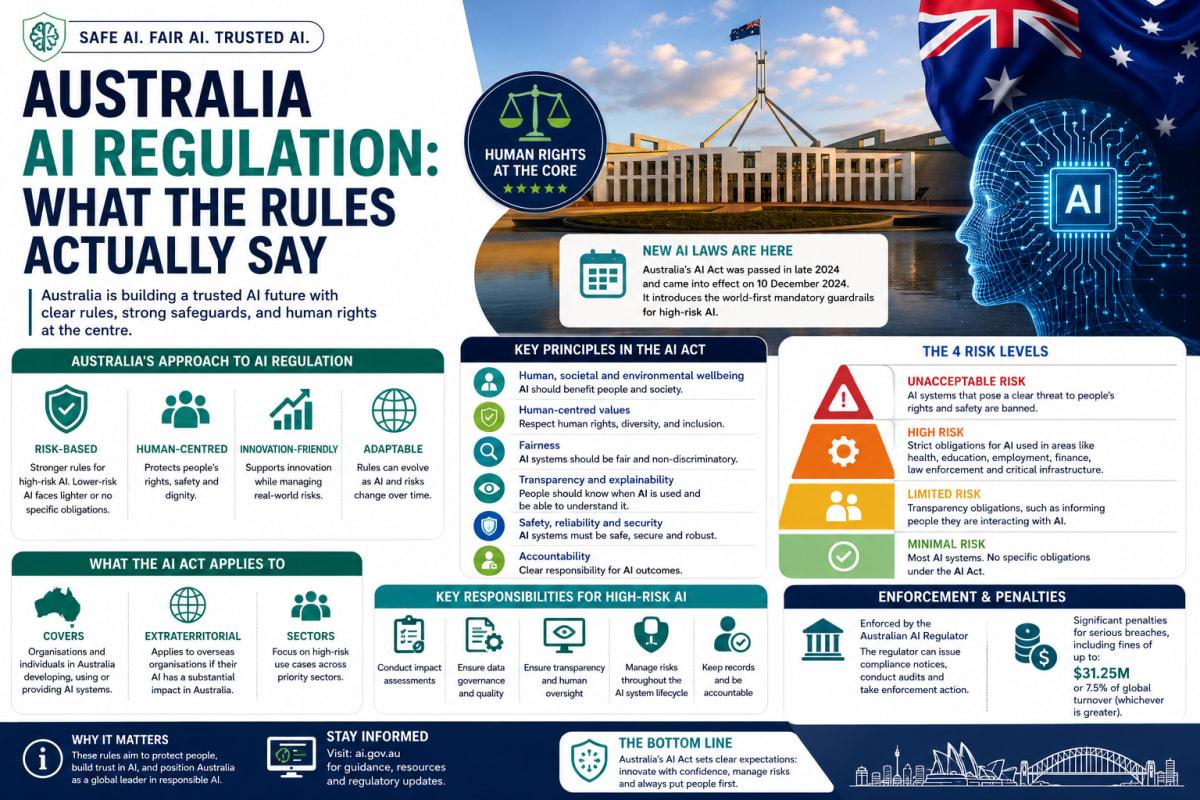
Australia doesn't have an AI Act, and that's not an oversight. It's a deliberate choice the government made after seriously considering the opposite path.
Australia AI regulation works through a patchwork of existing laws rather than one dedicated statute, and that structure is exactly what confuses businesses and everyday users trying to understand their rights and obligations. This guide breaks down how the system actually works right now, why a standalone AI Act got shelved, and what updates are actually coming that you should be tracking.
Australia AI Regulation — What It Is and Why It Matters
Australia AI regulation refers to the collection of existing and emerging laws that govern how AI systems are built, deployed, and used across the country. Instead of one comprehensive framework like the European Union's approach, Australia relies on technology-neutral laws such as the Privacy Act, Australian Consumer Law, and the Online Safety Act, layered with sector-specific rules and voluntary government guidance.
This matters because it changes where you actually go for protection or accountability. There's no single AI regulator to complain to. Instead, oversight is split across multiple agencies depending on what went wrong and in which industry.
Why This Is Important Right Now
Picture a small business owner using an AI tool to screen job applicants, unaware that automated hiring decisions can trigger obligations under employment and discrimination law even without any AI-specific statute involved. That gap in awareness is common, and it's getting more consequential as AI tools spread into hiring, lending, and customer service.
The government seriously considered mandatory, EU-style guardrails in late 2025, then walked that plan back in favor of voluntary guidance. That reversal means the regulatory ground is still shifting, and staying current matters more than assuming last year's headlines still apply.
Key Facts About Australia AI Regulation
A handful of core facts explain how Australia's approach actually functions today, and why it looks so different from other major economies.
- There is no standalone AI Act — Australia regulates AI through existing, technology-neutral legislation rather than dedicated AI-specific law.
- Mandatory guardrails were proposed, then dropped — the government shifted from a proposal for ten mandatory AI guardrails to a voluntary national plan instead.
- The AI Safety Institute is now operational — a government-funded body providing technical analysis and risk evaluation, without direct enforcement powers.
- Oversight is split across multiple regulators — including privacy, competition, financial, and online safety bodies, each covering AI within their existing remit.
- Privacy Act reforms are arriving in stages — new obligations around automated decision-making are set to commence in December 2026.
What the Industry Data Shows
Industry data suggests that Australia's technology-neutral approach reflects a broader policy debate playing out globally, between regulators who favor dedicated AI legislation and those who worry it slows innovation. Australia's government has leaned toward the latter view, at least for now.
Coverage from outlets like Reuters and industry-focused legal trackers has noted that business groups largely welcomed the shift away from mandatory guardrails, while academic and civil society voices have raised concerns that voluntary frameworks leave real gaps in accountability for AI-related harms.
Benefits and Real Opportunities
Understanding this regulatory landscape isn't just a compliance exercise. It shapes real opportunities for businesses and protections for individuals navigating AI-driven decisions.
- Lower compliance burden than the EU model — businesses avoid the heavy documentation requirements tied to formal AI Act frameworks.
- Faster adoption of new AI tools — the absence of pre-approval requirements lets businesses move quickly compared to more regulated markets.
- Existing legal protections still apply — privacy, consumer, and discrimination laws don't disappear just because AI is involved.
- Government guidance provides a practical starting point — voluntary frameworks still offer a credible baseline for responsible AI use.
Costs and What to Expect
Because there's no dedicated AI Act, there's no direct AI-specific licensing or compliance fee structure to budget for in Australia today. Costs instead show up indirectly, through legal and compliance work needed to map AI use against existing privacy, consumer, and sector laws.
Penalties for non-compliance under existing laws can still be significant. Recent reforms doubled the maximum corporate penalty under consumer law for the most serious breaches, which now applies to misleading claims about AI capabilities as well. Businesses using AI in hiring, lending, or insurance should also expect compliance costs tied to the incoming Privacy Act automated decision-making obligations later in 2026.
For most small businesses, the practical cost is time: reviewing existing policies against new guidance rather than paying for a new certification process that doesn't yet exist.
Voluntary Guidance vs Sector-Specific Law vs Formal AI Act: Which One Actually Applies to You?
| Option | Best For | Pros | Cons |
|---|---|---|---|
| Voluntary Guidance (GfAA) | Businesses wanting a practical baseline without legal mandates | Flexible and low-cost to implement | Not legally enforceable, so adoption varies widely |
| Sector-Specific Law | Organizations in healthcare, finance, or employment | Legally binding with established enforcement bodies | Doesn't address AI-specific risks not anticipated by older laws |
| Formal AI Act (Not Yet Adopted) | Comparison purposes only — this does not currently exist in Australia | Would offer clear, unified rules if eventually adopted | Government has explicitly opted against this approach for now |
Who Should Actually Care About Australia AI Regulation?
This matters most for businesses deploying AI in hiring, lending, insurance, or customer analytics, since those areas face the most direct upcoming obligations. It also matters for everyday consumers affected by automated decisions, employees whose workplaces use algorithmic scheduling or monitoring tools, and compliance teams trying to future-proof their organizations against rules that are still evolving.
Mistakes Most People Make
A few misunderstandings come up constantly when people talk about AI regulation in Australia.
Assuming Australia has an AI Act similar to the EU's leads to confused compliance planning. Checking which specific existing law actually applies to your use case, rather than assuming a single framework covers everything, avoids that error.
Treating voluntary guidance as legally binding creates a false sense of security. Understanding that frameworks like the Guidance for AI Adoption carry no direct penalty for non-compliance helps set realistic expectations.
Ignoring incoming Privacy Act changes because "there's no AI Act yet" overlooks that automated decision-making obligations are arriving regardless of AI-specific legislation. Reviewing privacy policies now, ahead of the December 2026 commencement, avoids a scramble later.
Assuming light-touch regulation means no accountability at all misses that existing consumer and privacy penalties still apply, and recent reforms actually increased maximum penalties for misleading conduct.
What Most Articles Won't Tell You
Most coverage treats Australia's light-touch approach as a settled outcome, but the government's own reversal on mandatory guardrails shows how quickly this could change again if public pressure or a major AI-related incident shifts political will.
There's also a detail often missed: some Australian states are moving faster than the federal government on specific AI risks, such as workplace safety obligations tied to algorithmic work allocation. That means your obligations can vary depending on which state you operate in, even without a national AI Act.
Advanced Moves Worth Knowing
Mapping your AI systems against the six essential practices in the government's current guidance, even though it's voluntary, puts you ahead of most competitors and creates a paper trail if mandatory rules do eventually return.
Tracking state-level developments alongside federal policy, rather than federal news alone, gives a more complete picture of your actual compliance exposure, especially if you operate across multiple states.
Frequently Asked Questions
Does Australia have an AI Act like the European Union?
No, Australia does not have a standalone AI Act. It regulates AI through existing technology-neutral laws such as the Privacy Act and Australian Consumer Law, alongside voluntary government guidance.
Was Australia planning to introduce mandatory AI guardrails?
Yes, the government proposed ten mandatory AI guardrails in 2025 but ultimately released a national plan favoring voluntary frameworks instead, after industry and economic concerns influenced the final direction.
What is the AI Safety Institute and what does it actually do?
The AI Safety Institute is a government-funded body that provides independent technical analysis, risk monitoring, and advice to regulators and ministers. It doesn't have direct enforcement powers over AI systems.
Who regulates AI in Australia if there's no dedicated AI regulator?
Multiple existing regulators share oversight depending on the context, including the privacy commissioner, the consumer and competition regulator, and sector-specific bodies covering finance and healthcare.
Will Australia eventually introduce a formal AI Act?
It's possible but not currently planned. The government has explicitly chosen a technology-neutral approach for now, though ongoing policy debate and international pressure could shift that position over time.
The Bottom Line on Australia AI Regulation
Australia AI regulation today runs on existing law and voluntary guidance rather than a single dedicated Act, and that structure is more fragile than it first appears. The government already reversed course once on mandatory guardrails, and incoming Privacy Act changes show the ground is still moving. Don't wait for a formal AI Act to start taking compliance seriously. Review your AI use against current guidance and upcoming privacy obligations now, because the rules that do exist are tightening even without new AI-specific legislation.
Read Next
iOS 27 Shock: Major AirPods Settings Overhaul Revealed!
Apple's Watch Faces Urgent Crisis: Can It Compete with New Wearables?
Google AI Shocks Users, Overlooks Key Words Like 'Disregard'

Apple Watch and AirPods Unveil Major Health Features—Don’t Miss This Upgrade!
AMD's $4K Ryzen AI Workstation: A Game-Changer That Pays Off Fast!