AI Trends in 2026: What's Next in Artificial Intelligence
From autonomous agents to multimodal AI, 2026 is bringing transformative changes to artificial intelligence. Here's what's next and how it will reshape industries, work, and daily life.
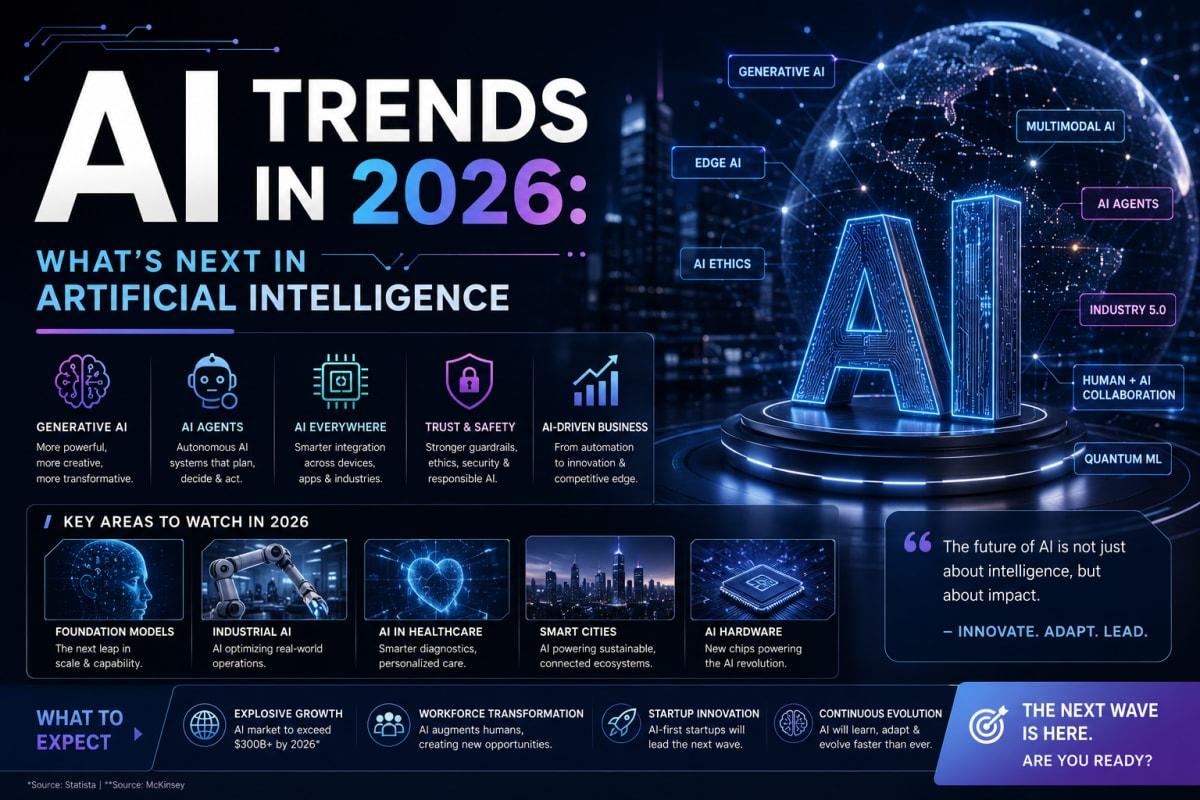
AI Trends in 2026: What's Next in Artificial Intelligence
Artificial intelligence isn't just evolving—it's accelerating in ways that would have seemed impossible just a few years ago.
In 2026, we're witnessing the next wave of AI innovation. The technology is moving beyond chatbots and image generators into something far more ambitious: autonomous agents that can plan and execute complex tasks, multimodal systems that understand the world across text, images, and video, and AI that's becoming deeply embedded in every industry.
The global AI market, valued at approximately $1.14 trillion in 2025, is projected to more than double to $2.8 trillion by 2030—a compound annual growth rate of nearly 20%. Generative AI alone is expected to contribute up to $4.4 trillion annually to the global economy.
Here's what's next in artificial intelligence and how these trends will reshape the world in 2026 and beyond.
What Are the Top AI Trends in 2026?
AI trends in 2026 reflect the next phase of artificial intelligence development: moving from narrow, task-specific models to more general, capable, and autonomous systems.
Think about it. The first wave of AI brought us chatbots and image generators. The second wave brought us systems that could reason and plan. Now we're entering a third wave—AI that can act independently, collaborate with other AI systems, and continuously learn and improve.
These trends are driven by advances in compute power, algorithmic innovation, and the sheer volume of data being generated. But they're also shaped by new challenges: safety concerns, regulatory pressure, and questions about the societal impact of increasingly capable AI systems.
Why These Trends Matter Now
Here's the thing: AI is no longer experimental. It's operational. Businesses across every sector are deploying AI to increase productivity, improve customer experiences, and create new revenue streams.
The AI market is projected to reach $1.2 trillion by 2026, and the global AI infrastructure market alone is expected to hit $423 billion by 2030. But with this growth comes increasing scrutiny. Governments are racing to regulate AI, and public trust is becoming a critical factor in adoption.
The organizations that navigate this landscape successfully will be those that understand both the opportunities and the responsibilities that come with AI.
Key AI Trends to Watch in 2026
Here are the most important artificial intelligence trends shaping 2026.
- Autonomous AI Agents — AI agents capable of planning, decision-making, and executing complex tasks with minimal human supervision are becoming mainstream. These agents can perform multi-step workflows, integrate with other tools, and adapt to changing circumstances. By 2028, Gartner predicts that 33% of enterprise software applications will include agentic AI.
- Multimodal AI — AI models that can process and generate multiple types of content—text, images, audio, video, and soon 3D environments—are becoming the new standard. These models understand the world more holistically, enabling more natural human-AI interaction. OpenAI's GPT-4o, launched in mid-2024, made multimodal AI widely accessible, and 2026 is seeing these capabilities become more sophisticated and affordable.
- AI in the Physical World — The boundaries between digital and physical AI are blurring. Newer models and robots are learning from simulations and applying those learnings in the real world. Researchers are developing robotic systems that can plan their actions using video, paving the way for robots that perform tasks once reserved for humans.
- Inference Scaling and Reasoning — The AI industry is shifting from simply training larger models to improving inference-time capabilities. OpenAI's o1 model demonstrated that allowing models to \"think\" longer during inference can produce better reasoning. Companies like Google's DeepMind are expected to advance this further, pushing AI toward superhuman reasoning.
- AI Regulation and Governance — The regulatory landscape for AI is rapidly evolving. The EU's AI Act is setting the global standard, and other regions are following suit. California's SB 1047, which aims to regulate frontier AI models, reflects growing concern about catastrophic risks. Compliance is becoming a competitive differentiator.
- Generative AI in the Enterprise — Generative AI is moving from experimentation to full-scale deployment. By 2026, it's estimated that 80% of enterprises will have adopted generative AI in some capacity. This is driving increased demand for AI infrastructure, training, and governance.
What the Industry Data Shows
The data tells a story of massive growth and accelerating adoption. The global AI market was valued at approximately $1.14 trillion in 2025 and is projected to reach $2.8 trillion by 2030. Generative AI is expected to contribute up to $4.4 trillion annually to the global economy.
AI infrastructure is a particularly hot segment. The global AI infrastructure market is projected to hit $423 billion by 2030, growing at a CAGR of 28.7%. This includes high-performance computing, data storage, networking, and cloud-based AI services.
Consumer adoption is also accelerating. Gartner predicts that by 2028, 75% of enterprise software engineers will use AI coding assistants—up from less than 10% in early 2023. The trend toward AI-augmented work is becoming the new normal.
Emerging AI Technologies in 2026
Several cutting-edge technologies are gaining momentum in 2026. Here's what's worth watching.
| Technology | Key Capability | Impact Area | Adoption Stage |
|---|---|---|---|
| Retrieval-Augmented Generation (RAG) | Enhanced accuracy with real-time data | Customer support, research | Mature |
| AI Agents | Autonomous task execution | Workplace automation | Early growth |
| Multimodal Models | Text, image, audio, video processing | Content creation, interfaces | Growth |
| Edge AI | On-device AI processing | Mobile, IoT, privacy | Growth |
| Quantum AI | Quantum-enhanced learning | Advanced research | Experimental |
RAG is already proving invaluable for improving AI accuracy, while AI agents and multimodal models are just entering their growth phase. Edge AI is enabling faster, more private AI applications, and quantum AI remains at the experimental stage but holds enormous long-term potential.
Who Should Care About These AI Trends?
AI trends in 2026 affect virtually everyone, but certain groups should pay particularly close attention.
- Business Leaders — AI is becoming a competitive necessity. Organizations that fail to adopt AI effectively risk falling behind. Leaders need to understand both the opportunities and the risks.
- Tech Professionals — Software engineers, data scientists, and IT professionals need to develop AI skills. The demand for AI talent is outpacing supply, and salaries reflect that scarcity.
- Investors — AI represents one of the largest investment opportunities of the decade. But the landscape is complex, and not every AI company will succeed. Understanding the technology is essential for smart investing.
- Policymakers — Governments are racing to regulate AI. The stakes are high—getting regulation right could foster innovation, while getting it wrong could stifle it.
- Educators and Students — AI is transforming education and the skills needed for the workforce. Students who understand AI will have a significant advantage.
Mistakes Most People Make
A common mistake is underestimating AI's potential impact. Many people see AI as a tool for automating routine tasks. They miss the bigger picture: AI is fundamentally changing how work gets done, how decisions are made, and how value is created.
Another mistake is overlooking the risks. AI brings significant challenges, including bias, privacy concerns, security vulnerabilities, and the potential for misuse. Organizations that ignore these risks expose themselves to regulatory, financial, and reputational damage.
Some also assume that AI will replace jobs entirely. The reality is more nuanced. AI will replace some tasks, but it will also create new jobs and augment human capabilities. The key is learning to work with AI rather than against it.
What Most Articles Won't Tell You
Most coverage focuses on the technology itself, but here's what gets overlooked: AI success is as much about people and processes as it is about technology. The organizations that succeed with AI invest heavily in change management, training, and governance.
Also worth noting: the AI landscape is becoming more concentrated. A small number of companies—including Microsoft, Google, Amazon, and Nvidia—are capturing the lion's share of AI value. This concentration has implications for competition, innovation, and antitrust policy.
And here's something most people miss: the most valuable AI applications may not be the flashy ones. The real wins often come from boring, practical applications—improving supply chains, optimizing manufacturing, personalizing healthcare, and making financial services more accessible.
Advanced Moves Worth Knowing
For organizations looking to get ahead, consider investing in AI governance early. Compliance is becoming a competitive advantage—customers and partners increasingly prefer working with organizations that can demonstrate responsible AI use.
Another advanced move: focus on high-quality data. AI is only as good as the data it's trained on. Organizations that invest in data quality, labeling, and curation will build better models and reduce risk.
Also consider AI integration, not just AI adoption. The most successful organizations embed AI into their existing workflows and systems rather than treating it as a separate initiative. This integration approach delivers faster time-to-value and better ROI.
Frequently Asked Questions
What are the top AI trends in 2026?
The top AI trends in 2026 include autonomous AI agents, multimodal AI models, AI in the physical world, inference scaling and reasoning, AI regulation, and enterprise generative AI deployment. These trends reflect the evolution of AI from reactive tools to proactive, autonomous systems.
How is AI evolving in 2026?
AI is evolving in several key ways: moving from single-task to multi-task capabilities, from text-only to multimodal understanding, from reactive responses to proactive action, and from centralized to edge deployment. Models are becoming more capable, efficient, and accessible.
What industries are being transformed by AI?
Every industry is being transformed, but the most significant impacts are in healthcare (diagnostics, drug discovery), finance (trading, fraud detection), manufacturing (supply chain, quality control), retail (personalization, inventory), and education (tutoring, content creation).
What are the risks of AI in 2026?
Key risks include bias and fairness issues, privacy concerns, security vulnerabilities, misinformation, job displacement, and regulatory compliance challenges. There are also existential risks from increasingly capable AI systems, which are driving calls for stronger governance and safety measures.
How should I prepare for AI trends in 2026?
Start by understanding AI's capabilities and limitations. Develop AI literacy—learn enough to ask the right questions and make informed decisions. For organizations, invest in data quality, talent, and governance frameworks. For individuals, focus on skills that complement AI rather than compete with it.
The Bottom Line on AI Trends in 2026
AI trends in 2026 are reshaping the world—how we work, how we live, and how we think about the future. From autonomous agents to multimodal models, the technology is becoming more capable, more accessible, and more deeply embedded in every aspect of society.
The key takeaway is that AI is no longer optional. It's becoming a fundamental part of how businesses compete, how governments operate, and how individuals navigate the world. Those who understand AI—its capabilities, its limitations, its risks, and its opportunities—will be best positioned for the future.
The trends are clear. The trajectory is set. AI is not coming—it's here. The question isn't whether to engage with AI, but how to do so wisely. Stay informed, stay curious, and stay adaptable. The future belongs to those who embrace it.
Read Next

Scalpers Shock Market: Steam Machines Now $1,700+

Best AI Tools for Businesses in 2026: What You Need to Know

GTA VI Reveal Sparks Gaming Surge After Decade-Long Wait

7 ChatGPT Alternatives Your Business Needs in 2026

Prime Day Deals Surge: Must-Shop Tech Discounts from Apple, Sony, Bose