AI in Healthcare: 2026 Trends Reshaping Patient Care
From ambient documentation to predictive risk alerts, here's how AI is actually changing patient care in 2026, and what it means for both patients and providers.
AI in Healthcare: 2026 Trends Reshaping Patient Care
A doctor who spends less time typing notes and more time actually looking at you during your appointment. That's not a distant vision anymore. It's happening in exam rooms right now, powered by AI tools most patients never see directly.
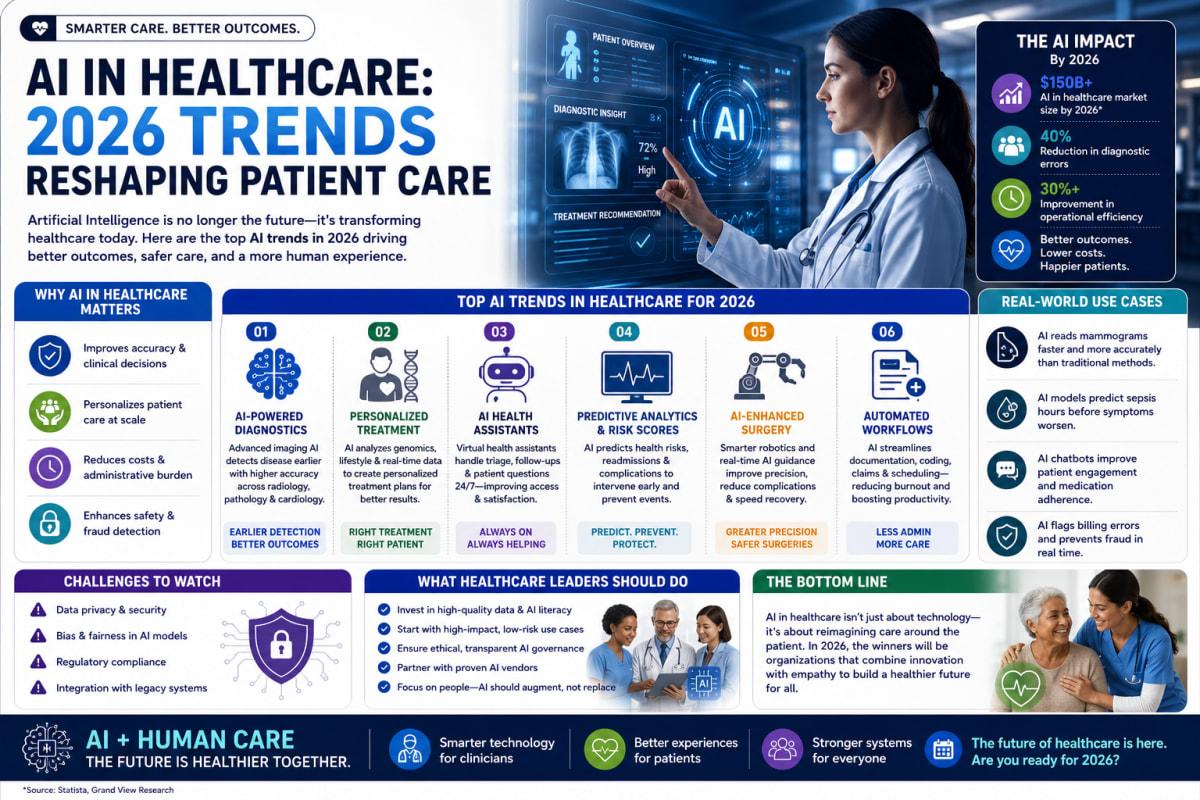
AI in healthcare has moved past pilot projects and into daily clinical workflows in 2026, changing how care gets documented, predicted, and delivered. This guide breaks down the trends actually reshaping patient care this year, where the real benefits show up, and what to watch for as these tools become a standard part of the healthcare experience.
AI in Healthcare — What It Is and Why It Matters
AI in healthcare refers to the use of machine learning and generative AI tools across clinical and administrative tasks, from diagnostic imaging support to ambient documentation that listens to a visit and drafts clinical notes automatically. It spans everything from hospital operations to the wearable device tracking your sleep at home.
This matters because these tools directly affect two things patients care about most: how much time their provider can actually spend with them, and how early a health risk gets caught. Both are improving as AI adoption spreads across the industry.
Why This Is Important Right Now
Picture a nurse practitioner who used to spend evenings finishing patient charts, now using an ambient scribe tool that drafts the note in real time during the visit itself. That shift alone gives clinicians back meaningful hours each week, hours that translate into more attentive, less rushed care.
Clinician burnout has reached record levels industry-wide, and administrative burden is one of the most frequently cited causes. That makes AI tools built specifically to reduce documentation time more than a convenience. They're becoming part of the solution to a genuine workforce crisis.
Key Facts About AI in Healthcare
A handful of core developments define where AI in healthcare actually stands in 2026, separate from the hype around any single tool.
- Ambient documentation tools are now widely used — automatically capturing and summarizing clinical conversations to reduce manual charting time.
- Agentic AI is expanding beyond analysis into action — some health systems now use autonomous AI agents to help orchestrate care journeys and adapt chronic disease protocols.
- Predictive analytics are supporting earlier risk detection — dynamic models increasingly flag patient risk in real time rather than only after symptoms appear.
- Wearables paired with AI now support preventive care — turning passive activity tracking into more active, personalized health monitoring.
- Governance frameworks are still catching up — health systems are actively building formal AI oversight policies to manage risks like unauthorized or unmonitored tool use.
What the Industry Data Shows
Industry data suggests that a large majority of radiologists believe AI technologies can meaningfully improve patient outcomes, reflecting broader clinician optimism as these tools move from novelty to routine use. Major health systems, including some of the country's largest academic medical centers, have already begun deploying agentic AI to automate repetitive tasks and support more personalized care coordination.
Reporting from healthcare-focused industry analysts has also noted that pharmaceutical and biotech companies remain especially focused on AI for research and drug development, while payers and providers are placing more weight on patient engagement and clinician efficiency. That split suggests AI's impact is landing differently depending on where you sit in the healthcare system.
Benefits and Real Opportunities
The practical upside of AI in healthcare goes well beyond efficiency gains, touching the actual quality and timing of care patients receive.
- More face-to-face time with providers — automated documentation frees up clinician attention during the visit itself.
- Earlier risk detection — predictive models can flag warning signs before they become acute emergencies.
- More personalized treatment planning — genetic and biomarker data increasingly inform individualized care rather than one-size-fits-all protocols.
- Better access through virtual tools — AI-powered communication systems can reduce scheduling delays and improve responsiveness for patients.
Costs and What to Expect
For patients, most AI-driven improvements arrive as part of standard care rather than a separate line-item cost, since health systems typically absorb the investment in these tools as part of broader operational upgrades. That said, some AI-enhanced diagnostic services or specialized monitoring programs may carry additional fees depending on your insurance coverage and provider.
For healthcare organizations, implementation costs remain significant, spanning software licensing, staff training, and the compliance infrastructure needed to govern AI use responsibly. Institutions are also investing in oversight processes to manage the risk of unauthorized or unmonitored AI tools being used informally by staff, sometimes called shadow AI, which introduces its own compliance costs.
Patients should also expect continued variation in how quickly different providers adopt these tools, since implementation timelines depend heavily on a health system's size, funding, and existing technology infrastructure.
Ambient Documentation vs Predictive Analytics vs Agentic AI Care Coordination: Which One Actually Affects Your Care?
| Option | Best For | Pros | Cons |
|---|---|---|---|
| Ambient Documentation | Patients wanting more attentive, less rushed appointments | Frees up clinician time and attention during the visit itself | Requires patient comfort with conversations being recorded and processed |
| Predictive Analytics | Patients managing chronic conditions or known risk factors | Can flag risks earlier than traditional periodic checkups | Depends heavily on data quality and consistent monitoring |
| Agentic AI Care Coordination | Patients navigating complex, multi-provider treatment plans | Can adapt and coordinate care journeys across multiple touchpoints | Still early-stage, with governance frameworks not fully mature yet |
Who Should Actually Care About AI in Healthcare?
This matters for anyone managing a chronic condition who could benefit from earlier risk detection, patients frustrated by long phone-based scheduling delays, and older adults interested in tools supporting healthy aging and independence. It's also relevant for healthcare workers themselves, since many of these tools are designed specifically to reduce the administrative burden driving clinician burnout.
Mistakes Most People Make
A few misunderstandings come up often as patients encounter these tools for the first time.
Assuming an AI tool is making the final medical decision overlooks that these systems are largely designed to support, not replace, clinical judgment. Asking your provider directly how a specific AI tool factors into your care clarifies this and builds appropriate trust.
Avoiding questions about ambient documentation out of discomfort can prevent patients from raising legitimate privacy concerns. Asking how recorded conversations are stored and used is a reasonable question any patient can raise.
Assuming AI adoption looks the same everywhere ignores that implementation varies widely between large academic medical centers and smaller community providers. Asking your specific provider what tools they use avoids assuming a uniform experience.
Dismissing wearable and remote monitoring data as unimportant misses a growing source of preventive insight. Sharing that data with your provider, where relevant, can meaningfully inform your care plan.
What Most Articles Won't Tell You
Most coverage focuses on flashy diagnostic breakthroughs, but the quieter shift toward reducing clinician burnout through documentation tools may be having the more immediate, measurable impact on day-to-day care quality.
There's also a governance gap worth understanding: health systems are still actively building formal oversight policies for AI use, which means the pace of innovation is currently outrunning the pace of standardized safety and compliance frameworks. That's not necessarily alarming, but it's a reasonable thing for patients to stay aware of.
Advanced Moves Worth Knowing
Asking your provider directly whether they use ambient documentation or predictive risk tools can open a useful conversation about how your specific care is being supported by these systems.
Actively sharing wearable device data with your care team, rather than letting it sit unreviewed in an app, can help predictive models generate more accurate, personalized insights over time.
Frequently Asked Questions
Is AI replacing doctors in 2026?
No, current AI tools in healthcare are largely designed to support clinical decision-making and reduce administrative burden, not replace the provider-patient relationship. Human oversight remains central to how these tools are deployed.
What is an ambient scribe and should I be concerned about privacy?
An ambient scribe is an AI tool that listens to a clinical visit and automatically drafts documentation notes. It's reasonable to ask your provider how recorded conversations are stored and protected if this is a concern for you.
Do all hospitals use the same AI tools?
No, adoption varies significantly based on a health system's size, funding, and technology infrastructure. Larger academic medical centers have often moved faster on advanced tools like agentic AI compared to smaller community providers.
Can wearable devices actually improve my care, or are they just for fitness tracking?
When paired with AI analytics and shared with your care team, wearables can support genuine preventive care by surfacing patterns your provider might not otherwise see between visits. Passive tracking alone offers less value than actively reviewing that data with a clinician.
Is healthcare AI regulated the same way everywhere?
Not currently. Health systems are actively developing more formal governance frameworks, and oversight maturity varies by institution and region, so it's reasonable to ask your provider about their specific policies if you have questions.
The Bottom Line on AI in Healthcare
AI in healthcare in 2026 isn't defined by a single breakthrough technology. It's defined by a steady shift toward tools that give clinicians back time and give patients earlier, more personalized insight into their own health. The biggest near-term impact may be the quiet reduction in administrative burden, not the flashiest diagnostic headline. If you're curious how this affects your own care, ask your provider directly what tools they're using and how those tools factor into your treatment decisions.
Read Next

Shocking Reasons to Delay Your iPhone 18 Pro Purchase Now!
Apple's Bold Move: Encrypted RCS Chats Now on iPhone!

Shock! Discord Nitro Rewards Unlocks Free Xbox Game Pass for Subscribers!

Apple's A20 Pro Chip: A Shocking Leap for the iPhone 18 Pro!

ASUS Reveals Shocking ROG Crosshair Motherboard for 20th Anniversary Boom!