How AI Is Changing Personal Finance in 2026
AI budgeting apps, robo-advisors, and fraud alerts are reshaping how millions manage money in 2026. Here's what's actually changed, and what to watch for.
How AI Is Changing Personal Finance in 2026
A financial advisor available 24/7, who never charges a fee and knows your spending habits better than you do, sounds like a stretch. In 2026, it's just what a decent AI budgeting app already does, quietly, in the background of an app you probably already have installed.
AI has moved from a novelty feature to a genuine part of how millions of people budget, invest, and bank in 2026. This guide breaks down what's actually changed across each of those three areas, where the real value shows up, and where these tools still fall short of the hype surrounding them.
AI in Personal Finance — What's Actually Changed and Why It Matters
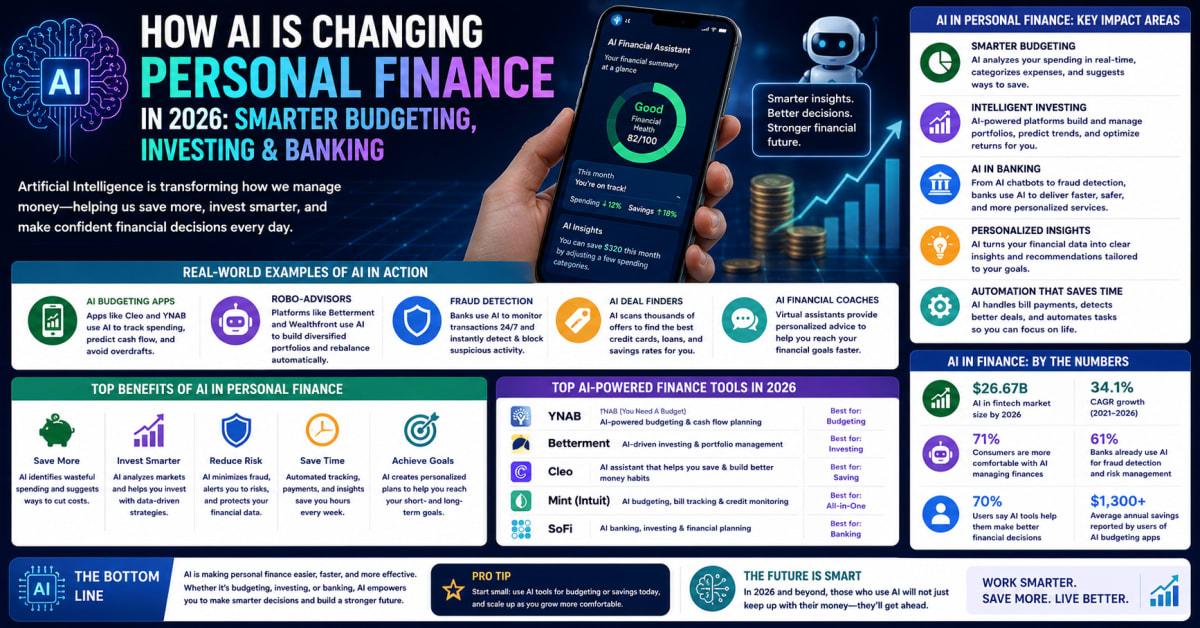
AI in personal finance now spans three core areas: budgeting apps that automatically categorize spending and flag unusual activity, robo-advisors that build and rebalance investment portfolios with minimal input, and banking tools that detect fraud and forecast cash flow in real time. What's changed recently isn't that these categories are new, it's that they've become genuinely capable rather than gimmicky.
This matters because these tools have crossed a real tipping point in accessibility. Features that once required a paid financial advisor, portfolio rebalancing, tax-loss harvesting, personalized spending insight, are now often built into free or low-cost apps most people already use.
Why This Is Important Right Now
Picture someone who's used the same budgeting spreadsheet for years, manually categorizing every transaction every week. An AI-powered budgeting app can now do that same categorization automatically, learn from corrections over time, and flag an unusual charge before the person even notices it themselves.
The AI for personal finance market is projected to keep growing at a rapid pace over the next several years, driven by rising demand for hyper-personalized financial insights and expanding open banking frameworks that let these tools access more of your actual financial picture than ever before.
Key Facts About AI in Personal Finance in 2026
A few core developments define where this space actually stands today, separate from the marketing language surrounding any single app.
- AI budgeting tools now automatically classify transactions and detect anomalies — popular tools like Monarch and Cleo learn from user corrections over time rather than relying on fixed, rigid rules.
- Robo-advisors have become mainstream, not just for wealthy investors — platforms like Betterment and Wealthfront now use AI to automatically rebalance portfolios and personalize asset allocation, often with no minimum balance required.
- Most current AI budgeting tools remain reactive, not proactive — they typically show you where you overspent after the money is already gone, rather than intercepting the decision beforehand.
- General-purpose AI chatbots lack native access to your actual financial data — they can explain financial concepts well but can't see your real accounts the way a dedicated finance app can.
- Behavioral AI is an emerging category — some newer platforms are specifically designed to intercept a risky spending decision in the moment, rather than just reporting on it afterward.
What the Industry Data Shows
Industry data suggests that the AI for personal finance market is expanding rapidly, driven by growing demand for generative AI in advisory tools, expanding open banking data access, and rising need for automated investment and credit score management across a broader range of income levels than these tools historically served.
Industry coverage has consistently noted that while budgeting apps have matured significantly in transaction categorization and anomaly detection, the more meaningful breakthrough still emerging is contextual budgeting, connecting spending patterns to broader goals like investing and debt payoff, rather than just labeling individual transactions in isolation.
Benefits and Real Opportunities
AI-driven personal finance tools create genuine, practical value across each core area of money management.
- Automated categorization saves real time — no more manually sorting every transaction into a budget category by hand.
- Lower barriers to investing — some robo-advisors now let people start investing with as little as $1, automatically building and rebalancing a diversified portfolio.
- Faster fraud detection — AI-driven banking alerts can flag unusual account activity in real time, often faster than a bank's older, rule-based fraud systems.
- More personalized insight than generic advice — tools connected to your actual accounts can offer recommendations grounded in your real financial picture, not generic rules of thumb.
Costs and What to Expect
Many AI budgeting tools offer a genuinely useful free tier, with premium versions commonly running $10 to $15 per month for deeper features like advanced forecasting or unlimited account connections. Robo-advisors typically charge a small annual management fee, often a fraction of a percent of assets managed, which remains far lower than a traditional human financial advisor's typical fee structure.
More comprehensive AI-driven financial planning platforms that combine budgeting, investing, and cash management in one ecosystem can carry a higher subscription cost, reflecting the broader scope of features involved. Banking apps' AI-driven fraud alerts and spending insights are typically included at no additional cost as part of a standard account, since banks benefit directly from reduced fraud losses.
The real cost consideration for many of these tools isn't the subscription fee, but the tradeoff of connecting your financial accounts to a third-party platform, which raises data privacy considerations worth weighing before granting that access.
AI Budgeting Apps vs Robo-Advisors vs AI-Enhanced Banking Features: Which One Should You Start With?
| Option | Best For | Pros | Cons |
|---|---|---|---|
| AI Budgeting Apps (e.g., Cleo, Monarch) | People wanting better visibility into everyday spending | Automated categorization and anomaly detection with strong free tiers | Often reactive, showing overspending after it's already happened |
| Robo-Advisors (e.g., Betterment, Wealthfront) | People wanting hands-off, automated investing | Low minimums, automatic rebalancing, far lower fees than a human advisor | Less personalized than a human advisor for complex financial situations |
| AI-Enhanced Banking Features | Anyone wanting basic fraud protection and spending alerts at no extra cost | Usually free, built directly into an account you already have | Less comprehensive than a dedicated budgeting or investing app |
Who Should Actually Care About AI in Personal Finance?
This matters for anyone who currently manages money manually and wants to save time, first-time investors intimidated by traditional financial advisors' fees and minimums, and anyone who wants faster fraud detection on their bank accounts than older, rule-based systems typically provide. It's genuinely relevant across income levels, since many of these tools now serve students, freelancers, and small business owners just as well as higher earners.
Mistakes Most People Make
A handful of habits keep people from getting real value out of these tools.
Assuming a general-purpose AI chatbot can replace a dedicated finance app overlooks that chatbots typically lack native access to your actual account data, meaning their advice stays generic rather than personalized to your real financial picture. Using a tool built to connect directly to your accounts produces far more useful insight.
Treating AI budgeting alerts as passive notifications to ignore, rather than acting on them, wastes the tool's main advantage. Reviewing and responding to flagged anomalies promptly captures the real value these features are designed to provide.
Connecting financial accounts to a new AI tool without checking its security and data privacy practices skips an important due diligence step. Confirming how a platform protects and uses your financial data before granting account access matters more than convenience.
Assuming a robo-advisor eliminates the need to understand your own investment goals ignores that these tools still perform best when given accurate information about your risk tolerance and timeline. Providing thoughtful input, not just accepting default settings, improves the output significantly.
What Most Articles Won't Tell You
Most coverage highlights budgeting and investing tools, but the more overlooked shift is toward behavioral AI, tools specifically designed to intercept a risky spending decision in the moment rather than just reporting on it after the fact. That category remains newer and less proven than mature budgeting apps, but represents a meaningfully different approach than passive tracking.
There's also a detail worth knowing: many banking apps now include basic AI-driven fraud alerts and spending insights at no additional cost, which means some of this technology's value is already available to you without downloading a separate app at all.
Advanced Moves Worth Knowing
Checking whether your existing bank already offers AI-driven fraud alerts before subscribing to a separate paid tool can capture meaningful value at no additional cost.
Pairing a budgeting app for day-to-day spending visibility with a separate robo-advisor for long-term investing, rather than expecting one all-in-one platform to excel at both, often produces stronger results in each specific area.
Frequently Asked Questions
Are AI budgeting apps actually free?
Many offer a genuinely useful free tier, though premium versions with deeper forecasting or unlimited account connections typically cost around $10 to $15 per month at popular apps.
Can I trust a robo-advisor with my retirement savings?
Major robo-advisors are regulated investment platforms and have become mainstream options used by millions of investors. As with any investment platform, it's worth confirming the specific fee structure and understanding how your portfolio is being managed.
Does using a general AI chatbot like ChatGPT count as AI personal finance help?
It can help explain financial concepts in plain language, but general-purpose chatbots typically don't have direct access to your actual account data, so their advice remains generic rather than personalized to your real financial situation.
Is it safe to connect my bank accounts to an AI budgeting app?
Reputable apps use secure, encrypted connections and don't store your bank login credentials directly. It's still worth reviewing a specific app's security practices and data usage policy before connecting your accounts.
What's the easiest way to start using AI for personal finance?
Starting with a free AI budgeting app to get a sense of your spending patterns is typically the easiest entry point, followed by checking whether your existing bank already offers AI-driven fraud alerts you haven't enabled yet.
The Bottom Line on How AI Is Changing Personal Finance in 2026
AI has genuinely transformed personal finance in 2026, making automated budgeting, low-cost investing, and real-time fraud detection accessible to far more people than a traditional financial advisor ever reached. The technology still has real limits, most tools remain reactive rather than truly proactive, and general AI chatbots can't see your actual financial data the way a dedicated tool can. Start with whichever area feels most useful to you right now, budgeting, investing, or banking security, and let the tool prove its value before expanding to the rest.
Read Next

Shock Reveal: Flipper's Linux Gadget Sparks Boom for Hackers and Tinkerers!

Apple TV Shocks Fans with First Live Pro Sports Event Filmed on iPhone 17 Pro!
Shocking iOS 27 Feature Reveals Siri's Major Upgrade Is Coming!

Google's Shocking AI Tool Boom: Android Version of Vibe Code Revealed!

Samsung Shocks Gamers: New 6K, 5K, and 4K OLED Monitors Unveiled!