AI Agents in 2026: How They're Transforming Work
AI agents now touch a majority of enterprises, but nearly 40% of agentic AI projects are expected to fail without proper oversight. Here's what's real and what's hype.
AI Agents in 2026: How They're Transforming Work
A majority of companies now report using AI agents in some form, yet analysts still expect a significant share of these projects to fail without proper oversight. Both things are true at once, and understanding why matters more than picking a side in the hype cycle.
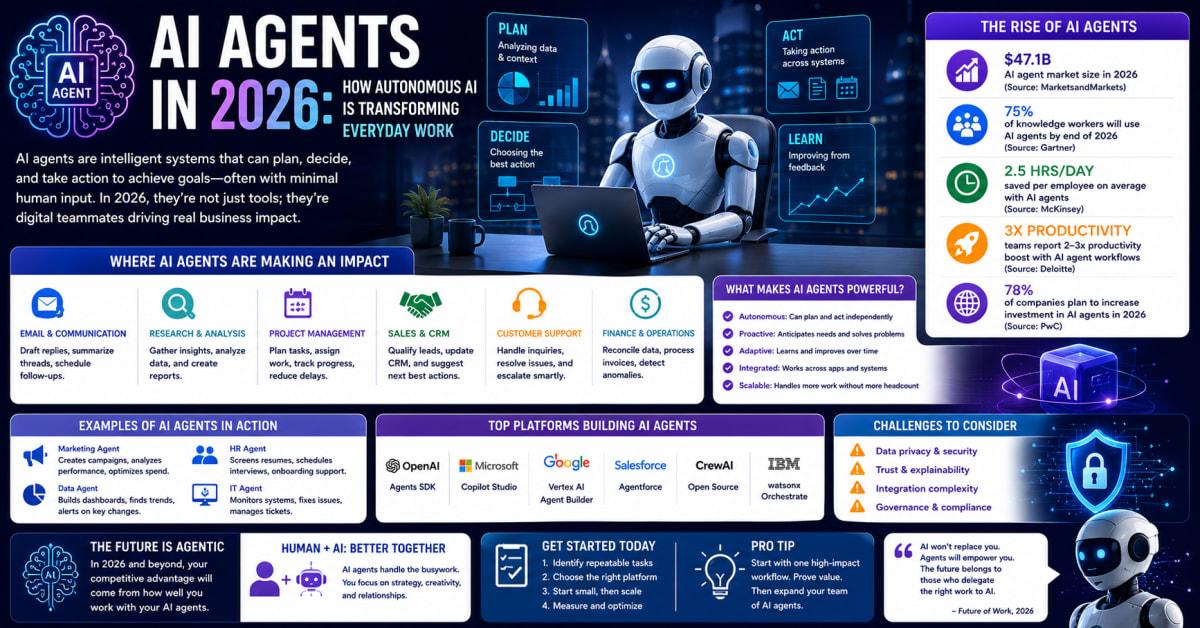
AI agents in 2026 have moved well past simple chatbots, now planning tasks, coordinating across multiple platforms, and executing multi-step workflows with limited human supervision. This guide breaks down what AI agents actually do today, where they're delivering real value, and where the risks analysts are warning about genuinely apply.
AI Agents — What They Are and Why the Distinction From Chatbots Matters
An AI agent is an intelligent software system that can perceive information, reason through a problem, and take action independently, rather than simply responding to a single prompt. Agentic AI describes the broader approach where multiple specialized agents work together, often coordinating across an entire workflow rather than handling one isolated task in isolation.
This distinction matters because a chatbot answers a question, while an agent can actually complete a multi-step task, like resolving a customer refund, matching an invoice, or screening a resume, often touching several connected systems along the way.
Why This Is Important Right Now
Picture a customer service team where a routine refund request used to require a human agent to check an order, verify a policy, and process the payment across three separate systems. An AI agent can now often complete that entire sequence autonomously, escalating to a human only when the situation falls outside its defined guardrails.
Analysts project that a substantial share of enterprise applications will embed task-specific AI agents by the end of 2026, with estimates ranging from roughly 40% to 80% depending on the research firm and definition used. Regardless of the exact figure, the direction is consistent: agentic AI is moving from experimental pilots into core business operations.
Key Facts About AI Agents in 2026
A few core facts define where AI agent adoption actually stands today, separate from the more speculative long-term projections.
- A majority of enterprises already report using AI agents in some form — with figures from recent surveys ranging from roughly 57% to 79% depending on how "in production" is defined.
- Proven use cases now span most core business functions — including customer service, finance and invoice matching, security threat detection, sales outreach, supply chain planning, and HR resume screening.
- Not every implementation delivers measurable results — one study found that while a large share of organizations had implemented AI agents, a notably smaller share reported tangible productivity gains they could actually measure.
- Gartner projects a significant failure rate for agentic AI projects — estimating that over 40% of agentic AI initiatives could fail by 2027 without proper governance and oversight controls in place.
- Multi-agent systems are becoming the standard architecture — rather than one general-purpose agent, specialized agents increasingly work together, communicating through emerging shared protocols across different platforms.
What the Industry Data Shows
Industry data suggests that healthcare has become one of the more advanced adopters of AI agents, with high usage rates for administrative tasks like clinical documentation and inpatient monitoring, and industry estimates pointing to substantial potential annual savings for the sector as adoption matures further.
Consulting firm research has estimated that AI agents could unlock trillions of dollars in annual economic value across industries by the end of the decade, though the same research consistently flags governance, transparency, and cost control as unresolved challenges that will determine how much of that projected value actually materializes.
Benefits and Real Opportunities
Where implemented thoughtfully, AI agents are delivering genuine, measurable value across a range of business functions.
- Faster resolution of routine tasks — customer service agents can resolve tickets, refunds, and simple escalations without waiting for a human to become available.
- Reduced burden on specialized staff — security teams handling routine threat detection through agents can focus their attention on more advanced, genuinely novel threats instead.
- More consistent execution of repetitive workflows — tasks like invoice matching or expense auditing benefit from an agent's consistency compared to manual review across a large volume of transactions.
- Lower barrier to deployment through no-code tools — business users, not just engineers, can now design and launch AI agents through visual interfaces rather than requiring dedicated development resources.
Costs and What to Expect
Costs for deploying AI agents vary enormously depending on scale and complexity, ranging from relatively low-cost, no-code agent builders suited to smaller teams, up to significant enterprise investment for custom multi-agent systems integrated across CRM, ERP, and other core business platforms. Ongoing operational costs also matter, since agents that run continuously can accumulate meaningful compute expenses if not properly monitored.
Beyond direct software costs, organizations should budget for governance infrastructure, monitoring systems, audit trails, and human review processes, since analysts consistently point to weak governance as the leading cause of failed agentic AI projects. Skipping this investment to save money upfront is one of the more common reasons deployments underperform or get rolled back later.
The less obvious cost is organizational: successfully deploying AI agents typically requires redesigning existing workflows around what the agent can and can't handle, not simply layering an agent on top of an unchanged process.
Single-Agent Workflows vs Multi-Agent Systems vs Human-in-the-Loop Hybrid Models: Which Approach Is Right for You?
| Option | Best For | Pros | Cons |
|---|---|---|---|
| Single-Agent Workflows | Simple, narrow, well-defined tasks | Simpler to build, deploy, and monitor | More prone to errors on complex, multi-step processes |
| Multi-Agent Systems | Complex workflows spanning multiple business functions | Specialized agents reduce errors and can handle end-to-end processes | More complex to govern and monitor across coordinated agents |
| Human-in-the-Loop Hybrid Models | Consequential decisions requiring accountability and oversight | Reduces risk of unintended autonomous decisions | Slower than full autonomy for high-volume, low-risk tasks |
Who Should Actually Care About AI Agents?
This matters for business leaders evaluating where to prioritize automation investment, operations and IT teams responsible for governance and monitoring, and employees whose day-to-day workflows are increasingly being reshaped by agents handling routine tasks. It's especially relevant for industries with high transaction volume and repetitive decision-making, like customer service, finance, and healthcare administration, where proven use cases are already well established.
Mistakes Most People Make
A handful of habits show up repeatedly in organizations struggling to get real value from AI agents.
Deploying an agent without proper governance controls or monitoring in place is the single most cited reason agentic AI projects fail, according to industry analysts. Building oversight and audit trails into the deployment from the start, not as an afterthought, meaningfully reduces this risk.
Handing off full autonomy for consequential decisions too quickly ignores that most successful deployments still keep a human in the loop for anything with real business or customer impact. Reserving full autonomy for lower-risk, high-volume tasks first builds trust before expanding scope.
Assuming implementation alone guarantees productivity gains overlooks that a meaningful share of organizations that have deployed AI agents still can't point to measurable results. Defining clear success metrics before deployment, not after, avoids that measurement gap.
Treating a single general-purpose agent as sufficient for a complex, multi-step workflow can lead to more errors than a coordinated multi-agent approach designed with specialized roles for each part of the process.
What Most Articles Won't Tell You
Most coverage leads with adoption statistics and economic value projections, but the more important operational detail is the gap between implementation and measurable results, since a meaningful share of organizations that have deployed agents still can't demonstrate clear productivity gains from doing so.
There's also a detail worth knowing: emerging shared communication protocols between agents built on different platforms are becoming an important technical foundation for multi-agent collaboration, since without this kind of standardization, agents built by different vendors or teams historically couldn't coordinate effectively with each other at all.
Advanced Moves Worth Knowing
Starting with a narrow, well-defined, lower-risk task before expanding to a full multi-agent workflow lets an organization build governance muscle and measure real results before scaling autonomy across more consequential processes.
Building in clear, measurable success metrics and monitoring dashboards from day one, rather than after deployment, closes the gap between implementation and demonstrable productivity gains that many organizations currently struggle with.
Frequently Asked Questions
What's the difference between an AI agent and a chatbot?
A chatbot typically responds to a single prompt or question, while an AI agent can plan and execute a multi-step task independently, often coordinating across multiple systems, with limited human supervision required.
How many companies are actually using AI agents in 2026?
Estimates vary by survey and definition, but a majority of enterprises now report using AI agents in some form, with figures from different studies ranging roughly from the high 50s to high 70s as a percentage of organizations surveyed.
Why do so many agentic AI projects fail?
Analysts most commonly point to weak governance, unclear success metrics, and insufficient human oversight for consequential decisions as the leading causes, rather than the underlying technology itself being fundamentally flawed.
Do AI agents make decisions completely without human involvement?
Not typically for consequential decisions. Most successful enterprise deployments still include human-in-the-loop controls for anything with real business or customer impact, reserving full autonomy for lower-risk, well-defined tasks.
What industries are seeing the most AI agent adoption right now?
Customer service, finance and operations, security and compliance, sales and marketing, supply chain, and HR are all cited as areas with proven, established AI agent use cases as of 2026, with healthcare also showing particularly high adoption for administrative and monitoring tasks.
The Bottom Line on AI Agents in 2026
AI agents in 2026 have genuinely moved from experimental pilots into core business operations, with proven use cases across customer service, finance, security, and beyond. But the gap between organizations that implement agents and those that can actually measure real productivity gains remains significant, and analysts consistently trace that gap back to weak governance rather than the technology itself. Whether you're evaluating AI agents for your own organization or simply trying to understand how they're reshaping the workplace around you, the real signal to watch isn't adoption headlines. It's whether an organization is investing as seriously in oversight as it is in the agents themselves.
Read Next

Apple shock: Siri AI locked to newer devices—full list revealed

Huawei’s HarmonyOS Revealed to Run on a Single Dry Cell Battery for a Year

Telegram Surges Back to Wear OS with Chats & Voice – What You Missed

Why Apple's Silence on AI Is a Smart Move (For Now)

Apple’s Siri AI shockingly learns when to stay silent