Fractional Investing 2026: Start With Just $10
A single share of some stocks costs hundreds of dollars. Fractional investing lets you own a slice for as little as $1 to $10. Here's how it actually works.
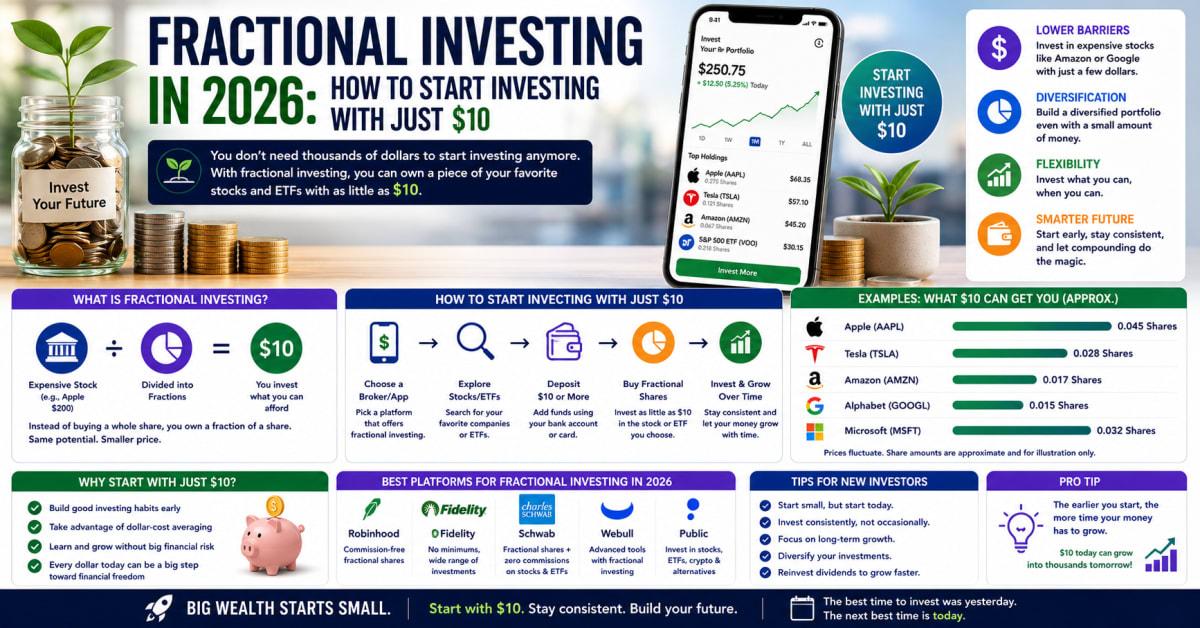
Fractional Investing 2026: Start With Just $10
A single share of Berkshire Hathaway costs close to $500. A single share of some other well-known companies runs even higher. For decades, that price tag alone kept plenty of beginner investors out of the market entirely.
Fractional investing solves that problem directly, letting you buy a slice of an expensive stock for as little as $1 to $10 instead of the full share price. This guide explains exactly how fractional shares work, which platforms handle them best in 2026, and what beginners should know before putting their first small amount of money into the market.
Fractional Investing — What It Is and Why It Matters
Fractional investing lets you buy a portion of a single share rather than requiring you to purchase at least one whole share. Instead of choosing a number of shares, you simply choose a dollar amount, and the platform buys the corresponding fraction of that stock or ETF at the current market price, dividends included.
This matters because it removes one of the biggest historical barriers to diversified investing: needing hundreds or thousands of dollars just to own a single share of a well-known company. Fractional investing makes that same ownership accessible starting with whatever amount you actually have.
Why This Is Important Right Now
Picture someone who wants to start investing with just $50 a month, discouraged because a single share of a stock they're interested in costs several hundred dollars on its own. Fractional investing turns that same $50 into a real, diversified starting position across multiple companies instead of forcing an all-or-nothing choice on a single expensive stock.
Nearly every major brokerage has eliminated commission fees on stock and ETF trades over the past several years, and fractional share support has become a standard, expected feature rather than a rare perk. That combination has made genuinely accessible investing more available than ever for beginners with limited starting capital.
Key Facts About Fractional Investing in 2026
A few core facts explain how fractional investing actually works and what to expect from the leading platforms.
- Minimum investments across top platforms range from $1 to $10 — with brokers like Fidelity, Webull, and Interactive Brokers allowing purchases as low as $1, and eToro setting a $10 minimum.
- Fractional shares earn proportional dividends — if you own a tenth of a share, you receive a tenth of that stock's dividend payout, just as you would with a full share.
- Most major brokers offer commission-free fractional trading — though some, like tastytrade, charge a small clearing fee per fractional trade, often just a few cents.
- Cash-quantity orders simplify the buying process — you specify a dollar amount, like $100, and the platform automatically calculates and purchases the corresponding fraction of a share.
- Fractional share availability varies by broker — some platforms cover thousands of U.S. and international stocks and ETFs, while others limit fractional trading to a narrower list of eligible securities.
What the Industry Data Shows
Industry data suggests that fractional share investing has become a standard, expected feature across nearly every major retail brokerage, reflecting a broader industry shift toward removing barriers for beginner and budget-conscious investors rather than treating fractional access as a premium add-on.
Analysis from brokerage comparison sites has consistently found that platforms combining $0 commissions, low fractional minimums, and broad stock and ETF coverage tend to rank highest for beginners specifically, since these three factors together determine how genuinely accessible a platform is for someone starting with a small amount of money.
Top Platforms for Fractional Investing Compared
Each of these platforms approaches fractional investing slightly differently, so the right fit depends on your specific goals and experience level.
- Fidelity — Offers fractional shares of thousands of U.S. stocks and ETFs starting at just $1, with a well-designed order ticket and a "Basket Portfolios" feature that simplifies building and rebalancing multiple positions at once.
- Charles Schwab — Its Stock Slices program lets you buy fractional shares of individual stocks with a low minimum, appealing to investors who also want access to Schwab's broader research and trading tools.
- Interactive Brokers — Uses cash-quantity orders that let you specify a dollar amount and automatically calculate the corresponding fraction, with fractional access across thousands of eligible U.S. and international stocks and ETFs starting around $1.
- Webull — A commission-free platform with no deposit minimum, supporting fractional investing from as little as $1, along with educational tools and paper trading for beginners still learning the basics.
- eToro — Combines fractional investing with a $10 minimum and a social trading feature that lets you follow and mirror the trades of other investors on the platform, appealing to beginners who want a more social, guided experience.
- Betterment — An automated robo-advisor that invests your money across selected ETFs using fractional shares, ideal for hands-off investors who'd rather not choose individual stocks themselves.
Benefits and Real Opportunities
Fractional investing creates real, practical advantages for anyone starting with limited capital.
- Access to expensive stocks without a large upfront cost — you can own a piece of a high-priced company without needing hundreds of dollars for a single share.
- Easier diversification with small amounts — spreading even $50 or $100 across several fractional positions builds a more diversified starting portfolio than concentrating in one affordable stock alone.
- Full dividend participation — fractional shareholders still receive their proportional share of any dividend payout, just like full shareholders.
- Removes a major psychological barrier to starting — the ability to invest with genuinely small amounts makes it easier to build the habit of investing consistently from day one.
Costs and What to Expect
Most major brokerages now offer commission-free fractional share trading on U.S. stocks and ETFs, meaning your entire investment amount goes toward the purchase rather than being reduced by a trading fee. A small number of platforms, like tastytrade, charge a modest clearing fee per fractional transaction, often just a few cents, which is worth checking if you plan to make frequent small trades.
Minimum investment amounts vary by platform, ranging from $1 at brokers like Fidelity, Webull, and Interactive Brokers, up to $10 at platforms like eToro. Some platforms also require a minimum account balance to access certain premium features or interest on uninvested cash, though the core fractional investing feature itself typically has no separate account minimum beyond the per-trade amount.
Standard investment costs still apply regardless of trade size: any gains are subject to capital gains tax when sold, and fractional shares of dividend-paying stocks generate taxable dividend income just like full shares, so it's worth tracking these small positions for tax purposes the same as any other investment.
Individual Fractional Stocks vs Fractional ETF Shares vs Robo-Advisor Fractional Investing: Which One Is Right for You?
| Option | Best For | Pros | Cons |
|---|---|---|---|
| Individual Fractional Stocks | Beginners who want to own specific, well-known companies | Direct ownership in specific companies you choose yourself | Requires more research and offers less built-in diversification |
| Fractional ETF Shares | Beginners wanting instant diversification in one purchase | Broad exposure to hundreds or thousands of companies in a single fractional share | Less control over which specific companies you're invested in |
| Robo-Advisor Fractional Investing | Hands-off investors who want the process automated | Automatic portfolio building and rebalancing with no manual selection required | Less flexibility to pick individual stocks or specific ETFs yourself |
Who Should Actually Care About Fractional Investing?
This matters for anyone starting to invest with a limited budget, whether that's a student, a young professional, or someone simply testing the waters before committing larger amounts. It's especially useful for anyone who wants exposure to a specific high-priced stock without needing hundreds of dollars, and for anyone building the habit of consistent, small, regular investing before scaling up their contributions over time.
Mistakes Most People Make
A handful of habits can undercut the value fractional investing is designed to provide.
Putting all of a small starting amount into a single fractional stock, rather than spreading it across a few positions or an ETF, recreates the same lack of diversification fractional investing is meant to solve. Spreading even a small amount across multiple holdings captures more of the actual benefit.
Choosing a platform based solely on its minimum investment amount without checking fractional share availability across the specific stocks you're interested in can lead to disappointment if your platform's fractional coverage is narrower than expected. Confirming the specific stocks or ETFs you want are actually eligible for fractional trading avoids that letdown.
Treating a small fractional investment as "not worth tracking" for tax purposes ignores that dividends and any eventual gains from fractional shares are taxed the same as full shares. Keeping records regardless of position size avoids tax season surprises.
Assuming fractional investing removes the risk of a stock declining misunderstands what it actually solves. Fractional shares still carry the same market risk as a full share, just at a smaller dollar amount, so ordinary investment risk still fully applies.
What Most Articles Won't Tell You
Most roundups focus on which broker has the lowest minimum, but the more meaningful comparison is fractional share coverage breadth, since some platforms support fractional trading across thousands of eligible stocks and ETFs while others limit it to a much narrower list.
There's also a detail worth knowing: cash-quantity orders, where you specify a dollar amount rather than a number of shares, make the entire fractional buying process far simpler for beginners than manually calculating what fraction of a share a given dollar amount would purchase.
Advanced Moves Worth Knowing
Automating small, regular fractional investments on a fixed schedule turns fractional investing into a genuine dollar-cost averaging strategy, building a diversified position gradually without requiring a large lump sum upfront.
Using a platform's basket or slice feature, where available, to split a single deposit across several fractional positions at once saves significant time compared to manually purchasing each fractional share individually.
Frequently Asked Questions
Is fractional investing safe for beginners?
It carries the same market risk as buying a full share, just at a smaller dollar amount, so it's not inherently safer or riskier than traditional investing. It does make diversification easier with small amounts, which can help beginners manage risk more effectively.
Do fractional shares pay dividends?
Yes, fractional shareholders receive a proportional share of any dividend payout, just as full shareholders do, based on the exact fraction of the share they own.
Can I sell fractional shares whenever I want?
Generally, yes. Fractional shares can typically be sold the same way as full shares, though it's worth confirming your specific platform's rules, since a small number of brokers may have slightly different processes for fractional trade execution.
What's the difference between fractional shares and buying a whole share?
A whole share represents complete ownership of one unit of stock, while a fractional share represents a portion of one unit, purchased based on a specific dollar amount rather than a whole-number quantity. Both carry the same proportional rights to dividends and price appreciation.
Which broker is best for a complete beginner with only $10 to invest?
Several platforms work well for this, including Fidelity and Webull, which allow investments starting at just $1 with broad fractional share coverage and no account minimum, making them accessible starting points for a first small investment.
The Bottom Line on Fractional Investing in 2026
Fractional investing has genuinely removed one of the biggest historical barriers to getting started in the market: needing hundreds of dollars just to own a single share. With minimums as low as $1 to $10 across nearly every major commission-free broker, the excuse of not having enough money to start no longer holds up the way it once did. Pick a platform with broad fractional coverage, spread even a small amount across a few positions rather than one stock, and let consistency, not the size of your first investment, do the real work over time.
Read Next

Citi's Investment Bank Chief Issues Urgent Warning: Talent Surge Ahead!

Coinbase Collapse: Shocking Revelations Behind the Crypto Selloff
$7 Billion Oil Bets Under Shock Investigation Amid Price Surge!
Whirlpool Stock Plummets Amid Shocking Recession Warning!
CoreWeave Earnings Surprise: Revenue Soars, But Stock Faces Shocking Collapse!