ETF vs Mutual Fund: Which Is Better for Beginners in 2026?
ETFs and mutual funds both pool your money into diversified investments, but the differences in cost, taxes, and ease of use matter a lot for beginners.
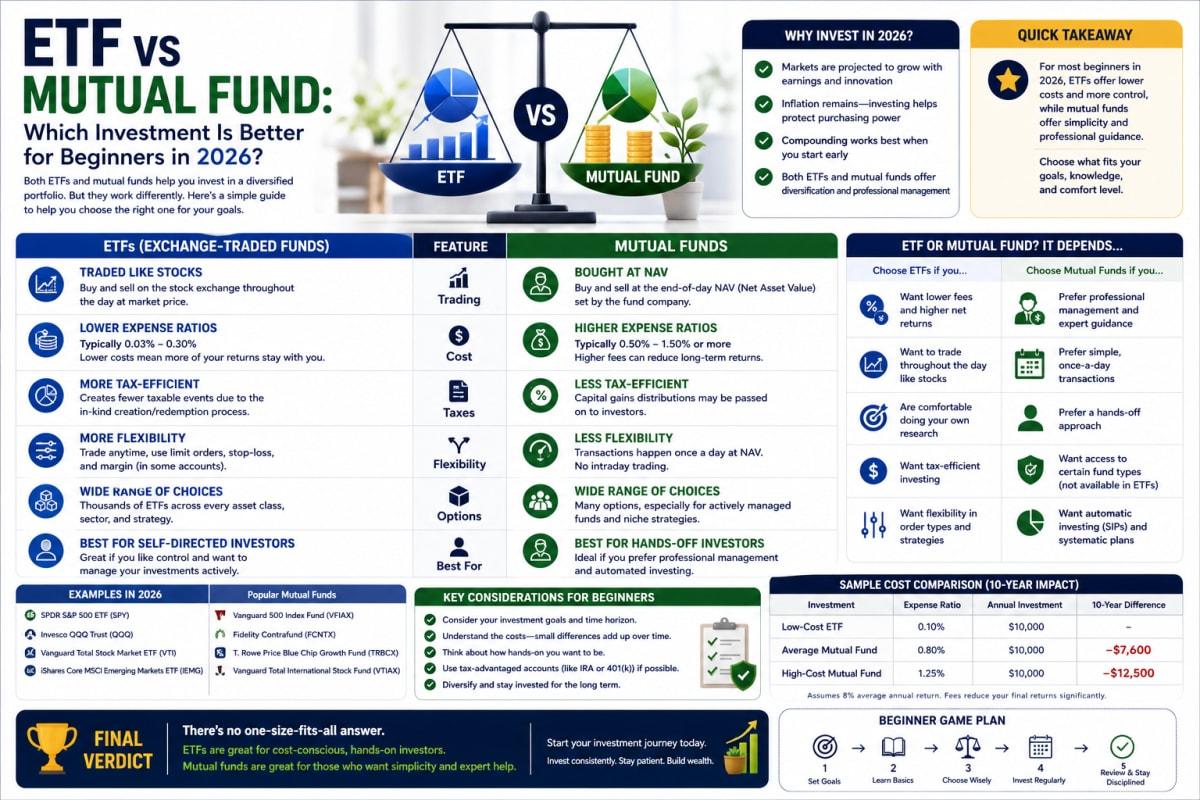
ETF vs Mutual Fund: Which Is Better for Beginners in 2026?
Two people can buy essentially the same basket of stocks, one through an ETF and one through a mutual fund, and end up with meaningfully different costs, tax bills, and flexibility. The wrapper matters more than most beginners realize.
Choosing between an ETF and a mutual fund is one of the first real decisions new investors face, and the right answer depends on your account type, trading habits, and how hands-on you want to be. This guide breaks down exactly how these two investment vehicles differ, where each one wins, and how to decide which fits your situation as a beginner in 2026.
ETF vs Mutual Fund — What They Are and Why the Difference Matters
Both ETFs and mutual funds pool money from many investors to buy a diversified basket of stocks, bonds, or other assets. The core difference is structural: ETFs trade on an exchange throughout the day like a stock, while mutual funds are priced and traded only once daily, after the market closes.
That structural difference cascades into real differences in cost, tax treatment, and minimum investment requirements, which is exactly why the choice matters more than it might seem at first glance.
Why This Is Important Right Now
Picture a new investor who puts $500 into an actively managed mutual fund with a 1% annual expense ratio, versus a comparable ETF charging a fraction of that. Over decades, that seemingly small percentage difference in fees can quietly cost tens of thousands of dollars in lost compound growth.
Investment platforms have made both options more accessible than ever, with many brokers now offering commission-free ETF trades and mutual funds with no minimum investment. That accessibility means the real decision now comes down to structure and cost, not access.
Key Facts About ETFs and Mutual Funds
A few core facts explain why these two investment types behave so differently in practice, even when they hold similar underlying assets.
- ETFs trade throughout the day at fluctuating prices — while mutual funds are only priced once daily at market close.
- ETFs are generally more tax-efficient in taxable accounts — due to their structure, which typically results in fewer taxable capital gains distributions.
- Many mutual funds require a minimum initial investment — often several hundred to a few thousand dollars, while most ETFs can be bought for the price of a single share.
- Passively managed index funds exist in both formats — so low-cost investing isn't exclusive to either ETFs or mutual funds specifically.
- Most major brokers now offer commission-free ETF trades — removing what used to be a meaningful cost disadvantage for frequent ETF investors.
What the Industry Data Shows
Industry data suggests that ETF adoption among individual investors has grown steadily for years, driven largely by lower average expense ratios and the tax efficiency advantages built into the ETF structure. Mutual funds, meanwhile, remain deeply embedded in employer-sponsored retirement plans, where they're often the primary or only option available.
Analysis from outlets like Morningstar and Forbes has repeatedly noted that the average expense ratio gap between passively managed ETFs and actively managed mutual funds remains significant, even as fees across both categories have trended downward industry-wide over the past decade.
Benefits and Real Opportunities
Understanding these differences upfront helps beginners avoid an expensive mismatch between their investment vehicle and their actual goals.
- Lower ongoing costs — many ETFs, especially passive index-tracking ones, carry meaningfully lower expense ratios than comparable mutual funds.
- Greater tax efficiency — ETFs generally distribute fewer unexpected capital gains, which matters most in taxable brokerage accounts.
- Lower barrier to entry — ETFs let you start investing with the price of a single share instead of a large minimum deposit.
- Automatic investing convenience with mutual funds — many retirement plans and robo-advisors use mutual funds specifically because they support automatic, fractional recurring investments smoothly.
Costs and What to Expect
Passively managed ETFs often carry some of the lowest expense ratios available, frequently well under 0.10% annually for broad market index funds. Actively managed mutual funds, by contrast, commonly charge annual expense ratios in the range of 0.5% to 1% or more, reflecting the cost of professional fund management.
Mutual funds sometimes carry additional costs beyond the expense ratio, including sales loads charged when you buy or sell shares, though many no-load funds avoid this entirely. Trading ETFs may involve a small bid-ask spread, the tiny gap between buying and selling price, which is generally negligible for highly liquid, popular ETFs but can matter more for thinly traded ones.
Both investment types can trigger capital gains tax when sold at a profit in a taxable account, though ETFs typically generate fewer unexpected taxable distributions along the way compared to actively managed mutual funds.
ETFs vs Actively Managed Mutual Funds vs Index Mutual Funds: Which One Is Right for You?
| Option | Best For | Pros | Cons |
|---|---|---|---|
| ETFs | Beginners investing in a taxable brokerage account | Low costs, strong tax efficiency, and no large minimum investment | Requires a brokerage account and basic understanding of trading |
| Actively Managed Mutual Funds | Investors seeking professional stock selection and willing to pay for it | Professional management with the potential to outperform a benchmark | Higher fees and no guarantee of beating a comparable index fund |
| Index Mutual Funds | Beginners investing through an employer retirement plan | Low-cost passive investing with easy automatic recurring contributions | May require a minimum initial investment outside of a retirement plan |
Who Should Actually Care About This ETF vs Mutual Fund Decision?
This matters for anyone starting to invest for the first time, whether through a taxable brokerage account or a workplace retirement plan. It's especially relevant for beginners with a smaller starting amount, since ETFs typically require far less money to begin, and for anyone focused on minimizing fees over a long investment horizon.
Mistakes Most People Make
A handful of common errors trip up beginners choosing between these two investment types.
Assuming all mutual funds are expensive and all ETFs are cheap overlooks that low-cost index mutual funds exist too, and some actively managed ETFs carry high fees. Checking the actual expense ratio, not just the fund type, avoids this generalization.
Ignoring tax location entirely can lead to holding tax-inefficient mutual funds in a taxable account when they'd fit better inside a tax-advantaged retirement account. Matching fund type to account type reduces unnecessary tax drag.
Trading ETFs frequently like individual stocks, rather than buying and holding for the long term, can rack up costs and undermine the simplicity that made the ETF appealing in the first place. Treating ETFs as long-term holdings, not trading vehicles, usually serves beginners better.
Overlooking sales loads on certain mutual funds can quietly reduce your invested amount before it even starts growing. Confirming a fund is no-load before investing avoids that unnecessary cost.
What Most Articles Won't Tell You
Most comparisons focus purely on cost, but the practical reality for many beginners is dictated by their retirement plan's fund lineup. If your 401(k) only offers mutual funds, the ETF-versus-mutual-fund debate becomes largely academic for that specific account, even if you prefer ETFs elsewhere.
There's also a detail often missed: dollar-cost averaging, investing a fixed amount on a regular schedule, works more smoothly with mutual funds in some platforms, since they support fractional share purchases natively, while ETF fractional share support varies by broker.
Advanced Moves Worth Knowing
Using ETFs for your taxable brokerage account while relying on your employer's mutual fund lineup for retirement contributions lets you optimize each account for its specific tax treatment without needing to reconcile the two.
Checking whether your broker supports fractional ETF shares can remove one of the last practical advantages mutual funds held over ETFs for beginners investing smaller, irregular amounts.
Frequently Asked Questions
Are ETFs really cheaper than mutual funds?
Often, yes, particularly when comparing passively managed ETFs to actively managed mutual funds. But low-cost index mutual funds can match ETF fees closely, so it's worth comparing the specific expense ratio rather than assuming based on fund type alone.
Can beginners buy ETFs and mutual funds with a small amount of money?
Yes, generally more easily with ETFs, since many can be purchased for the price of a single share, and fractional share investing has expanded this further. Mutual funds sometimes require a minimum initial investment, though many no-minimum options exist too.
Which is better for a retirement account, an ETF or a mutual fund?
Inside a tax-advantaged retirement account, the tax efficiency advantage of ETFs matters less, since gains aren't taxed annually either way. The better choice often comes down to what your specific plan offers and the fees of the funds available.
Do ETFs and mutual funds carry the same investment risk?
The underlying investment risk depends on what the fund actually holds, not whether it's structured as an ETF or a mutual fund. A stock-heavy fund carries similar risk in either format, so it's the holdings that matter most, not the wrapper.
Is it better to choose actively managed or passively managed funds as a beginner?
Many beginners start with passively managed index funds, available in both ETF and mutual fund form, due to their lower costs and simplicity. Actively managed funds can make sense for specific strategies but carry higher fees with no guarantee of outperforming a comparable index.
The Bottom Line on ETFs vs Mutual Funds for Beginners
There's no universal winner between ETFs and mutual funds. For most beginners investing through a taxable brokerage account, ETFs typically offer a lower-cost, more tax-efficient starting point. For retirement accounts, the right choice often depends on what your specific plan actually offers. Focus less on the fund wrapper and more on the expense ratio, tax treatment, and whether the fund matches your actual investment goals. Get those fundamentals right, and the ETF-versus-mutual-fund debate becomes far less important than it first appears.
Read Next
AI Crisis: NVDA, MSFT, GOOGL Stocks at Risk Amid Data Center Backlash!

Micron Stock Soars Amid Chip Crisis as Samsung Talks Collapse!

OpenAI Surges Ahead in AI IPO Race: Will They Dominate the Market?

Nvidia Stock Surges: What Shocking Revelations Will CEO Huang Unveil?
Stock Market Shrugs Off Trump’s Iran Talk—What’s the Hidden Danger?