Dollar-Cost Averaging vs Lump Sum: Which Wins in 2026?
Research consistently shows lump sum investing wins more often, but dollar-cost averaging still has a real place. Here's how to decide which fits you.
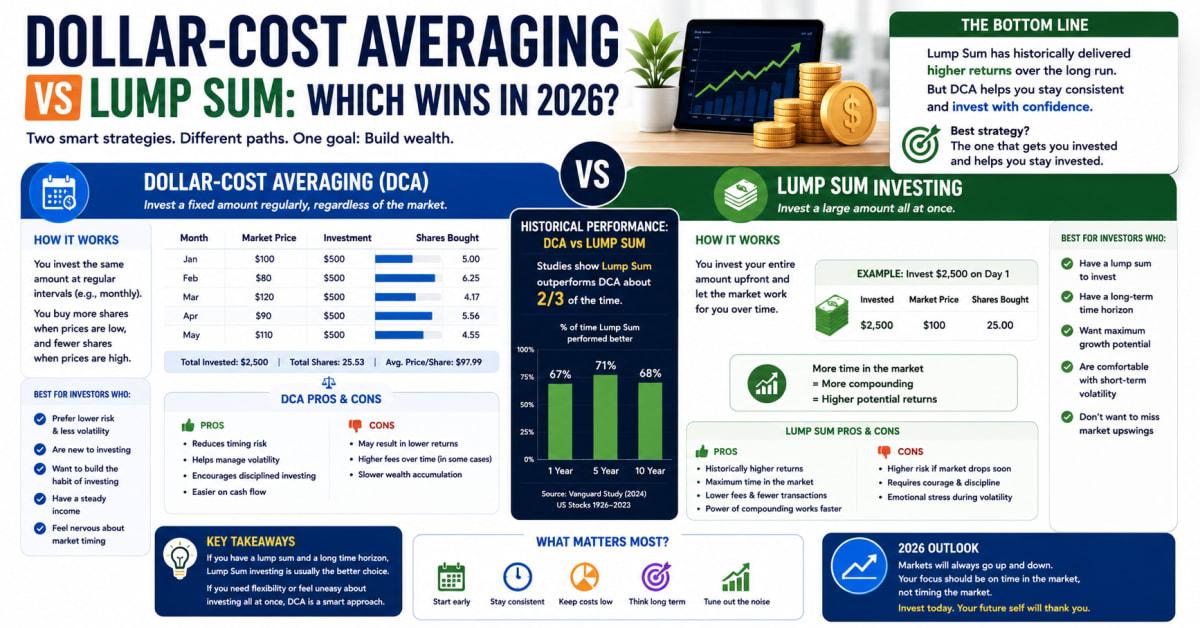
Dollar-Cost Averaging vs Lump Sum: Which Wins in 2026?
You just received a windfall, an inheritance, a bonus, or a settlement, and now you're staring at two very different ways to invest it. One feels safer. The other has math on its side most of the time.
Deciding between dollar-cost averaging and lump sum investing isn't just a technical question. It's as much about your psychology as it is about historical returns. This guide breaks down what the research actually shows, where each strategy genuinely wins, and how to decide which approach fits your specific situation in 2026.
Dollar-Cost Averaging vs Lump Sum — What They Are and Why the Choice Matters
Lump sum investing means putting all your available money into the market at once. Dollar-cost averaging means splitting that same amount into smaller, regular investments spread out over weeks or months instead. Both approaches assume you already have the money on hand, which is what separates this decision from the regular paycheck-to-paycheck investing most people already do automatically.
This choice matters because it directly affects both your expected long-term returns and how much anxiety you'll feel watching the market in the weeks after you invest.
Why This Is Important Right Now
Picture someone who receives a $50,000 inheritance and, worried about investing it all right before a downturn, spreads it out over twelve months instead. If the market rises steadily during that period, as it does more often than not, that caution quietly costs real money in missed growth on the uninvested portion.
Markets have experienced real volatility in recent years, which makes the psychological pull toward dollar-cost averaging stronger than usual. Understanding what the actual data shows, rather than just what feels safer, helps you make a more informed decision regardless of current market conditions.
Key Facts About Dollar-Cost Averaging vs Lump Sum Investing
A few core facts from long-running investment research shape how this decision should actually be made.
- Lump sum investing has historically outperformed dollar-cost averaging in roughly two-thirds of rolling time periods studied — largely because markets trend upward over time more often than they decline.
- The advantage comes from time in the market, not timing the market — money invested immediately has more time to compound than money sitting in cash waiting to be phased in.
- Dollar-cost averaging reduces regret risk, not just financial risk — spreading out purchases limits the emotional impact of investing everything right before a sharp downturn.
- The strategy you already use for retirement contributions is technically dollar-cost averaging — since regular paycheck contributions are invested on a fixed schedule regardless of price.
- Neither strategy eliminates risk entirely — both remain subject to overall market performance over your specific holding period.
What the Industry Data Shows
Industry data suggests that research from major asset managers analyzing historical market returns has repeatedly found that lump sum investing produces higher average returns than phased-in dollar-cost averaging across most multi-decade periods studied, largely reflecting the general upward drift of markets over long stretches of time.
That said, financial researchers and outlets like Morningstar have also noted that the outperformance of lump sum investing tends to shrink, and dollar-cost averaging's psychological benefits tend to grow, during periods of heightened market volatility or when an investor is genuinely new to investing and prone to panic-selling.
Benefits and Real Opportunities
Understanding both strategies clearly, rather than defaulting to whichever feels emotionally safer, helps you make a more deliberate investing decision.
- Lump sum investing maximizes time in the market — getting your full amount invested immediately captures more potential growth over your investing horizon.
- Dollar-cost averaging reduces short-term regret — spreading purchases smooths out the price you pay and softens the emotional sting of a sudden downturn right after investing.
- Either approach beats sitting entirely in cash — both strategies put your money to work instead of losing value to inflation while waiting for a "better" time.
- A hybrid approach offers flexibility — splitting a windfall between immediate investment and a shorter phase-in period can balance both the math and the emotional comfort.
Costs and What to Expect
Neither strategy carries a direct fee by itself, since most major brokers now offer commission-free trades on stocks and ETFs. The real "cost" difference comes from opportunity cost: money held in cash while dollar-cost averaging phases in typically earns little beyond a savings account rate, while that same money invested immediately has the chance to grow at market returns instead.
If you're investing in a taxable account, both strategies can trigger similar tax treatment on any eventual gains, based on how long you hold the investment, not how you phased in your initial purchase. Frequent small purchases under a dollar-cost averaging plan may generate slightly more transaction records to track for tax purposes, though this is a minor administrative consideration rather than a real cost difference.
Choosing a hybrid approach, like investing half immediately and phasing in the rest over three to six months, doesn't add meaningful cost beyond the same commission-free trades either full strategy would involve.
Full Lump Sum vs Dollar-Cost Averaging vs Hybrid Approach: Which One Is Right for You?
| Option | Best For | Pros | Cons |
|---|---|---|---|
| Full Lump Sum | Investors comfortable with short-term volatility and a long time horizon | Historically higher average returns in most market periods studied | Full exposure to a downturn immediately after investing |
| Dollar-Cost Averaging | Cautious investors or those new to investing large amounts | Reduces regret risk and smooths out your average purchase price | Historically lower average returns in most periods studied |
| Hybrid Approach | Investors wanting a balance between growth potential and peace of mind | Captures some immediate market exposure while easing in the rest | Slightly more complex to plan and track than a single lump sum |
Who Should Actually Care About This Decision?
This matters for anyone who's received a windfall, an inheritance, a large bonus, or proceeds from selling an asset, and needs to decide how to invest it. It's especially relevant for first-time large-sum investors who haven't experienced a significant market downturn yet, since their true risk tolerance is often untested until they actually live through one.
Mistakes Most People Make
A handful of errors show up repeatedly in this decision.
Choosing dollar-cost averaging purely out of fear, without acknowledging the historical performance gap, can leave meaningful returns on the table over a long time horizon. Being honest about whether the choice is driven by data or by anxiety helps clarify the real tradeoff.
Choosing a full lump sum without genuinely testing your own risk tolerance can backfire emotionally if a downturn hits right after investing, potentially leading to panic-selling at the worst possible time. Being realistic about your own behavior under stress matters as much as the math.
Phasing in a windfall over an excessively long period, like several years instead of several months, leaves too much money out of the market for too long, eroding much of dollar-cost averaging's intended benefit.
Treating this decision as permanent rather than revisiting it if your circumstances or risk tolerance shift can lock you into an approach that no longer fits your actual situation.
What Most Articles Won't Tell You
Most comparisons cite the historical performance gap but skip explaining why it exists: markets rise more often than they fall over most multi-year stretches, so any strategy that delays full investment misses out on that upward drift more often than it avoids a downturn.
There's also a detail worth knowing: the psychological research on regret aversion suggests investors feel the pain of a lump sum loss more intensely than the pain of a missed gain from dollar-cost averaging, even when the dollar amounts are identical. That asymmetry is exactly why dollar-cost averaging remains popular despite the data favoring lump sum investing.
Advanced Moves Worth Knowing
Splitting a windfall into a lump sum for a core, long-term portion and a shorter dollar-cost averaging phase-in for the remainder lets you capture most of the statistical advantage of investing immediately while still managing genuine anxiety about timing.
Setting a fixed, short phase-in window, like three to six months rather than a full year, if you do choose dollar-cost averaging, limits how much of the historical performance gap you're likely to give up compared to investing immediately.
Frequently Asked Questions
Does dollar-cost averaging guarantee a lower average purchase price?
Not necessarily. It can lower your average price if the market declines during your phase-in period, but it can also mean paying more on average if the market rises steadily, which happens more often historically.
Is dollar-cost averaging the same as regular 401(k) contributions?
Functionally, yes. Investing a fixed amount on a regular schedule, like each paycheck, is a form of dollar-cost averaging, even though most people don't think of their retirement contributions that way.
Why does lump sum investing outperform dollar-cost averaging more often?
Because markets tend to rise over most multi-year periods, money invested immediately spends more time exposed to that general upward trend than money held back and phased in gradually.
Is it ever better to dollar-cost average even if lump sum historically wins?
Yes, particularly if the emotional risk of a lump sum loss would genuinely lead you to panic-sell during a downturn. A strategy you can actually stick with often outperforms a theoretically better one you abandon under stress.
How long should a dollar-cost averaging phase-in period last?
Shorter phase-in periods, often three to six months, tend to balance the psychological benefit against giving up too much of the historical performance advantage that comes with investing sooner.
The Bottom Line on Dollar-Cost Averaging vs Lump Sum Investing in 2026
The data leans clearly toward lump sum investing for long-term returns, but the best strategy is still the one you can actually follow through a real market downturn without panic. If you have a long time horizon and genuine comfort with volatility, investing your full amount immediately gives you the strongest statistical edge. If the anxiety of a lump sum investment would keep you up at night, a shorter dollar-cost averaging window, or a hybrid split between the two, still gets your money working far better than leaving it in cash indefinitely.
Read Next

Citi's Investment Bank Chief Issues Urgent Warning: Talent Surge Ahead!

Coinbase Collapse: Shocking Revelations Behind the Crypto Selloff

$7 Billion Oil Bets Under Shock Investigation Amid Price Surge!
Whirlpool Stock Plummets Amid Shocking Recession Warning!
CoreWeave Earnings Surprise: Revenue Soars, But Stock Faces Shocking Collapse!