Dividend vs Growth Investing: Which Wins in 2026?
High-yield dividend ETFs are beating growth-oriented ones so far in 2026, but that's not the whole story. Here's an honest breakdown of which strategy actually fits your goals.
Dividend vs Growth Investing: Which Wins in 2026?
So far in 2026, the Vanguard High Dividend Yield ETF has delivered a 13.19% year-to-date return, comfortably ahead of the Vanguard Dividend Appreciation ETF's 8.70%. That gap sounds like a clear answer, until you realize it's measuring two different dividend strategies against each other, not dividends versus growth at all.
Dividend investing versus growth investing is one of the oldest debates in personal finance, and 2026's numbers add a genuinely interesting wrinkle rather than settling anything. This guide breaks down what each strategy is actually built to do, walks through two real-style case studies, and includes a calculator so you can see the actual numbers for your own situation instead of taking anyone's word for it.
Dividend Investing vs Growth Investing — What They Are and Why the Comparison Gets Oversimplified
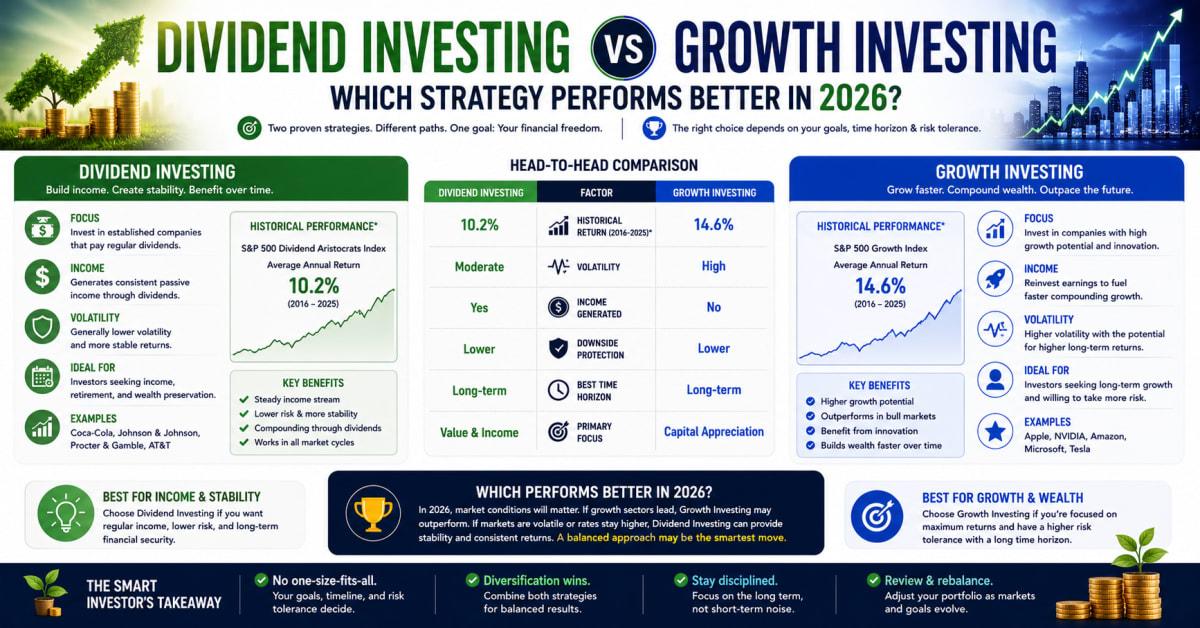
Dividend investing focuses on companies that pay regular cash distributions to shareholders, typically mature, stable businesses with steady cash flow. Growth investing focuses on companies reinvesting most or all of their profits back into the business to fuel expansion, usually paying little or no dividend at all, with returns coming primarily from share price appreciation.
This comparison gets oversimplified because it's often framed as a single head-to-head contest, when in reality dividend investing itself splits into meaningfully different sub-strategies, high-yield versus dividend growth, that can perform very differently from each other in the same year.
Why This Is Important Right Now
Picture an investor who sees a headline citing dividend ETFs outperforming in 2026 and assumes "dividends beat growth" as a blanket rule, without realizing the actual comparison was between two different dividend strategies, high current yield versus steady dividend growth, not dividends against growth stocks at all.
With markets navigating real volatility in early 2026, dividend growth strategies have drawn renewed attention as a potential inflation hedge and stability play, while growth stocks remain more dependent on continued strong earnings expectations and investor sentiment.
2026 Year-to-Date Performance at a Glance
Here's how the two leading dividend strategy ETFs actually compare this year, shown as a simple visual so the gap is easy to see at a glance.
Year-to-date total return, 2026. Bar length scaled to VYM's return. Past performance doesn't predict future results.
Key Facts About Dividend vs Growth Investing in 2026
A few core facts explain what the current data actually shows and where the common oversimplifications creep in.
- High-yield dividend ETFs are outperforming dividend growth ETFs so far in 2026 — with VYM returning 13.19% year-to-date versus 8.70% for VIG.
- Dividend growth stocks have historically delivered stronger long-term risk-adjusted returns than high-yield stocks — with lower volatility over long measurement periods, even when high-yield strategies win in shorter windows.
- A high dividend yield can signal slower future growth — companies offering unusually high current yields sometimes sacrifice future capital appreciation or carry higher business risk.
- Dividend-paying and dividend-growing companies have historically shown lower volatility than non-payers — based on long-term studies comparing dividend growers, maintainers, and non-payers across full market cycles.
- Growth investing has historically delivered stronger pure long-term capital appreciation — though typically with meaningfully higher volatility along the way compared to dividend-focused approaches.
What the Industry Data Shows
Industry data suggests that nearly 13 years of live results across major dividend-focused ETFs reveal genuinely different underlying portfolios and risk profiles, even among funds sharing the same general "dividend" label, underscoring that not all dividend strategies are interchangeable.
Analysis from asset managers studying performance across different interest rate environments has found that dividend growth stocks and high dividend yield stocks tend to lead in different rate regimes, with dividend growth often performing more consistently across both rising and falling rate periods.
Two Investors, Two Strategies: A Case Study
To make this concrete, here's how two hypothetical investors with the same $50,000 starting balance might approach 2026 very differently, based on their actual goals.
Case Study 1: Maria, age 61, retiring next year. Maria shifted her portfolio toward dividend-paying stocks five years ago specifically for the income. In 2026, her mix of dividend growth and moderate-yield holdings generates roughly $2,600 a year in cash distributions on her $50,000 balance, money she can use to supplement Social Security without selling a single share. She accepted a lower growth ceiling in exchange for predictable income and historically lower volatility heading into retirement.
Case Study 2: Devon, age 29, investing for a goal 30 years out. Devon put the same $50,000 into a growth-oriented index fund instead. He earns no meaningful dividend income today, but he doesn't need it. His entire strategy depends on compounding capital appreciation over three decades, and he's comfortable with the sharper short-term swings that come with it, since he won't touch the money for decades.
Neither investor is "right" or "wrong." Maria optimized for income and stability because her timeline demanded it. Devon optimized for growth because his timeline allowed him to ride out volatility. The strategy matched the goal, not a headline about which ETF won this year.
Step-by-Step: How to Decide Which Strategy Fits You
Use this sequence to figure out where you actually land, rather than picking a side based on a single year's performance.
Step 1: Define your time horizon. Money you'll need within 5 years behaves very differently than money you won't touch for 20 or 30 years. Growth investing generally needs a longer runway to smooth out its volatility.
Step 2: Decide if you need current income. If you're retired or semi-retired and want cash flow without selling shares, dividend-focused holdings, especially dividend growth stocks, are built for exactly that.
Step 3: Check your volatility tolerance honestly. Growth stocks can swing harder in both directions. If a 20% drawdown would genuinely change your behavior, like panic-selling, a more dividend-heavy allocation may suit you better regardless of your age.
Step 4: Look at the sub-strategy, not just the label. If you're leaning dividend, decide whether you want maximum current yield or steadier dividend growth, since these behave differently, as 2026's numbers show.
Step 5: Consider a blend rather than an all-or-nothing choice. Most experienced investors hold both dividend and growth positions, adjusting the ratio as their timeline and income needs shift over the years.
Try It Yourself: Dividend vs Growth Calculator
Enter your own numbers below to see a simplified projection of how each strategy might grow over time. This is a simple illustrative model, not a guarantee of future returns.
Benefits and Real Opportunities
Each strategy offers genuine, distinct advantages depending on what an investor actually needs from their portfolio.
- Dividend investing provides tangible current income — regular cash distributions that can be spent or reinvested, useful for retirees or anyone wanting cash flow now.
- Dividend growth stocks have historically offered lower volatility — providing more stability during market drawdowns than high-growth, non-dividend-paying companies.
- Growth investing offers the strongest pure capital appreciation potential — appealing to investors with a long time horizon who don't need current income and can tolerate more volatility.
- Blending both strategies can capture complementary benefits — income and stability from dividends alongside appreciation potential from growth holdings, rather than sacrificing one for the other entirely.
Costs and What to Expect
Both strategies can be implemented through individual stocks or low-cost ETFs, with most major dividend and growth-focused ETFs now carrying expense ratios well under 0.20% annually, though actively managed dividend or growth funds can charge meaningfully more, sometimes exceeding 0.50% to 1%. Trading either type of stock or ETF is typically commission-free at major brokers.
Dividend income is taxed differently depending on whether it's qualified or ordinary, with qualified dividends generally taxed at lower long-term capital gains rates and ordinary dividends taxed as regular income. Growth stock gains are only taxed when sold, meaning you have more control over timing that tax event compared to dividend income, which is taxable each year it's received regardless of whether you reinvest it.
The less obvious cost with growth investing is volatility itself: since these stocks depend heavily on continued strong earnings expectations, a disappointing earnings report or shift in investor sentiment can trigger sharper price swings than a typical dividend-paying company would experience.
High-Yield Dividend Investing vs Dividend Growth Investing vs Pure Growth Investing: Which One Is Right for You?
| Option | Best For | Pros | Cons |
|---|---|---|---|
| High-Yield Dividend Investing | Investors prioritizing maximum current income | Higher immediate cash yield for spending or reinvesting | A high yield can signal slower future growth or added business risk |
| Dividend Growth Investing | Investors wanting a growing income stream with historically lower volatility | Historically strong risk-adjusted returns and steady payout growth over time | Typically offers a lower current yield than high-yield alternatives |
| Pure Growth Investing | Investors with a long time horizon who don't need current income | Strongest historical potential for pure long-term capital appreciation | Typically higher volatility and no current income along the way |
Who Should Actually Care About This Comparison?
This matters for retirees or near-retirees prioritizing current income and stability, younger investors with a long time horizon weighing how much volatility they can comfortably tolerate, and anyone building a portfolio who's currently choosing between these strategies based on an oversimplified "one wins" headline rather than their actual financial goals.
Mistakes Most People Make
A handful of habits lead investors to a mismatched strategy or a misunderstanding of the current data.
Assuming this year's dividend ETF performance settles the broader dividend-versus-growth debate overlooks that the comparison being cited is actually between two different dividend sub-strategies, high yield and dividend growth, not dividends against growth stocks at all.
Chasing the highest current dividend yield without checking the underlying company's growth trajectory can mean sacrificing future capital appreciation for current income that may not be sustainable long term.
Treating "growth investing always wins long term" as a universal rule ignores that dividend growth stocks have historically delivered strong risk-adjusted returns with meaningfully lower volatility, a genuinely competitive outcome once risk is factored in, not just raw return.
Picking one strategy permanently rather than blending both misses that most experienced investors combine dividend and growth holdings specifically to capture income, stability, and appreciation potential together, much like Maria and Devon in the case studies above chose the approach that matched their actual timeline.
What Most Articles Won't Tell You
Most comparisons frame this as dividends versus growth, but the more useful, nuanced comparison is often high dividend yield versus dividend growth within the dividend category itself, since these two sub-strategies can perform very differently depending on interest rate conditions and market sentiment.
There's also a detail worth knowing: dividend growth and high dividend yield strategies have historically tended to lead in different interest rate environments, with dividend growth often showing more consistent performance across both rising and falling rate periods, which matters more for long-term planning than a single year's snapshot.
Advanced Moves Worth Knowing
Blending dividend growth holdings with a portion of pure growth stocks lets you capture historically lower volatility and rising income from the dividend side while still participating in stronger capital appreciation potential from the growth side.
Reviewing whether a dividend ETF you're considering is built around high current yield or dividend growth, rather than assuming all dividend funds behave similarly, ensures the fund actually matches your specific income or stability goal.
Frequently Asked Questions
Is dividend investing safer than growth investing?
Historically, dividend-paying and dividend-growing companies have shown lower volatility than non-payers, though "safer" is relative, since dividend stocks still carry market risk and can decline in value like any equity investment.
Do dividend ETFs really beat growth ETFs in 2026?
The most commonly cited 2026 comparison is actually between two dividend sub-strategies, high-yield and dividend growth, not dividends against growth stocks broadly. High-yield dividend ETFs have outperformed dividend growth ETFs so far this year specifically.
Should I choose dividend growth or high-yield dividend stocks?
It depends on your goal. High-yield stocks offer more current income, while dividend growth stocks have historically delivered stronger long-term risk-adjusted returns with more consistent performance across different interest rate environments.
Can I combine dividend investing and growth investing in one portfolio?
Yes, and many experienced investors do exactly that, blending both strategies to capture income and stability from dividend holdings alongside stronger appreciation potential from growth stocks, similar to a hybrid version of the two case studies above.
Is a high dividend yield always a good sign?
Not necessarily. An unusually high yield can sometimes signal slower future growth, a declining share price, or added business risk, rather than simply representing a better investment than a lower-yielding alternative.
The Bottom Line on Dividend vs Growth Investing in 2026
Dividend investing and growth investing aren't really competing in the same event, and this year's data, showing high-yield dividend ETFs outperforming dividend growth ETFs, actually illustrates that dividend investing itself isn't a single, uniform strategy. Growth investing still offers the strongest historical potential for pure capital appreciation, while dividend growth stocks have historically delivered competitive risk-adjusted returns with more stability. Use the calculator above to run your own numbers, think about which case study, Maria's or Devon's, sounds more like your situation, and build a blended portfolio around your actual goals instead of chasing whichever strategy won last year's headline comparison.
Read Next

Stock Futures Shock as U.S.-Iran Conflict Intensifies; Chip Stocks Collapse!

Shocking SpaceX IPO: How It Could Impact Tesla's Future!
Warning: Michael Burry Reveals Stocks May Face Major Collapse!

S&P 500 Soars as Trump Warns of Iran Crisis Cease-Fire
Shock Wave: Dow Dips, Micron Surges Amid Trump's Iran Deal Rejection