Crypto Tax Reporting in 2026: What Changed With 1099-DA
The IRS now gets a copy of your crypto trades directly from exchanges. Here's what Form 1099-DA actually reports, where the gaps are, and how to avoid a mismatch notice.
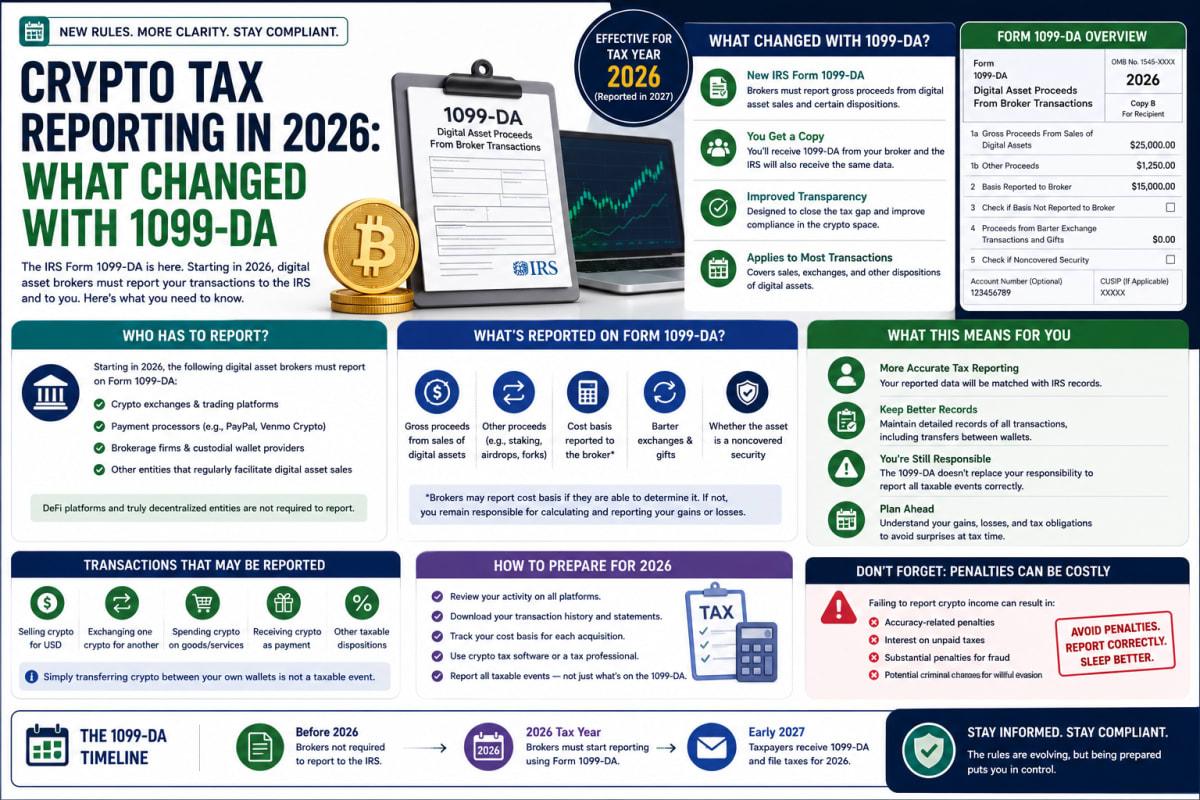
Crypto Tax Reporting in 2026: What Changed With 1099-DA
For years, crypto tax reporting ran almost entirely on the honor system. That changed in 2026, and the IRS now receives a copy of your trading activity at the same time you do.
Crypto tax reporting in 2026 centers on a new form called 1099-DA, which standardizes how exchanges report your digital asset sales to the IRS. This guide breaks down what the form actually covers, where the gaps still exist, and the mistakes that could trigger an automated mismatch notice if you're not careful this filing season.
Crypto Tax Reporting in 2026 — What It Is and Why It Matters
Crypto tax reporting in 2026 refers to the new IRS framework built around Form 1099-DA, which requires centralized exchanges and other digital asset brokers to report gross proceeds from your sales, exchanges, and dispositions directly to the IRS. It's the crypto equivalent of the 1099-B form long used for stock sales.
This matters because it fundamentally changes the risk of underreporting. The IRS now has a direct data feed from your exchange, so any gap between what you file and what your broker reports is far more likely to be caught automatically than it was in previous years.
Why This Is Important Right Now
Picture an investor who bought Bitcoin on a hardware wallet years ago, later moved it to an exchange, and sold it. That exchange often has no record of the original purchase price, so it may report the entire sale as if it were pure profit with a zero cost basis, unless the investor corrects that manually.
This filing season is the first time this standardized reporting is in effect, which means both taxpayers and exchanges are still working through implementation issues. Getting ahead of the gaps now avoids a scramble, or worse, an audit notice later.
Key Facts About Crypto Tax Reporting in 2026
A few core facts define how this new system actually works and where taxpayers still carry the reporting burden themselves.
- Form 1099-DA reports gross proceeds from broker transactions — covering sales, exchanges, and dispositions of crypto, stablecoins, and NFTs through centralized platforms.
- Cost basis reporting is not yet required for 2025 transactions — brokers generally don't have to report what you originally paid, so you may need to calculate that yourself.
- Cost basis tracking is now required per wallet, not pooled — the IRS eliminated the universal method that let taxpayers treat holdings across multiple wallets as one combined pool.
- A digital asset question now appears directly on Form 1040 — and it cross-references data the IRS already has from broker reporting.
- Receiving a 1099-DA doesn't mean you owe tax — proceeds are only taxable to the extent they represent a gain above your cost basis.
What the Industry Data Shows
Industry data suggests that a large majority of US taxpayers now need to answer the digital asset question on their federal return, reflecting just how widespread crypto activity has become even among people who don't consider themselves active traders.
Tax professionals writing in outlets covering this rollout have flagged that first-year implementation carries real risk, particularly for anyone who's moved assets between exchanges or self-custody wallets, since receiving platforms often can't verify the original purchase price and may report an inflated gain by default.
Benefits and Real Opportunities
Despite the added complexity, standardized reporting does create some real advantages for taxpayers who stay organized.
- More consistent documentation — a standardized form makes it easier to compile records compared to the inconsistent statements exchanges issued in past years.
- Reduced risk of accidental underreporting — having a broker-issued form as a reference point helps catch transactions you might otherwise forget.
- Clearer audit trail if disputes arise — standardized reporting gives both you and the IRS the same starting reference point for any discrepancy.
- Growing software support — crypto tax tools have matured alongside this transition, making reconciliation across multiple platforms more manageable than it used to be.
Costs and What to Expect
There's no direct filing fee tied to Form 1099-DA itself, but the real cost shows up in the time and, in some cases, professional fees needed to reconcile broker-reported figures against your own records. Crypto tax software typically ranges from modest annual subscription costs for basic tracking up to higher tiers for high-volume traders or DeFi activity.
If discrepancies trigger an IRS notice, working with a tax professional experienced in digital assets can involve meaningfully higher costs than routine tax prep, especially if forensic reconstruction of historical transactions is needed. Amended returns, if a corrected 1099-DA arrives after you've already filed, can also add complexity and potential preparer fees.
Capital gains tax itself depends on your income bracket and how long you held the asset, with long-term holdings generally taxed at more favorable rates than short-term gains.
Manual Tracking vs Crypto Tax Software vs Professional Reconciliation: Which One Is Right for You?
| Option | Best For | Pros | Cons |
|---|---|---|---|
| Manual Tracking | Investors with very few transactions on a single platform | No software cost and full control over your own records | Time-consuming and error-prone once activity spans multiple wallets |
| Crypto Tax Software | Investors with moderate to high transaction volume across platforms | Automates matching across exchanges and wallets, saving significant time | Subscription cost and still requires review for accuracy |
| Professional Reconciliation | High-volume traders, DeFi users, or anyone facing an IRS notice | Expert handling of complex cost basis gaps and audit defense | Highest cost of the three options, especially for forensic work |
Who Should Actually Care About Crypto Tax Reporting in 2026?
This matters for anyone who bought, sold, traded, or earned crypto in the past year, even casually. It's especially important for investors who've moved assets between multiple exchanges or self-custody wallets, since those transfers are exactly where cost basis gaps tend to appear. High-volume traders and DeFi participants face the most complexity, since much of that activity isn't captured by broker reporting at all.
Mistakes Most People Make
A handful of errors show up constantly during this first year of standardized reporting.
Assuming the 1099-DA is complete and accurate leads people to file based on a number that may be missing cost basis entirely. Cross-checking the form against your own transaction history before filing catches this early.
Ignoring wallet-to-wallet transfers because "nothing was sold" overlooks that the receiving platform often can't verify your original purchase price, which can inflate your reported gain if left uncorrected. Keeping your own acquisition records, independent of any single exchange, prevents this problem.
Answering the digital asset question on Form 1040 incorrectly, even for simple holding with no sales, can create confusion during IRS matching. Reading the exact question wording carefully avoids an unnecessary red flag.
Waiting until the deadline to reconcile multiple platforms leaves little time to fix cost basis gaps properly. Starting reconciliation as soon as your 1099-DA forms arrive gives you room to correct errors before filing.
What Most Articles Won't Tell You
Most coverage focuses on the existence of the new form, but the real risk sits in the reconciliation trap: since the IRS receives the same 1099-DA you do, any mismatch between your return and the broker's figures can trigger an automated inquiry, even when the broker's number, not yours, was wrong.
There's also a detail worth knowing: brokers have been granted transition relief that allows some to issue corrected or late 1099-DA forms up to a year after the original deadline. That means you could receive a form for a prior year's transaction well after you've already filed, potentially requiring an amended return.
Advanced Moves Worth Knowing
Maintaining your own wallet-by-wallet cost basis ledger, independent of what any single exchange reports, gives you a reliable backup if a platform reports an incomplete or inaccurate 1099-DA.
Reviewing your DeFi and wallet-to-wallet activity separately from your exchange-reported trades is worth the extra effort, since much of that activity currently falls outside mandatory broker reporting but remains fully taxable on your end.
Frequently Asked Questions
Do I owe tax just because I received a Form 1099-DA?
Not necessarily. Receiving the form means a reportable transaction occurred, but you're only taxed on your actual gain, the difference between what you sold the asset for and your cost basis. If you had a loss, the proceeds aren't taxable.
What if I never received a 1099-DA but I traded crypto in 2025?
You're still required to report all taxable crypto transactions regardless of whether a form was issued. Not all transactions or platforms currently trigger mandatory 1099-DA reporting, so the absence of a form doesn't remove your filing obligation.
Does moving crypto between my own wallets count as a taxable sale?
No, transferring crypto between wallets you own isn't a taxable event as long as you retain ownership throughout. It's swapping one crypto for another, or converting to cash, that typically triggers a taxable transaction.
How is crypto held for more than a year taxed differently?
Crypto held longer than a year before selling generally qualifies for long-term capital gains rates, which are typically lower than short-term rates applied to assets held for a year or less.
What should I do if my 1099-DA shows the wrong cost basis?
Use your own transaction records to calculate the correct cost basis and report the accurate figure on your return, rather than the broker's number, since you remain responsible for accurate reporting regardless of what the form shows.
The Bottom Line on Crypto Tax Reporting in 2026
Crypto tax reporting in 2026 marks a real turning point, with the IRS now receiving broker data directly instead of relying almost entirely on self-reporting. The first year of any major reporting change tends to be messy, and cost basis gaps from wallet transfers are the biggest risk most investors will face. Don't wait for your 1099-DA forms to arrive before organizing your own records. Start reconciling your transaction history now, and treat every broker-reported figure as a starting point to verify, not a final answer to accept.
Read Next

Datadog Stock Surges Post-Earnings: A Shocking Software Boom Revealed!

US Stock Futures Dive as Oil Surges: Iran Crisis Unfolds!

Ramp's Shocking $40 Billion Valuation Surge: What It Means for Corporate Spending

Stock Market Shock: Dow Dips Below 50K Amid Oil Crisis Warnings

Whirlpool Shock: Americans Face Spending Crisis Amid Recession Fears