Best Low-Cost Index Funds for Long-Term Investors 2026
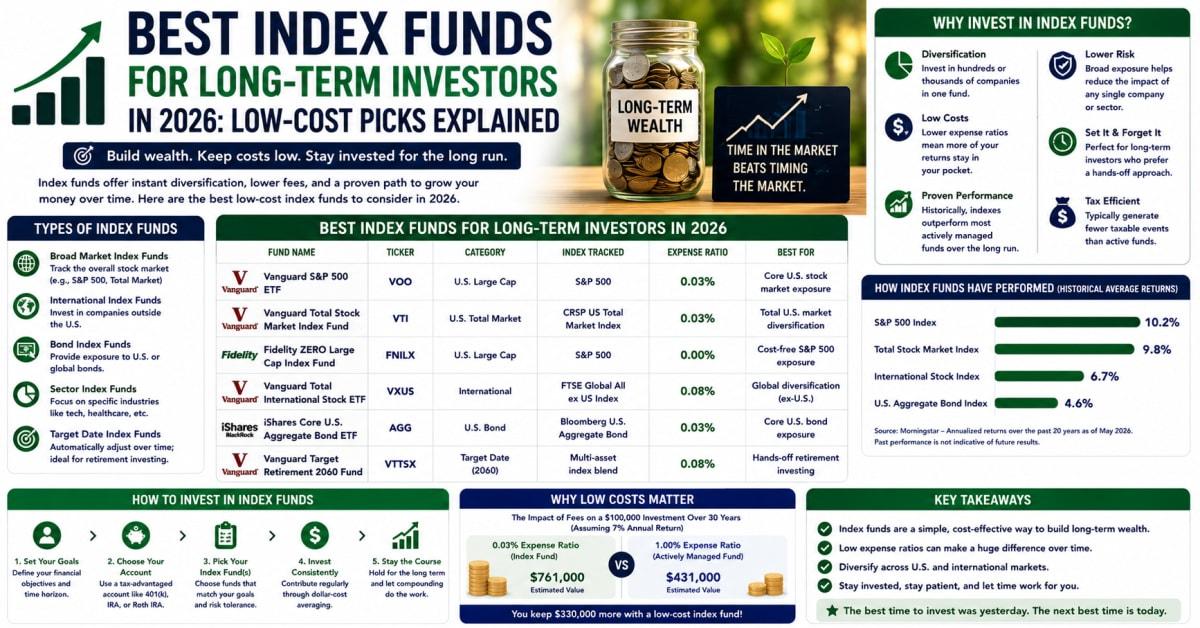
The gap between a 0.03% and 1% expense ratio can cost you over $100,000 over a 30-year career. Here's how the top low-cost index funds of 2026 actually compare.
Best Low-Cost Index Funds for Long-Term Investors 2026
The difference between a 0.03% expense ratio and a 1% one can cost you over $100,000 in lost growth over a 30-year investing career on the exact same starting balance. That's not a rounding error. It's the single biggest reason index funds have become the default choice for long-term investors.
Choosing the best index funds for long-term investing in 2026 mostly comes down to picking the right level of diversification for your goals, then minimizing cost within that category. This guide compares the leading low-cost index fund options, from total market funds to S&P 500 trackers, and breaks down exactly how to build a simple, effective portfolio around them.
Best Index Funds — What They Are and Why Cost Matters So Much
An index fund is a fund designed to track a specific market benchmark, like the S&P 500 or the total U.S. stock market, rather than trying to beat it through active stock picking. Because there's no research team trying to outguess the market, index funds can charge dramatically lower fees than actively managed alternatives while still capturing the market's overall long-term growth.
Cost matters enormously here because index funds have consistently outperformed the majority of actively managed funds over long time periods, and the expense ratio is one of the few variables an investor can actually control directly, unlike future market returns.
Why This Is Important Right Now
Picture two investors each starting with $10,000, one in a fund charging 1% annually and one in a fund charging 0.03%. Over three decades of otherwise identical market returns, that seemingly small fee gap compounds into a genuinely enormous difference in final account value, simply from fees quietly eating into growth every single year.
Index fund assets have surged past $10 trillion in the U.S. alone, and expense ratios have kept trending downward as competition between major providers intensifies. That means long-term investors today have access to genuinely free or near-free options that simply didn't exist a decade ago.
Key Facts About Low-Cost Index Funds in 2026
A few core facts explain how today's leading index funds actually compare and why fees have fallen so dramatically.
- Some index funds now charge a genuine 0% expense ratio — including Fidelity's ZERO funds like FNILX, meaning investors pay literally nothing in annual management fees.
- Total market funds and S&P 500 funds serve slightly different purposes — a total market fund like VTI covers thousands of companies across all sizes, while an S&P 500 fund focuses specifically on around 500 of the largest U.S. companies.
- Performance differences between comparable low-cost S&P 500 funds are nearly indistinguishable — at today's expense ratios, annual cost differences on a typical investment amount to just a few dollars between competing funds.
- ETFs and mutual fund versions of the same index often carry nearly identical fees — the choice between them usually comes down to trading flexibility and minimum investment requirements, not cost.
- International index funds fill a genuine diversification gap — since a purely U.S.-focused portfolio misses meaningful global market exposure, even though many U.S. total market funds already include companies with significant international revenue.
What the Industry Data Shows
Industry data suggests that index funds now command a substantial and growing share of total fund assets, consistently outpacing actively managed alternatives year after year as more investors recognize the long-term cost advantage of passive investing.
Analysis from outlets like Morningstar and the Motley Fool has repeatedly found that even small differences in expense ratio compound meaningfully over multi-decade holding periods, reinforcing that fee minimization remains one of the most reliable, controllable levers for long-term investment growth.
Top Low-Cost Index Funds Compared
These funds represent some of the strongest low-cost options across the most common index categories long-term investors use.
- Vanguard Total Stock Market ETF (VTI) — Tracks the CRSP US Total Market Index, covering more than 3,500 stocks across large-, mid-, small-, and micro-cap companies, at a 0.03% expense ratio. A strong single-fund core holding for broad U.S. exposure.
- Fidelity ZERO Large Cap Index (FNILX) — Charges a genuine 0% expense ratio with no minimum investment, making it one of the most cost-effective large-cap options available anywhere.
- Vanguard S&P 500 ETF (VOO) — A well-established, highly liquid S&P 500 tracker with a low expense ratio, often considered the gold standard for large-cap U.S. exposure.
- Schwab S&P 500 Index Fund (SWPPX) — Another ultra-low-cost S&P 500 tracker with no minimum investment, closely mirroring the broader large-cap market.
- SPDR Portfolio S&P 500 ETF (SPYM) — Currently among the lowest-cost ETFs tracking the S&P 500, at roughly 0.02%, appealing to highly cost-sensitive investors.
- Vanguard Total International Stock ETF (VXUS) — Provides international developed and emerging-market exposure across thousands of companies at a low expense ratio, useful for global diversification beyond a purely U.S. portfolio.
Benefits and Real Opportunities
Building a portfolio around low-cost index funds creates real, compounding advantages for long-term investors.
- Minimal fee drag on long-term growth — at today's near-zero expense ratios, fees barely dent your returns compared to actively managed alternatives.
- Instant, broad diversification — a single total market fund can provide exposure to thousands of companies in one purchase.
- Historical outperformance versus most active funds — index funds have consistently beaten the majority of actively managed funds over long holding periods.
- Simplicity that supports consistency — a straightforward two- or three-fund portfolio is easy to maintain, which supports the long-term discipline that matters more than fund selection itself.
Costs and What to Expect
Leading index funds in 2026 commonly charge expense ratios between 0.00% and 0.15%, with several genuinely free options now available from major providers like Fidelity. Minimum investments vary by fund structure: most ETFs can be purchased for the price of a single share with no separate minimum, while some mutual fund versions of similar indexes require an initial investment, commonly $0 to $3,000 depending on the provider.
Trading ETFs may involve a small bid-ask spread, though this is typically negligible for highly liquid, widely traded funds like VOO or VTI. Both ETFs and index mutual funds can trigger capital gains tax when sold at a profit in a taxable account, with index funds generally producing fewer unexpected taxable distributions than actively managed alternatives due to their lower turnover.
The real cost consideration for most long-term investors isn't the expense ratio at today's ultra-low levels, but rather the discipline to stay invested consistently through market volatility, since interrupting the compounding process to time the market tends to cost far more than any fee difference between comparable funds.
Total Market Index Funds vs S&P 500 Index Funds vs International Index Funds: Which One Is Right for You?
| Option | Best For | Pros | Cons |
|---|---|---|---|
| Total Market Index Funds (e.g., VTI) | Investors wanting the broadest possible single-fund U.S. exposure | Includes large-, mid-, small-, and micro-cap companies in one fund | Slightly more volatile than large-cap-only funds due to smaller company exposure |
| S&P 500 Index Funds (e.g., VOO, SWPPX, FNILX) | Investors wanting a straightforward large-cap core holding | Extremely low cost with a long, well-understood track record | No exposure to smaller companies outside the largest 500 |
| International Index Funds (e.g., VXUS) | Investors wanting geographic diversification beyond the U.S. | Reduces reliance on U.S. market performance alone | Historically has lagged U.S. market returns in several recent years |
Who Should Actually Care About Low-Cost Index Funds?
This matters for any long-term investor building a retirement or brokerage portfolio, especially beginners who want a simple, effective starting point without needing to research individual stocks. It's equally relevant for experienced investors looking to minimize fee drag on an existing portfolio, and for anyone pursuing a financial independence strategy where cost efficiency compounds significantly over a multi-decade timeline.
Mistakes Most People Make
A handful of habits undermine the natural cost advantage index funds offer.
Overcomplicating a portfolio with many overlapping funds, rather than a simple two- or three-fund structure, adds complexity without meaningfully improving diversification, since many funds already overlap significantly in their underlying holdings. Sticking to a simple core structure is usually just as effective.
Chasing the absolute lowest expense ratio between two nearly identical funds ignores that the difference at today's ultra-low rates amounts to just a few dollars annually on a typical portfolio. Prioritizing consistency and staying invested matters far more than shaving another basis point off an already minimal fee.
Assuming U.S. total market funds provide sufficient global diversification overlooks that meaningful international exposure typically requires a dedicated international fund, even though many U.S. companies do generate substantial overseas revenue.
Reacting to short-term market volatility by selling index fund holdings undermines the entire long-term compounding advantage these funds are built to capture. Staying invested through downturns is central to how index investing actually works over time.
What Most Articles Won't Tell You
Most roundups rank funds purely by expense ratio, but at today's near-zero rates across major providers, the practical difference between competing S&P 500 funds is genuinely negligible. The bigger decision is choosing the right index category, total market versus S&P 500 versus international, not agonizing over a fractional fee difference within a category.
There's also a detail worth knowing: brokerage choice matters less than it once did, since major providers like Vanguard, Fidelity, and Schwab all now offer commission-free trading and their own competitively priced index funds, meaning your choice of brokerage rarely locks you out of the best fund options.
Advanced Moves Worth Knowing
Building a simple two- or three-fund portfolio, a U.S. total market or S&P 500 fund, an international fund, and optionally a bond fund, covers most long-term investors' diversification needs without unnecessary complexity or overlapping holdings.
Automating regular contributions into your chosen index funds removes the temptation to time the market and captures the benefit of dollar-cost averaging into a genuinely low-cost, diversified portfolio over time.
Frequently Asked Questions
Are zero expense ratio index funds too good to be true?
No, several major providers genuinely offer 0% expense ratio funds as a way to attract and retain customers who may also use other services at that brokerage. These funds are legitimate and widely used by long-term investors.
Should I choose a total market index fund or an S&P 500 index fund?
Both are reasonable core holdings. A total market fund offers broader exposure including smaller companies, while an S&P 500 fund focuses on the largest U.S. companies specifically. Many long-term investors find either a suitable single core holding.
Do I need an international index fund if I already own a U.S. total market fund?
A U.S. total market fund provides some indirect international exposure through companies with global revenue, but a dedicated international fund is typically needed for meaningful direct exposure to overseas markets and economies.
Is an ETF or a mutual fund version of an index better?
Both often carry nearly identical expense ratios for the same underlying index. ETFs typically offer more intraday trading flexibility and lower minimum investments, while some mutual fund versions may better suit automatic recurring investment plans.
How much difference does expense ratio really make over time?
A meaningful amount over a multi-decade holding period. The gap between a 0.03% and a 1% expense ratio can cost over $100,000 in lost growth over a 30-year investing career on an identical starting balance, purely from the fee difference compounding annually.
The Bottom Line on Best Index Funds for Long-Term Investors in 2026
The best index funds for long-term investors in 2026 share two traits: broad diversification and expense ratios so low they barely register against your returns. Whether you choose a total market fund, an S&P 500 tracker, or a simple combination with international exposure, the specific fund matters far less than starting consistently and staying invested through market ups and downs. Pick a simple, low-cost structure, automate your contributions, and let time and compounding do the heavy lifting from there.
Read Next
Revealed: The Hidden AI Stocks Set to Boom in 2026!
Shock Dip in Stock Futures as Iran War Talks Hit Crisis Point!
Apollo's $3 Billion Credit Fund Sale Talks Spark Financial Shockwaves!
U.S. Job Market Crisis: Shocking Optimism Gap Revealed!
Market Guru Reveals Shocking S&P 500 Surge to 8,250 Amid Earnings Boom