AI Investing Trends in 2026: What Investors Should Watch
From generative AI to predictive analytics, 2026 is shaping up to be a pivotal year for AI in investing. Here are the key trends, opportunities, and risks every investor should watch.
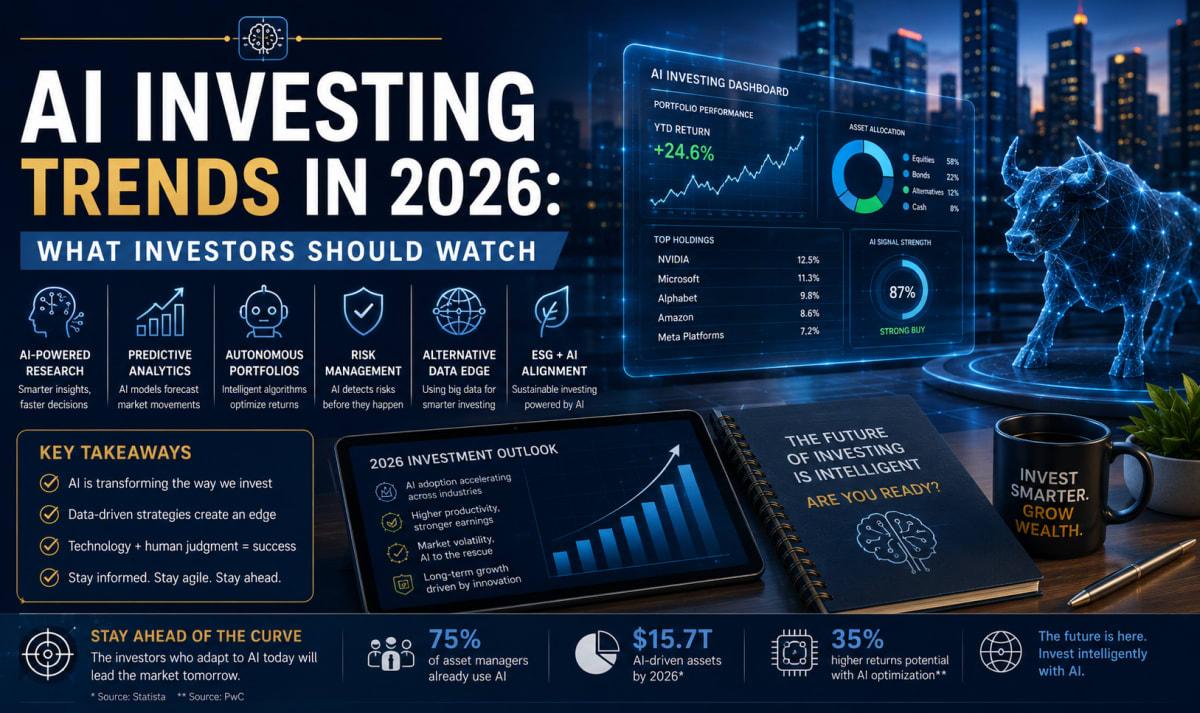
AI Investing Trends in 2026: What Investors Should Watch
If you're not paying attention to AI in investing, you're already behind.
Artificial intelligence is transforming the investment landscape at an unprecedented pace. In 2026, we're seeing AI move beyond the hedge fund world and into the hands of everyday investors. From generative AI that writes investment theses to algorithms that execute trades in milliseconds, the tools available today would have seemed like science fiction just a few years ago.
The numbers are staggering. The global AI in asset management market is projected to grow from $4.77 billion in 2024 to $35.63 billion by 2030—a compound annual growth rate of 33%. More than 70% of asset managers already use AI in some capacity, and 77% say AI will reshape the industry over the next two years.
Here's what investors should be watching in AI investing trends for 2026—and how to position yourself for what's coming next.
What Are AI Investing Trends in 2026?
AI investing trends refer to the emerging ways artificial intelligence technologies—including machine learning, natural language processing, predictive analytics, and generative AI—are being applied to investment analysis, decision-making, and execution.
Think about it. Traditional investing relies heavily on human analysis of financial statements, economic indicators, and market data. AI adds a layer of computational power that can process vast amounts of information, identify patterns invisible to the human eye, and execute decisions at speeds no person could match.
In 2026, we're seeing AI become more accessible, more integrated, and more sophisticated. The shift is moving from experimental to essential—and investors who understand these trends stand to gain a significant advantage.
Why These Trends Matter Now
Here's the thing: the financial industry is in the middle of a fundamental transformation. Between July 2023 and June 2024, 74% of asset managers named AI as their top investment priority.
Citi Research predicts that widespread AI adoption across the financial sector could boost earnings by 12% to 16% over the next five years. McKinsey suggests generative AI alone could deliver between $200 billion and $340 billion in annual value to the banking sector.
The shift is driven by increasing data complexity, the need for faster decision-making, and growing client expectations for personalized investment advice. The investors who embrace these tools now will be better positioned for the future.
Key AI Investing Trends to Watch in 2026
Here are the most important AI investing trends shaping the market in 2026.
- Generative AI for Financial Research — Large language models are being deployed to summarize earnings reports, generate investment theses, and create portfolio recommendations. Over 55% of asset managers now have a dedicated generative AI budget. Firms like Bloomberg and Morningstar are integrating generative AI into their research platforms.
- Algorithmic Trading Evolution — AI-driven trading systems now account for over 70% of all equity trading volume in the U.S. The algorithms analyze market conditions, identify patterns, and execute trades at speeds measured in milliseconds. The next evolution involves reinforcement learning—algorithms that improve their strategies through trial and error.
- AI-Powered Stock Selection — Machine learning algorithms are becoming more sophisticated at analyzing financial data, earnings reports, and alternative data sources to identify promising stocks. Platforms like Kavout and QuantConnect are making these tools accessible to individual investors.
- Sentiment Analysis at Scale — AI systems are processing news articles, social media posts, and earnings call transcripts in real-time to gauge market sentiment. These tools can detect subtle shifts in tone that might indicate market-moving events before they're widely recognized.
- Robo-Advisor Evolution — Robo-advisors are moving beyond simple asset allocation. New capabilities include tax-loss harvesting, socially responsible investing strategies, dynamic portfolio rebalancing, and behavioral coaching. Assets managed by robo-advisors are projected to exceed $2 trillion by 2027.
- Alternative Data Analysis — AI is enabling investors to analyze non-traditional data sources—satellite imagery, credit card transactions, shipping data, and even weather patterns—to gain unique market insights.
What the Industry Data Shows
The data paints a clear picture of accelerating adoption. According to the 2024 EY AI Pulse Survey, 77% of asset managers say AI will reshape the industry over the next two years. More than 70% already use AI in some capacity, and 55% have a dedicated generative AI budget.
Research also shows that early adopters are seeing measurable returns. Institutions that have integrated AI into their investment processes report improved efficiency, better risk-adjusted returns, and increased client satisfaction.
However, the data also reveals concentration risks. As of March 2025, the S&P 500's weight in the top 10 stocks exceeded 37%, up from 35.5% at the end of 2024—the highest concentration level in over 30 years. Much of this concentration is in AI-related stocks.
Top AI Investing Platforms in 2026
Several platforms are leading the AI investing revolution. Here's how they compare.
| Platform | Core Capability | Best For | Key Feature |
|---|---|---|---|
| QuantConnect | Algorithmic trading | Active traders & quants | Cloud-based backtesting and deployment |
| Kavout | AI stock scoring | Individual investors | K-Score predictive ratings |
| Wealthfront | Robo-advisory | Passive investors | Tax-loss harvesting and direct indexing |
| Betterment | Goal-based investing | Long-term goals | Behavioral coaching and goal tracking |
The AI investing tools market is evolving rapidly. We're seeing increased integration across segments, with platforms offering more comprehensive solutions rather than point solutions.
Who Should Watch These Trends?
AI investing trends matter to a wide range of investors and professionals.
- Individual Investors — Robo-advisors and AI-powered stock selection tools are making sophisticated strategies accessible to retail investors with modest portfolios. The trend toward democratization is accelerating.
- Institutional Investors — Pension funds, endowments, and asset managers are deploying AI to improve returns, manage risk, and reduce operational costs. Early adopters are gaining competitive advantages.
- Fintech Professionals — Those working at the intersection of finance and technology need to understand AI capabilities to stay relevant and competitive.
- Tech-Forward Millennials and Gen Z — Younger investors are driving the shift toward digital-first, transparent investment experiences. They're also the most likely to adopt AI-powered tools.
Mistakes Most People Make
A common mistake is assuming AI investing is a shortcut to wealth. AI tools are powerful, but they're not infallible. Market conditions can change rapidly, and machine learning models are only as good as the data they're trained on. The 2021-2022 market correction showed that even sophisticated algorithms can struggle with unexpected events.
Another mistake is over-relying on AI without understanding its limitations. AI excels at pattern recognition but can struggle with unprecedented events—like the COVID-19 pandemic or major geopolitical shocks. A balanced approach that combines AI insights with human judgment is essential.
Some investors also overlook the concentration risk in AI-related investments. The S&P 500's weight in the top 10 stocks has exceeded 37%—the highest concentration level in over three decades. Diversification remains essential.
What Most Articles Won't Tell You
Most coverage focuses on the upside, but here's what gets overlooked: the risks are real and often understated. Regulatory uncertainty, data privacy concerns, algorithmic bias, and the potential for AI-amplified market volatility all pose challenges.
Also worth noting: AI investing tools are not one-size-fits-all. The best approach depends on your investment goals, risk tolerance, and time horizon. What works for a day trader won't necessarily work for a retirement investor.
And here's something most people miss: AI is creating its own investment theme. The companies that power AI—chip manufacturers, cloud providers, data centers—are seeing massive growth. But so are the companies that effectively deploy AI to improve their operations.
Advanced Moves Worth Knowing
For investors looking to get ahead, consider focusing on the \"enablers\" rather than just the \"users\" of AI. Companies like Nvidia, AMD, and cloud providers are foundational to the AI ecosystem.
Another advanced move: use AI to improve your own investment process. Even if you don't use algorithmic trading, AI-powered research tools can help you analyze companies more efficiently. Platforms that summarize earnings calls, analyze sentiment, and identify trends can give you an edge.
Also consider the behavioral aspect. AI can help investors overcome cognitive biases by providing data-driven, objective analysis. Tools that highlight when you're making emotionally driven decisions can improve investment outcomes.
Frequently Asked Questions
What are AI investing trends in 2026?
The top AI investing trends in 2026 include generative AI for financial research, algorithmic trading evolution, AI-powered stock selection, sentiment analysis, robo-advisor evolution, and alternative data analysis. These trends reflect how AI is becoming more integrated and accessible in the investment process.
How is AI changing investing?
AI is changing investing by enabling faster data processing, more sophisticated pattern recognition, automated trading, personalized portfolio management, and deeper market analysis. It's democratizing tools that were once available only to institutional investors.
What are the risks of AI investing?
Risks include market concentration, data quality issues, algorithmic bias, regulatory uncertainty, and the potential for AI systems to amplify market volatility. AI models can also struggle with unprecedented events that lack historical precedent. Diversification and careful risk management remain essential.
Can AI predict stock market movements?
AI can identify patterns and trends that humans might miss, but it cannot reliably predict stock market movements with certainty. Markets are influenced by countless variables, including human behavior, which AI cannot fully model. AI is best used as a tool to inform decisions, not as a crystal ball.
How can I start using AI for investing?
You can start by exploring robo-advisory platforms (like Betterment or Wealthfront), using AI-powered stock screeners (like Kavout), or investing in AI-focused ETFs. Many brokerage platforms now offer AI-driven research tools. Start small, understand the technology, and gradually increase your exposure as you become more comfortable.
The Bottom Line on AI Investing Trends 2026
AI investing trends in 2026 are reshaping the financial landscape. From generative AI research tools to algorithmic trading, artificial intelligence is democratizing sophisticated investment capabilities and creating new opportunities for investors at every level.
The key takeaway is that AI is a powerful tool—but it's not magic. The most successful investors will understand AI's capabilities and limitations, use it to complement rather than replace human judgment, and maintain a disciplined approach to risk management.
The trend is clear: AI will continue to transform investing. The question isn't whether to embrace AI, but how to do so intelligently. Start by educating yourself, exploring available tools, and building a strategy that aligns with your goals.
The future of investing is here—and it's powered by AI. Watch the trends, stay informed, and position yourself for what's coming next.
Read Next

Shock Warning: Union Calls SpaceX IPO Financial Logic into Crisis

CoreWeave Stock Dips: Shocking Earnings Reveal Potential Crisis Ahead!

Redfin's Shocking Warning: Mortgage Rates Could Trigger Housing Market Crisis

Shock Alert: Coinbase Faces Second Quarterly Loss as Crypto Boom Fades!
IREN Stock Surges After Shocking Nvidia Partnership for AI Boom!