AI Investing Trends 2026: What Smart Investors Need to Know
AI is reshaping investing in 2026—from algorithmic trading to portfolio optimization. Here's what every investor needs to know about the top AI investing trends, opportunities, and risks.
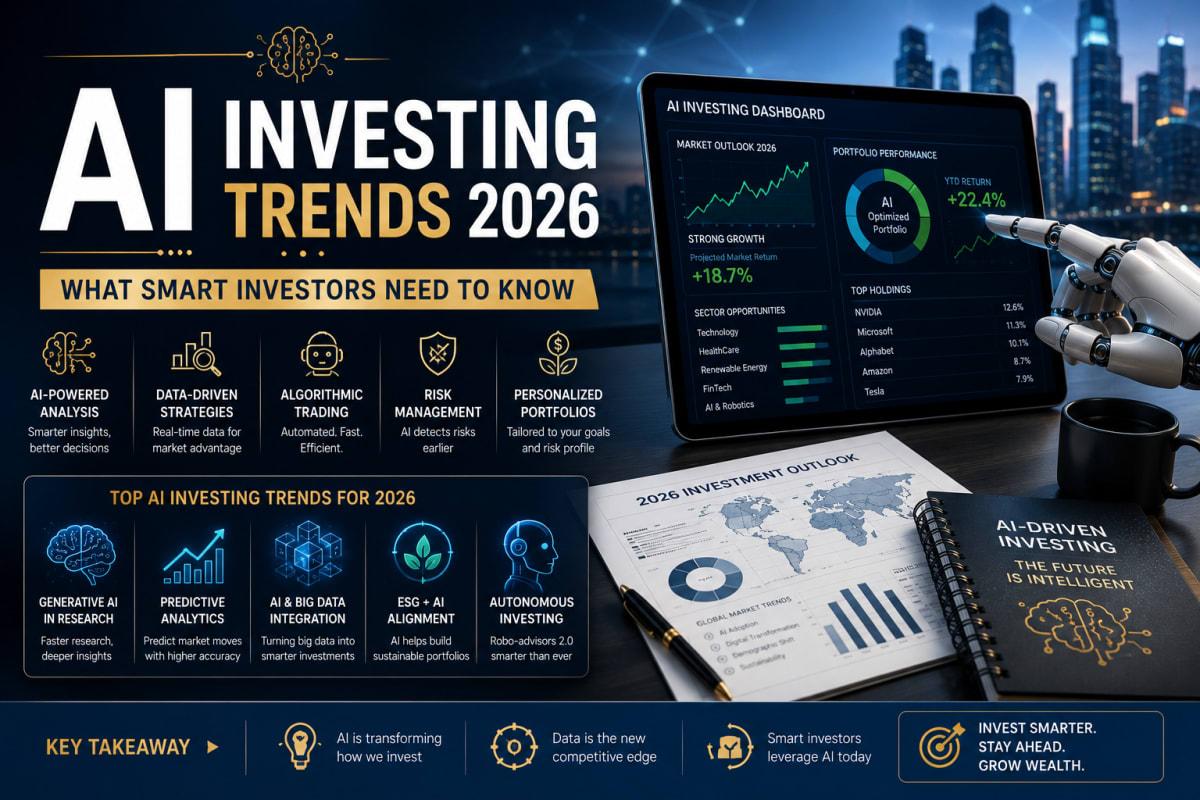
AI Investing Trends 2026: What Smart Investors Need to Know
Artificial intelligence is no longer a niche tool for hedge fund quants—it's becoming the backbone of modern investing.
From algorithmic trading to portfolio optimization, AI is transforming how investors analyze markets, manage risk, and generate returns. In 2026, the shift is accelerating. AI-powered tools are becoming more accessible, more sophisticated, and more integrated into mainstream investing strategies.
According to the 2024 EY AI Pulse Survey, 77% of asset managers say AI will reshape the industry over the next two years. More than 70% of asset managers already use AI in some capacity, and 55% have a dedicated generative AI budget.
Here's what you need to know about the top AI investing trends for 2026—and how to position yourself for what comes next.
What Are AI Investing Trends?
AI investing refers to the use of artificial intelligence technologies—including machine learning, natural language processing, and predictive analytics—to analyze market data, identify opportunities, and execute investment decisions. These trends reflect how AI is changing the investment landscape.
Think about it. Traditional investing relies heavily on human analysis of financial statements, market data, and economic indicators. AI investing adds a layer of computational power that can process vast amounts of data, identify patterns invisible to the human eye, and execute trades at speeds no person could match.
In 2026, we're seeing AI go beyond quantitative analysis to include generative AI for financial research, AI-powered risk assessment, and even tools that help investors understand their own behavioral biases.
Why These Trends Matter Now
Here's the thing: the financial industry is undergoing a fundamental transformation. Between July 2023 and June 2024, 74% of asset managers named AI as their top investment priority. The adoption of AI is moving from experimental to essential.
The shift is driven by increasing data complexity, the need for faster decision-making, and growing client expectations for personalized investment advice. Investors who understand and leverage these trends stand to gain a significant advantage.
Key AI Investing Trends for 2026
Here are the most important AI investing trends shaping the market in 2026.
- AI-Powered Stock Selection — Machine learning algorithms are becoming more sophisticated at analyzing financial data, earnings reports, and alternative data sources to identify promising stocks. The global AI in asset management market is projected to grow at a 33% CAGR through 2030.
- Algorithmic Trading Expansion — AI-driven trading systems now account for over 70% of all equity trading volume in the U.S. The algorithms analyze market conditions, identify patterns, and execute trades at speeds measured in milliseconds.
- Robo-Advisor Evolution — Robo-advisors are moving beyond simple asset allocation to include tax-loss harvesting, socially responsible investing strategies, and dynamic portfolio rebalancing. Assets managed by robo-advisors are projected to exceed $2 trillion by 2027.
- Sentiment Analysis and News Processing — AI systems are processing news articles, social media, and earnings call transcripts in real-time to gauge market sentiment. These tools can detect subtle shifts in tone that might indicate market-moving events.
- Risk Management and Fraud Detection — AI is increasingly used to identify unusual trading patterns, detect potential fraud, and assess portfolio risk. Insurance companies are using AI to optimize claims processing and identify suspicious activities.
- Generative AI for Financial Research — Large language models are being deployed to summarize financial reports, generate investment theses, and even create portfolio recommendations. Over 55% of asset managers now have a dedicated generative AI budget.
What the Industry Data Shows
The numbers tell a compelling story. The global AI in asset management market is projected to grow from USD 4.77 billion in 2024 to USD 35.63 billion by 2030—a compound annual growth rate of 33%.
Citi Research predicts that the widespread adoption of AI across the financial sector could boost earnings by 12% to 16% over the next five years. The consulting firm McKinsey suggests that generative AI could deliver between $200 billion and $340 billion in annual value to the banking sector alone.
Research also shows that early adopters are seeing measurable returns. Institutions that have integrated AI into their investment processes report improved efficiency, better risk-adjusted returns, and increased client satisfaction.
Top AI Investing Tools and Platforms
Several companies are leading the AI investing space with innovative technologies. Here's a comparison of the top providers.
| Platform | Core AI Capability | Best For | Key Advantage |
|---|---|---|---|
| QuantConnect | Algorithmic trading | Active traders & quants | Backtesting and cloud deployment |
| Kavout | AI stock scoring | Individual investors | K-Score predictive ratings |
| Wealthfront | Robo-advisory | Passive long-term investors | Tax-loss harvesting and direct indexing |
The AI investing tools market is broadly segmented into AI-powered asset management platforms, algorithmic trading platforms, and AI-driven financial research tools. As the industry matures, we can expect more integration across these segments.
Who Should Actually Care About AI Investing?
AI investing isn't just for hedge fund managers. These trends matter to a wide range of investors.
- Individual Investors — Robo-advisors and AI-driven stock selection tools are making sophisticated strategies accessible to retail investors with modest portfolios.
- Institutional Investors — Pension funds, endowments, and asset managers are deploying AI to improve returns, manage risk, and reduce operational costs.
- Fintech Enthusiasts — Investors who follow emerging technology trends are using AI as both a tool and a thematic investment opportunity.
- Tech-Savvy Millennials and Gen Z — Younger investors are driving the shift toward digital-first, transparent, and personalized investment experiences.
Mistakes Most People Make
A common mistake is assuming AI investing is a guaranteed path to wealth. AI tools are powerful, but they're not infallible. Market conditions can change rapidly, and machine learning models are only as good as the data they're trained on.
Another mistake is over-relying on AI without understanding its limitations. AI is excellent at pattern recognition but can struggle with unprecedented events—like the COVID-19 pandemic or major geopolitical shocks. A balanced approach that combines AI insights with human judgment is essential.
Some investors also overlook the concentration risk in AI-related investments. As of March 2025, the S&P 500's weight in the top 10 stocks exceeded 37%, up from 35.5% at the end of 2024—the highest concentration level in over 30 years.
What Most Articles Won't Tell You
Most coverage of AI investing focuses on the upside, but here's what gets overlooked: the risks are real and often understated. Regulatory uncertainty, data privacy concerns, and the potential for algorithmic bubbles all pose challenges.
Also worth noting: AI investing tools are not one-size-fits-all. The best approach depends on your investment goals, risk tolerance, and time horizon. What works for a day trader won't necessarily work for a retirement investor.
Advanced Moves Worth Knowing
For investors looking to get ahead, consider combining multiple AI tools for a more comprehensive strategy. For example, use one platform for portfolio optimization and another for real-time market analysis.
Another advanced move: focus on AI quality rather than quantity. A few well-chosen AI-powered investments often outperform a basket of lower-quality AI stocks. Look for companies with strong AI capabilities, deep data assets, and sustainable competitive advantages.
Frequently Asked Questions
What is AI investing?
AI investing uses artificial intelligence technologies—including machine learning, natural language processing, and predictive analytics—to analyze markets, identify opportunities, and execute investment decisions. It includes tools like algorithmic trading platforms, robo-advisors, and AI-powered stock screeners.
Is AI good for investing?
AI can be a powerful tool for investing, offering advantages in data processing, pattern recognition, and speed. However, it's not a substitute for sound investment principles. AI tools work best when combined with human judgment and a clear understanding of investment goals and risk tolerance.
What are the risks of AI investing?
Risks include market concentration, data quality issues, algorithmic bias, regulatory uncertainty, and the potential for AI systems to amplify market volatility. AI models can also struggle with unprecedented events that lack historical precedent. Diversification and careful risk management remain essential.
How can I start AI investing?
You can start by exploring robo-advisory platforms (like Betterment or Wealthfront), using AI-powered stock screeners (like Kavout), or investing in AI-focused ETFs. Many brokerage platforms now offer AI-driven research tools. Start small, understand the technology, and gradually increase your exposure as you become more comfortable.
Will AI replace human investors?
AI is unlikely to fully replace human investors. While AI excels at data processing and pattern recognition, human judgment remains essential for understanding context, managing risk, and making strategic decisions. The most successful investors will likely combine AI tools with human insight.
The Bottom Line on AI Investing Trends 2026
AI investing trends are reshaping the financial landscape in 2026. From algorithmic trading to robo-advisors, AI is democratizing sophisticated investment tools and creating new opportunities for investors at every level.
The key takeaway is that AI is a tool—not a magic solution. The most successful investors will be those who understand AI's capabilities and limitations, use it to complement rather than replace human judgment, and maintain a disciplined approach to risk management.
The trend is clear: AI will continue to transform investing. The question isn't whether to embrace AI, but how to do so intelligently. Start by educating yourself, exploring available tools, and building a strategy that aligns with your goals. The future of investing is here—and it's powered by AI.
Read Next

OpenAI Surges Ahead in AI IPO Race: Will They Dominate the Market?
Nvidia Stock Surges: What Shocking Revelations Will CEO Huang Unveil?
Stock Market Shrugs Off Trump’s Iran Talk—What’s the Hidden Danger?

Trump's Shocking Stock Trades Exposed: Did His Policies Profit Him?

Bank CEO’s Shocking 'Lower-Value' Label Sparks Job Loss Crisis Amid AI Boom