Roth IRA vs 401(k): Which Wins for You in 2026?
2026 brings higher limits: $24,500 for 401(k)s and $7,500 for IRAs. Here's how to decide which account should get your money first.
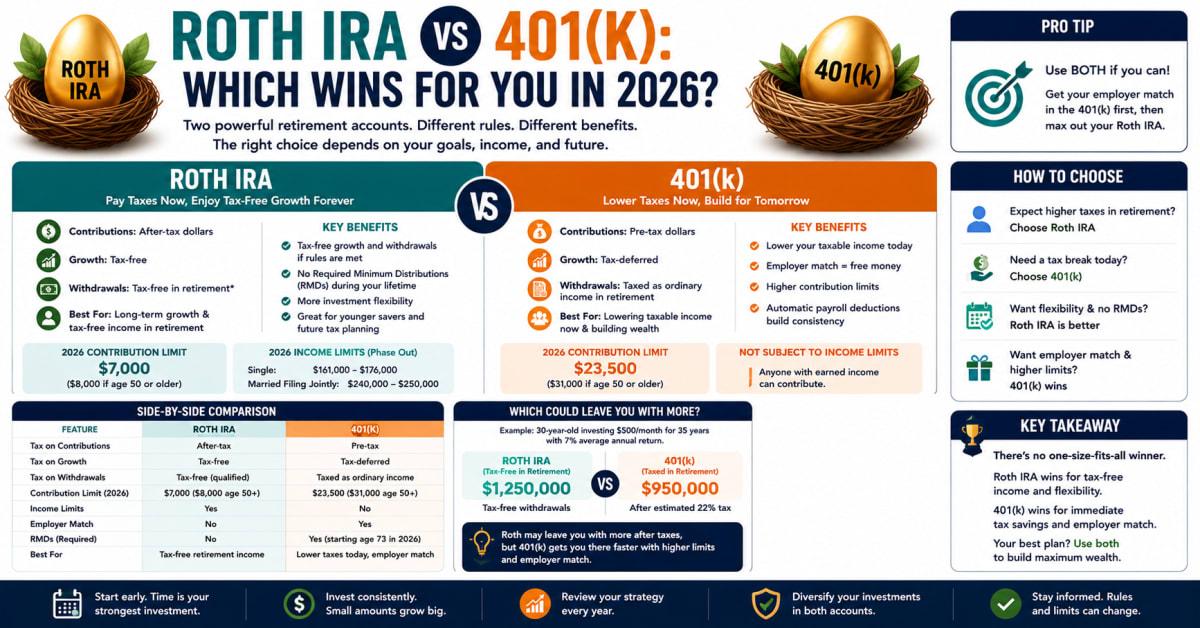
Roth IRA vs 401(k): Which Wins for You in 2026?
You can max out a 401(k) at $24,500 in 2026, or contribute up to $7,500 to a Roth IRA. Most people don't need to choose one exclusively, but almost everyone needs to know which order to prioritize them in.
The Roth IRA versus 401(k) decision isn't really about picking a winner. It's about understanding how each account's tax treatment, contribution limits, and rules fit your specific income and career stage in 2026. This guide breaks down the real differences, the new rules taking effect this year, and exactly how to prioritize your contributions if you can't max out both.
Roth IRA vs 401(k) — What They Are and Why the Difference Matters
A 401(k) is an employer-sponsored retirement plan with high contribution limits and often an employer match, typically offering both traditional pre-tax and Roth after-tax options. A Roth IRA is an individual account you open on your own, funded with after-tax dollars, offering tax-free growth and tax-free qualified withdrawals in retirement.
The core difference comes down to who controls the account, how much you can contribute, and when you pay taxes. Understanding both matters because most people benefit from using each account for a different part of their retirement strategy, not choosing one exclusively.
Why This Is Important Right Now
Picture someone contributing just enough to their 401(k) to get the full employer match, then wondering where extra savings should go next. Without understanding Roth IRA income limits and 401(k) rules together, it's easy to either miss out on tax-free growth or accidentally over-contribute.
2026 brought meaningful increases to both account types, along with a new rule requiring high earners to make catch-up contributions as Roth, not pre-tax. These changes make it worth revisiting your strategy even if you haven't touched it in years.
Key Facts About Roth IRA vs 401(k) in 2026
A few core facts define how these accounts actually work and what's changed for 2026 specifically.
- The 401(k) employee contribution limit is $24,500 for 2026 — up from $24,000 in 2025, with a $72,000 combined employee-and-employer cap.
- The Roth and traditional IRA combined contribution limit is $7,500 for 2026 — up from $7,000 in 2025, with an additional $1,100 catch-up allowed for those 50 and older.
- Roth IRA eligibility phases out at higher incomes — single filers must have a MAGI under $153,000, and joint filers under $242,000, to contribute the full amount in 2026.
- High earners now face a new Roth catch-up requirement — starting in 2026, anyone who earned over $150,000 in FICA wages the prior year must make any 401(k) catch-up contributions as Roth, not pre-tax.
- 401(k) plans have no income limit for contributing — unlike a Roth IRA, your income doesn't affect your ability to contribute to a workplace 401(k).
What the Industry Data Shows
Industry data suggests that a meaningful share of workers still don't contribute enough to their 401(k) to capture their full employer match, effectively leaving free money unclaimed even before considering how a Roth IRA might fit into their broader strategy.
Retirement research from providers like Fidelity has consistently found that small, incremental increases in contribution rate, even just one percentage point, can meaningfully change long-term retirement outcomes due to the compounding effect of consistent, sustained saving.
Benefits and Real Opportunities
Understanding how these accounts work together, rather than treating them as competitors, opens up real strategic opportunities.
- Employer match is free money — a 401(k) match is essentially an immediate, guaranteed return that no other investment can match.
- Roth IRA offers tax-free growth — money contributed after tax grows and can be withdrawn tax-free in retirement, which is valuable if you expect to be in a similar or higher tax bracket later.
- Higher limits in 2026 mean more tax-advantaged room — both account types saw increases this year, letting disciplined savers shelter more money from taxes than in 2025.
- Using both accounts diversifies your tax exposure in retirement — having both pre-tax and Roth money gives you flexibility to manage your taxable income once you start withdrawing.
Costs and What to Expect
There's no direct fee to contribute to either account type, though 401(k) plans often carry administrative and fund expense ratios set by your employer's plan provider, which can range from very low to meaningfully high depending on the plan. A Roth IRA opened through a major brokerage typically carries no account fee and gives you full control over which low-cost funds you invest in.
Excess Roth IRA contributions, if you accidentally exceed the limit or contribute while over the income threshold, trigger a 6% excise tax penalty on the excess amount for every year it remains in the account, so it's worth double-checking your eligibility before contributing directly, especially if your income fluctuates near the phase-out range.
For high earners now required to make Roth catch-up contributions, the "cost" is really a shift in tax timing: you lose the upfront tax deduction on that catch-up portion but gain tax-free growth and withdrawals later, assuming your plan offers a Roth 401(k) option at all.
401(k) Only vs Roth IRA Only vs Both Accounts Combined: Which One Is Right for You?
| Option | Best For | Pros | Cons |
|---|---|---|---|
| 401(k) Only | People prioritizing the highest possible contribution limit | Much higher contribution limit and potential employer match | Limited to whatever fund options your specific plan offers |
| Roth IRA Only | People without access to an employer plan, or those maximizing tax-free growth | Full control over investment choices and tax-free qualified withdrawals | Much lower contribution limit and income-based eligibility restrictions |
| Both Accounts Combined | Most savers who want to maximize tax-advantaged space and flexibility | Captures the employer match plus tax diversification in retirement | Requires enough income to fund both accounts meaningfully |
Who Should Actually Care About This Decision?
This matters for anyone with access to an employer-sponsored 401(k), especially with a matching contribution, as well as anyone eligible for a Roth IRA who wants tax-free growth as part of their retirement mix. It's especially relevant for high earners newly subject to the mandatory Roth catch-up rule in 2026, and for younger workers early in their careers who may benefit most from Roth accounts while in a lower tax bracket.
Mistakes Most People Make
A handful of errors show up repeatedly when people navigate these two accounts.
Contributing to a Roth IRA before capturing a full employer 401(k) match effectively leaves free money on the table. Contributing enough to get the full match first, then directing additional savings to a Roth IRA, captures both benefits in the right order.
Contributing directly to a Roth IRA without checking current income limits can trigger an excess contribution penalty if your income has crept above the phase-out threshold since you last checked. Verifying your MAGI against the current year's limits before contributing avoids that costly mistake.
Assuming all 401(k) plans offer a Roth option ignores that some employer plans only offer traditional pre-tax contributions. Checking your specific plan's options, especially if you're now required to make Roth catch-up contributions, avoids a surprise.
Failing to revisit contribution limits each year means missing out on the extra room 2026's increases provide. Adjusting your contribution percentage annually as limits rise keeps you on track to actually use your full tax-advantaged space.
What Most Articles Won't Tell You
Most comparisons treat this as a binary choice, but the more sophisticated approach layers both accounts based on tax diversification. Having both Roth and traditional money in retirement gives you flexibility to control your taxable income each year by choosing which account to withdraw from.
There's also a detail specific to 2026 worth knowing: the new mandatory Roth catch-up rule for high earners only applies if your plan actually offers a Roth 401(k) option. If your plan doesn't offer one and you're affected by this rule, you may lose the ability to make catch-up contributions at all until your employer adds that option.
Advanced Moves Worth Knowing
If your income exceeds the Roth IRA limit, a backdoor Roth conversion, contributing to a nondeductible traditional IRA and converting it to Roth, remains a widely used strategy to access Roth benefits despite the income phase-out.
Reviewing your FICA wages from the prior year against the $150,000 threshold each January helps you confirm in advance whether the mandatory Roth catch-up rule applies to you, rather than discovering it mid-year when your contributions are already underway.
Frequently Asked Questions
Can I contribute to both a Roth IRA and a 401(k) in the same year?
Yes, contributing to both is allowed and common. Your 401(k) contribution limit and your IRA contribution limit are entirely separate, so maxing out one doesn't reduce how much you can contribute to the other.
What's the Roth IRA contribution limit for 2026?
The combined limit for traditional and Roth IRAs is $7,500 for those under 50, and $8,600 for those 50 and older, up from $7,000 and $8,000 respectively in 2025.
What is the new Roth catch-up rule for 2026?
Starting in 2026, employees 50 and older who earned more than $150,000 in FICA wages the prior year must make any 401(k) catch-up contributions as Roth, after-tax contributions, rather than traditional pre-tax ones, if their plan offers a Roth option.
What happens if my income is too high for a Roth IRA?
If your income exceeds the phase-out range, you can't contribute directly to a Roth IRA, but a backdoor Roth conversion, using a nondeductible traditional IRA contribution converted to Roth, remains a common workaround.
Should I prioritize my 401(k) match or my Roth IRA first?
Most financial guidance recommends contributing enough to your 401(k) to capture the full employer match first, since that's essentially a guaranteed return, before directing additional savings toward a Roth IRA.
The Bottom Line on Roth IRA vs 401(k) in 2026
There's no single winner between a Roth IRA and a 401(k) in 2026. The smartest approach for most people uses both: capture your full employer match first, then contribute to a Roth IRA if you're eligible, before maxing out the rest of your 401(k) room. With higher limits this year and a new mandatory Roth catch-up rule for high earners, it's worth revisiting your contribution strategy even if it's been working fine until now. A few minutes checking your numbers against 2026's updated limits could meaningfully change how much you're able to save tax-efficiently this year.
Read Next

Urgent Reveal: Medicaid's Key Role in Boosting Children's Health Now!

Urgent Warning: Hantavirus Cruise Outbreak Revealed—Is a Crisis Looming?

States Face Medicaid Crisis: Urgent Provider Revalidation Plans Due Now!
Shocking Reveal: What Medicare Part B Won't Cover Costs You!

Shock: Child Medicaid Enrollment Plummets Ahead of HR 1 Policies!