HSA vs FSA 2026: Which Should You Choose?
One of these accounts lets your unused money roll over forever. The other makes you spend it or lose it by year-end. Here's the 2026 breakdown that actually matters.
HSA vs FSA 2026: Which Should You Choose?
One of these accounts lets your unused money grow, invested, for decades. The other typically disappears if you don't spend it by December 31st. That single difference is often more important than either account's contribution limit.
HSA vs FSA in 2026 comes down to more than just picking whichever one your employer happens to offer. Eligibility rules, contribution limits, and what happens to unused funds differ enough between these two accounts that the wrong choice can genuinely cost you money. This guide breaks down exactly how each works this year and how to decide which fits your situation.
HSA vs FSA — What They Are and Why the Difference Matters
A Health Savings Account (HSA) is a tax-advantaged account available only to people enrolled in a qualifying high-deductible health plan, letting contributions grow and roll over indefinitely, with funds that stay yours even if you change jobs. A Flexible Spending Account (FSA) is available more broadly through many employer plans regardless of your health plan type, but most FSA funds must be used within the plan year or forfeited.
This distinction matters because it changes the entire strategy behind each account. An HSA functions almost like a secondary retirement account for medical expenses, while an FSA is better suited for predictable, near-term healthcare spending you're confident you'll use.
Why This Is Important Right Now
Picture someone who contributes the maximum to an FSA expecting a busy year of medical expenses, only to have a lighter year than planned and forfeit several hundred dollars at year-end because their plan didn't offer a grace period or carryover. That same money in an HSA would have simply rolled over, untouched, for as long as they needed it.
Contribution limits for both accounts increased again for 2026, giving eligible savers more room to shelter income from taxes than in previous years, which makes this a good moment to revisit which account, or combination of both, actually fits your situation.
Key Facts About HSA vs FSA in 2026
A few core facts define how these two accounts actually work this year, based on IRS-set limits for 2026.
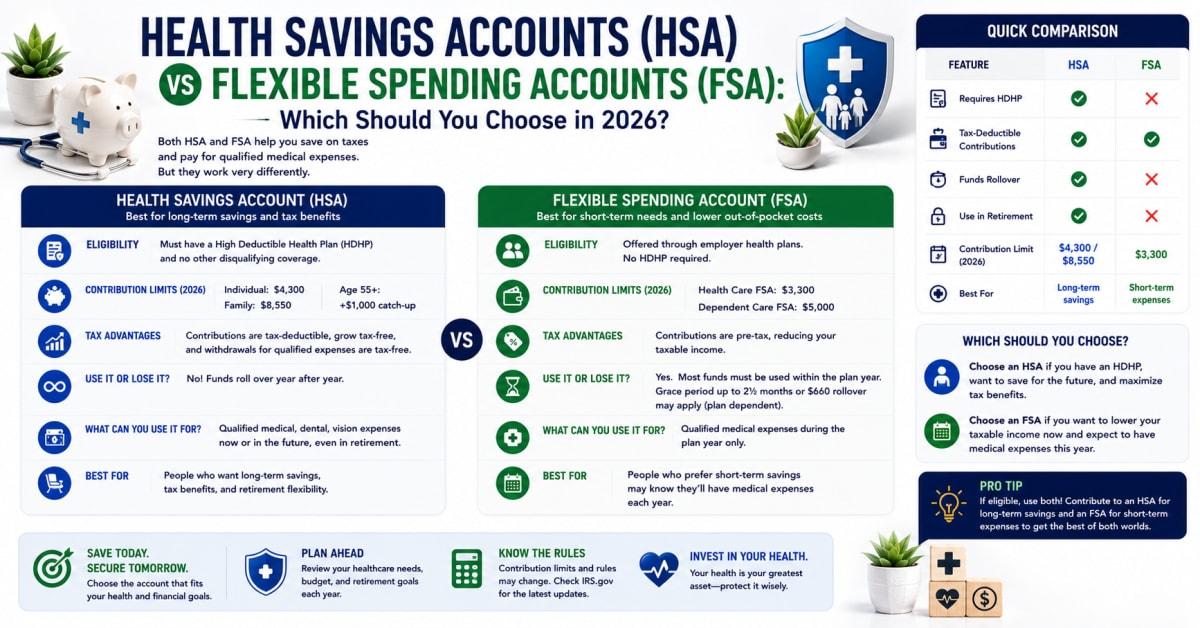
- The 2026 HSA contribution limit is $4,400 for self-only coverage and $8,750 for family coverage — up from $4,300 and $8,550 in 2025, with an additional $1,000 catch-up contribution allowed for those 55 and older.
- The 2026 healthcare FSA contribution limit is $3,400 — up $100 from 2025, with plans offering a carryover option capped at $680 for unused funds.
- The Dependent Care FSA limit jumped significantly to $7,500 — a $2,500 increase from 2025, per household, or $3,750 if married and filing separately.
- HSA eligibility requires a qualifying high-deductible health plan — with a minimum deductible of $1,700 for self-only or $3,400 for family coverage in 2026, and you cannot be enrolled in a general-purpose FSA at the same time.
- HSA and FSA can sometimes be combined — through a "limited purpose" FSA restricted to dental and vision expenses, letting you contribute up to $3,400 more, or $6,800 if both spouses have access, on top of your HSA.
What the Industry Data Shows
Industry data suggests that while employer HSA investment options have become nearly universal, with roughly two-thirds of employers offering them, actual participant investment behavior remains surprisingly low, with only about one in five HSA participants actually investing their balance rather than leaving it in cash.
Financial planning research consistently highlights the HSA's "triple tax advantage," tax-deductible contributions, tax-free growth, and tax-free qualified withdrawals, as a benefit unmatched by any other common tax-advantaged account, including traditional retirement accounts, which only offer two of those three benefits.
Benefits and Real Opportunities
Each account offers genuine, distinct value depending on your health coverage and how predictable your medical spending is.
- HSA funds never expire — unused contributions roll over indefinitely, functioning as a long-term savings vehicle rather than a use-it-or-lose-it account.
- HSAs offer a genuine triple tax advantage — deductible contributions, tax-free growth, and tax-free qualified withdrawals, a combination no other common account matches.
- FSAs are available to more people — since eligibility doesn't require a high-deductible health plan, making them accessible to employees who wouldn't otherwise qualify for an HSA.
- Dependent Care FSAs got a major limit increase — the jump to $7,500 in 2026 offers meaningfully more tax-advantaged room for childcare expenses than in prior years.
Costs and What to Expect
Neither account carries a direct enrollment fee beyond your contribution itself, though some HSA custodians charge a small monthly maintenance fee, particularly on accounts with lower balances, which is worth checking since fees vary by provider. FSA funds typically have no associated fee, since they're administered directly through your employer's plan.
The real cost consideration is the risk of forfeiture with an FSA. Most healthcare FSAs enforce a strict "use it or lose it" rule, with only a $680 carryover allowed for plans that offer it, meaning contributions beyond that carryover cap are forfeited if unused by year-end. HSAs carry no such risk, since unused funds simply remain in the account, invested or in cash, for however long you need them.
Excess HSA contributions, if you accidentally exceed the annual limit, trigger a 6% excise tax penalty on the excess amount for each year it remains uncorrected, so it's worth tracking your contributions carefully, especially if you switch jobs or health plans mid-year.
HSA vs Standard FSA vs Combining an HSA With a Limited Purpose FSA: Which One Is Right for You?
| Option | Best For | Pros | Cons |
|---|---|---|---|
| HSA (Health Savings Account) | People enrolled in a high-deductible health plan wanting long-term savings | Funds roll over indefinitely with a genuine triple tax advantage | Only available with a qualifying high-deductible health plan |
| Standard FSA | People with predictable annual medical expenses and no HDHP | Available regardless of health plan type, reducing taxable income immediately | Subject to use-it-or-lose-it rules with only limited carryover allowed |
| HSA Plus Limited Purpose FSA | People wanting to maximize tax-advantaged room for dental and vision costs | Captures HSA's long-term benefits plus extra room for specific near-term costs | The limited purpose FSA portion still carries the same use-it-or-lose-it risk |
Who Should Actually Care About This Decision?
This matters for anyone choosing between health plan options during open enrollment, especially if a high-deductible health plan with HSA eligibility is on the table. It's especially relevant for people who want to treat healthcare savings as a long-term investment vehicle, and for parents weighing the newly expanded Dependent Care FSA limit against their actual childcare costs.
Mistakes Most People Make
A handful of habits lead people to the wrong choice or leave money on the table.
Overestimating annual FSA spending to maximize the tax break can backfire if the year turns out lighter on medical expenses than expected, resulting in forfeited funds beyond any carryover limit. Basing your FSA contribution on realistic, historical spending, not a hopeful guess, avoids that loss.
Assuming you can contribute to both a full HSA and a general-purpose FSA simultaneously overlooks that doing so violates HSA eligibility rules entirely. Confirming your FSA is specifically a "limited purpose" plan before combining it with an HSA avoids an eligibility problem.
Leaving HSA funds entirely in cash rather than investing any portion ignores that the account is designed to function like a long-term investment vehicle, similar to a retirement account, for those who don't need the funds immediately.
Forgetting to check your HSA-qualifying health plan's specific deductible and out-of-pocket limits each year can lead to accidentally contributing to an HSA when your plan no longer qualifies, since these thresholds adjust annually.
What Most Articles Won't Tell You
Most comparisons focus on contribution limits alone, but the more important long-term detail is that only about one in five HSA participants actually invest their balance, even though the majority of employers now offer that option. Simply opening an HSA without investing any of it captures only a fraction of its real long-term value.
There's also a detail worth knowing: the significant jump in the Dependent Care FSA limit to $7,500 for 2026 reflects a meaningful policy change worth revisiting even if you assumed the older, lower limit still applied from previous open enrollment decisions.
Advanced Moves Worth Knowing
Treating your HSA like a secondary retirement account, contributing the maximum and paying current medical expenses out of pocket when possible, lets the balance grow tax-free for decades before you eventually need it, including in retirement.
Pairing an HSA with a limited purpose FSA specifically for dental and vision expenses captures additional tax-advantaged room without violating HSA eligibility rules, since limited purpose FSAs are explicitly compatible with HSA participation.
Frequently Asked Questions
What happens to unused FSA money at the end of the year?
In most cases, it's forfeited, since FSAs operate under a "use it or lose it" rule. Some plans offer a limited carryover, capped at $680 for 2026, or a grace period, but any amount beyond that is typically lost.
Can I have both an HSA and an FSA at the same time?
Only if the FSA is specifically a "limited purpose" FSA restricted to dental and vision expenses. A general-purpose healthcare FSA disqualifies you from HSA eligibility entirely.
Do I lose my HSA if I change jobs?
No, an HSA belongs to you, not your employer, so the account and its balance stay with you regardless of job changes, unlike an FSA, which is typically tied to your specific employer's plan.
What is the 2026 HSA contribution limit?
The 2026 limit is $4,400 for self-only coverage and $8,750 for family coverage, with an additional $1,000 catch-up contribution allowed for those 55 and older.
Is an HSA better than an FSA?
For most people who qualify, yes, largely because HSA funds roll over indefinitely and offer a genuine triple tax advantage. An FSA still makes sense for people who don't have access to a qualifying high-deductible health plan or who have very predictable annual medical expenses.
The Bottom Line on HSA vs FSA in 2026
If you're eligible for both, an HSA is generally the stronger long-term choice in 2026, thanks to its rollover flexibility and genuine triple tax advantage that an FSA simply can't match. An FSA still fills a real need for people without access to a qualifying high-deductible health plan, or those with predictable, near-term medical costs they're confident they'll use. Check your eligibility, review this year's updated limits, and if you already have an HSA sitting in cash, consider whether investing part of that balance might be the single easiest change you make this open enrollment season.
Read Next

Urgent Warning: Hantavirus Cruise Outbreak Revealed—Is a Crisis Looming?
States Face Medicaid Crisis: Urgent Provider Revalidation Plans Due Now!
Shocking Reveal: What Medicare Part B Won't Cover Costs You!
Shock: Child Medicaid Enrollment Plummets Ahead of HR 1 Policies!
Oklahoma House's Shocking Medicaid Change Sparks Urgent Financial Crisis