Embedded Insurance 2026: Why It's Everywhere Now
That checkout insurance add-on isn't a coincidence. Embedded insurance is a fast-growing market reshaping how coverage gets sold. Here's what to know before clicking "add protection."
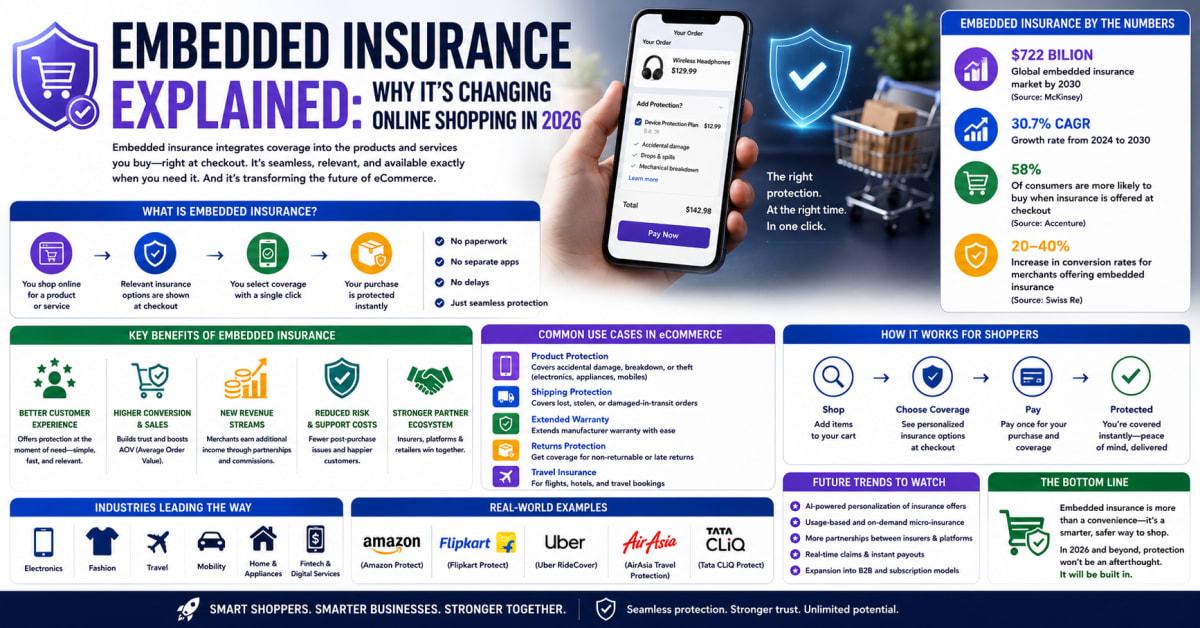
Embedded Insurance 2026: Why It's Everywhere Now
You've almost certainly seen it: a small checkbox at checkout offering to protect your new phone, your flight, or your rental car for a few extra dollars. That's not a random upsell. It's a fast-growing part of the insurance industry called embedded insurance, and it's changing how coverage gets sold entirely.
Embedded insurance means coverage built directly into the purchase itself, offered in real time at the point of sale without a separate application process. This guide explains how it actually works, why it's expanding so quickly across online shopping, travel, and even car purchases, and how to tell a genuinely useful add-on from one you can safely skip.
Embedded Insurance — What It Is and Why It's Growing So Fast
Embedded insurance integrates coverage directly into the purchase journey of a product or service, powered by APIs that connect insurers with retailers, travel platforms, or tech companies. Instead of separately shopping for a policy, you're offered relevant protection, like device damage coverage or trip cancellation insurance, right at the moment you're already buying something related to it.
This matters because it fundamentally changes insurance distribution. Rather than insurers marketing policies directly to consumers, coverage now shows up contextually, embedded in the exact transaction where it's most relevant, which dramatically lowers the friction to purchase.
Why This Is Important Right Now
Picture someone buying a new laptop online and being offered device protection for a few dollars a month at checkout, without ever having to research or compare separate insurance providers. That frictionless moment is exactly why embedded insurance has grown so quickly. It removes the traditional barrier of insurance feeling like a separate, tedious purchase decision.
A large majority of Millennials and Gen Z consumers say they want auto insurance included directly with a vehicle purchase, reflecting a broader generational shift toward expecting protection to be bundled into the buying experience rather than sourced separately.
Key Facts About Embedded Insurance in 2026
A few core facts explain how this market actually works and why it's expanding so rapidly across so many industries.
- E-commerce and online platforms represent the largest distribution channel — commonly cited as capturing roughly half of the embedded insurance market by channel share in 2026.
- Electronics protection is the single largest insurance line — accounting for close to 45% of embedded insurance offerings, driven by checkout add-ons for smartphones, laptops, and other devices.
- The market is growing at a rapid annual rate — with multiple industry analysts projecting compound annual growth rates in the 19% to 30% range through the rest of the decade.
- API-first, no-code platforms are cutting insurer costs significantly — enabling faster product launches and letting non-insurance companies partner with carriers more efficiently than traditional distribution ever allowed.
- Real-world examples are already common — platforms like Airbnb now embed home-sharing insurance directly into bookings, automatically covering hosts and guests for certain liabilities or damages during a stay.
What the Industry Data Shows
Industry data suggests that embedded insurance is one of the fastest-growing segments of the broader insurance industry, with growth attributed to rising digital commerce, increasing insurtech partnerships between carriers and non-insurance platforms, and improving AI-driven underwriting that allows real-time risk assessment at the exact moment of purchase.
Market research firms have consistently identified electronics protection and travel-related coverage as leading insurance lines within this space, while noting that usage-based and micro-insurance products, tied to connected devices or specific short-term needs, represent some of the fastest-growing subcategories as the underlying technology matures.
Benefits and Real Opportunities
Embedded insurance offers real advantages for consumers, not just convenience for retailers and platforms.
- Contextual, relevant coverage at the right moment — protection offered exactly when it's needed, like device coverage when buying a phone, rather than requiring a separate search later.
- Faster, simpler purchasing process — no separate application, medical questionnaire, or lengthy underwriting process for many embedded products.
- Often lower cost for narrow, specific coverage — a targeted policy, like trip cancellation insurance for one flight, can cost less than adjusting a broader existing policy to cover the same risk.
- Increasing automation in claims — many embedded insurance products are built with streamlined, digital-first claims processes designed to match the frictionless purchase experience.
Costs and What to Expect
Embedded insurance products are typically priced as small add-ons relative to the primary purchase, ranging from a few dollars for device protection plans to a modest percentage of a larger purchase, like a vacation package or a vehicle. Because these policies are narrow in scope, tied specifically to the item or trip being purchased, they're often cheaper upfront than adjusting a broader homeowners or renters policy to cover the same specific risk.
That narrow scope is also the tradeoff: embedded coverage typically protects only the specific item or event tied to the original purchase, unlike a broader policy that might cover a wider range of situations. Reading the exact terms, deductibles, and exclusions matters just as much here as with any traditional insurance product, even though the purchase process feels far more casual.
For businesses, the cost consideration is different: integrating embedded insurance typically requires an API partnership with an insurer or insurtech provider, and no-code platforms have significantly reduced the development cost and time needed to launch these offerings compared to traditional insurance product development.
Embedded Device Protection vs Embedded Travel Insurance vs Traditional Standalone Policies: Which One Is Right for You?
| Option | Best For | Pros | Cons |
|---|---|---|---|
| Embedded Device Protection | Buyers of smartphones, laptops, and other electronics | Instant coverage at checkout with no separate application | May overlap with existing homeowners, renters, or credit card coverage |
| Embedded Travel Insurance | Travelers wanting trip-specific cancellation or delay coverage | Convenient, trip-specific pricing tied directly to your booking | Coverage limits and exclusions vary widely between platforms |
| Traditional Standalone Policies | People wanting broader, more comprehensive coverage across many risks | Typically more comprehensive, covering a wider range of situations | Requires a separate application and more upfront research |
Who Should Actually Care About Embedded Insurance?
This matters for anyone who regularly shops online for electronics, books travel, or rents property through a platform, since embedded coverage will likely be presented to you at checkout whether you seek it out or not. It's also relevant for small business owners and platform operators exploring insurtech partnerships as a way to add value and revenue to their existing customer purchase journey.
Mistakes Most People Make
A handful of habits lead consumers to either overpay or miss out on genuinely useful embedded coverage.
Clicking "add protection" reflexively at checkout without checking whether an existing policy, like a renters policy or a credit card's purchase protection benefit, already covers the same item leads to paying for duplicate coverage. Checking your existing policies first avoids that overlap.
Skipping the fine print on an embedded travel insurance add-on because the checkout process feels casual can mean missing important exclusions, like coverage that doesn't apply to pre-existing conditions or specific cancellation reasons. Reading the actual terms, even for a quick add-on, matters just as much as with a traditional policy.
Assuming all embedded insurance products come from the same underwriter or carry the same claims process overlooks that these products vary significantly depending on which insurtech partner powers the specific platform's offering. Checking who actually underwrites the policy helps set realistic claims expectations.
Declining every checkout insurance offer out of general skepticism can mean missing genuinely useful, low-cost protection for a specific, real risk, like device damage or trip cancellation, that a broader policy might not fully cover anyway.
What Most Articles Won't Tell You
Most coverage focuses on the market's rapid growth, but the more practical consumer question is overlap: many embedded protection offers duplicate coverage you may already have through a credit card's purchase protection benefit or an existing homeowners or renters policy's personal property coverage.
There's also a detail worth knowing: real-time, AI-driven underwriting is what makes embedded insurance's instant approval possible, but that same speed means less individualized risk assessment than a traditional policy might apply, which is part of why embedded products tend to be narrower in scope rather than broadly comprehensive.
Advanced Moves Worth Knowing
Checking your credit card's purchase protection and extended warranty benefits before buying embedded device coverage can reveal you're already covered for a meaningful portion of what the checkout add-on offers, at no additional cost.
Comparing an embedded travel insurance quote against a standalone travel insurance policy for the same trip occasionally reveals better coverage limits or pricing outside the platform's default offering, especially for longer or more expensive trips.
Frequently Asked Questions
Is embedded insurance the same as a warranty?
Not exactly. A warranty typically covers manufacturing defects, while embedded insurance more often covers accidental damage, loss, theft, or trip-related risks, depending on the specific product. It's worth checking the exact coverage terms, since the two aren't interchangeable.
Do I need embedded insurance if I already have homeowners or renters insurance?
Not necessarily. Many homeowners and renters policies already cover personal property, including electronics, against certain risks, so it's worth checking your existing policy's coverage and deductible before adding embedded protection for the same item.
Who actually underwrites embedded insurance products?
It varies by platform. Embedded insurance is typically powered by a partnership between the retailer or platform and an established insurer or insurtech company, so the underwriter and claims process can differ significantly even for similar-looking checkout offers.
Is embedded insurance more expensive than a traditional policy?
Not usually, for its narrow scope. Since embedded products typically cover a specific item or event rather than broad risks, they're often cheaper upfront than adjusting a comprehensive policy, though they also generally provide narrower protection in return.
Why is embedded insurance growing so quickly?
Growth is driven largely by expanding digital commerce, improved API technology that lets insurers partner with retailers and platforms efficiently, and rising consumer demand for frictionless, contextual protection at the point of sale rather than a separate insurance-shopping process.
The Bottom Line on Embedded Insurance in 2026
Embedded insurance has become a genuinely fast-growing part of how coverage gets sold in 2026, showing up at checkout across online shopping, travel booking, and even vehicle purchases. The convenience is real, but so is the risk of paying for coverage you already have through an existing policy or credit card benefit. Before clicking "add protection" on your next purchase, take thirty seconds to check what you're already covered for. The embedded option might still be worth it, but that quick check ensures you're paying for something you actually need.
Read Next
Shock Warning: Humana Cuts Medicare Benefits for Thousands in GA!

Rural Health Crisis: Shocking Medicaid Loss Threatens New Hampshire's Future

Shocking Reveals: What Medicare Part B Truly Covers in 2023

Urgent Reveal: Medicaid's Key Role in Boosting Children's Health Now!

Urgent Warning: Hantavirus Cruise Outbreak Revealed—Is a Crisis Looming?