Cyber Insurance for Small Business in 2026: Worth It?
The average data breach costs $4.44 million. Cyber insurance costs $1,200 to $7,500 a year for most small businesses. Here's whether that math makes sense for you.
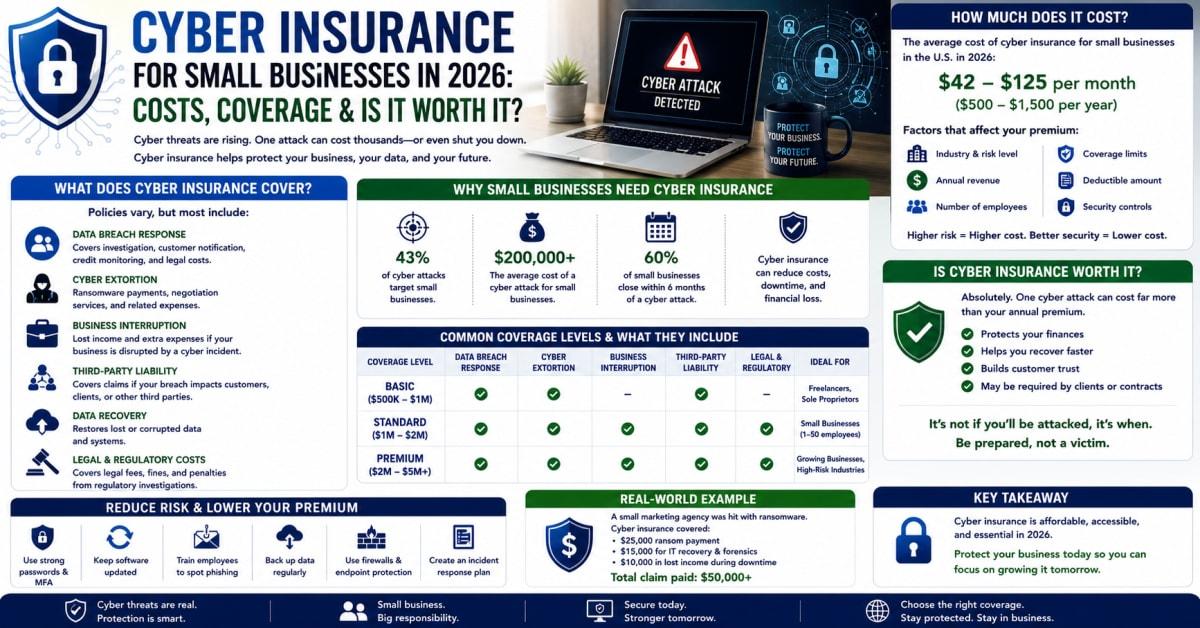
Cyber Insurance for Small Business in 2026: Worth It?
A single data breach now costs businesses an average of $4.44 million globally, a figure that would end most small businesses outright. Cyber insurance for a typical small business costs a small fraction of that per year, which makes the math worth understanding before deciding whether to skip it.
Cyber insurance for small businesses in 2026 sits at an important crossroads: premiums remain reasonable for well-secured businesses, but insurers now expect specific security controls before they'll even quote a policy. This guide breaks down what coverage actually costs, what it covers, and how to decide if it's genuinely worth it for your specific business.
Cyber Insurance for Small Business — What It Is and Why It Matters
Cyber insurance shifts the financial burden of a data breach or cyberattack from your business to an insurance carrier, covering costs like forensic investigation, system restoration, legal defense, and customer notification. It typically splits into first-party coverage, your business's direct losses, and third-party coverage, claims and legal costs from affected customers or partners.
This matters because small businesses have become a primary target for cybercriminals precisely because they tend to hold valuable customer data while running weaker security defenses than larger enterprises with dedicated security teams.
Why This Is Important Right Now
Picture a small accounting firm hit by a business email compromise scam, where a fraudulent wire transfer request drains tens of thousands of dollars before anyone catches it. Without cyber coverage, that loss comes directly out of the business's operating cash, often with no recovery path at all.
Ransomware payments have climbed past an average of $400,000 per incident in 2026, with total event costs, including recovery and business interruption, often reaching $1 million to $5 million for mid-size businesses. That scale of exposure has pushed cyber insurance from optional to increasingly essential for any business handling customer data.
Key Facts About Cyber Insurance for Small Businesses
A few core facts explain how pricing and coverage actually work in the current cyber insurance market.
- Most small businesses pay between $1,200 and $7,500 annually — for a standard policy, with the median cost sitting around $1,500 to $1,740 per year for $1 million in coverage.
- Industry risk significantly affects pricing — construction firms often pay $1,000 to $2,000, while professional services and healthcare practices typically pay $2,500 to $5,000 for the same coverage limit.
- Multi-factor authentication has become a near-universal requirement — most insurers won't quote a policy at all without it in place.
- Business email compromise is now the most common claim type — with average losses of $50,000 to $300,000 per event, often uninsured if social engineering coverage is missing.
- Ransomware remains the most expensive claim type — with total event costs frequently reaching $1 million to $5 million once recovery and business interruption are included.
What the Industry Data Shows
Industry data suggests that despite rising claim activity industry-wide, many small businesses are actually seeing flat to slightly lower pricing on an apples-to-apples basis in 2026, since there remains substantial capacity in the cyber insurance marketplace for well-controlled risks.
Analysis from insurance industry sources has found that global cyber insurance premiums reached nearly $15 billion in 2024 and are forecast to climb toward roughly $23 billion by the end of 2026, reflecting both rising demand and insurers' growing confidence in pricing this risk accurately as claims data matures.
Benefits and Real Opportunities
Beyond simply covering losses, the right cyber policy creates real strategic value for a small business.
- Financial protection against catastrophic loss — a policy that costs a few thousand dollars a year protects against claims that can reach millions.
- Access to breach response expertise — many policies include access to forensic investigators and legal counsel who specialize in breach response, resources most small businesses don't have on staff.
- Stronger security posture as a side effect — meeting insurer requirements like MFA and endpoint detection often meaningfully improves your actual security, not just your insurability.
- Better rates for businesses that invest in controls early — implementing security measures before you're forced to by growth or a near-miss typically earns more favorable pricing.
Costs and What to Expect
Most small businesses, generally defined as having 1 to 100 employees and revenue under $10 million, pay between $1,200 and $7,500 annually for standalone cyber coverage with a $1 million limit, with median costs commonly cited around $1,500 per year. On a monthly basis, this often works out to roughly $37 to $187, depending on industry and risk profile.
Industry matters significantly: construction and lower-risk service businesses often see the lowest end of that range, while professional services, legal, and healthcare practices handling more sensitive data typically pay $2,500 to $5,000 or more for comparable coverage. Businesses with prior claims, weak security controls, or high volumes of regulated data like health or financial records can see premiums climb well beyond $10,000 annually in higher-risk cases.
Beyond the premium itself, most experts recommend budgeting separately for the security controls insurers now expect, including multi-factor authentication, endpoint detection and response, and regular employee security training, which itself offers a strong return, since a modest annual training investment per employee can meaningfully cut phishing click rates.
Standalone Cyber Policy vs Cyber Endorsement on Existing Insurance vs Bundled Business Owner's Policy: Which One Is Right for You?
| Option | Best For | Pros | Cons |
|---|---|---|---|
| Standalone Cyber Policy | Businesses handling sensitive customer or regulated data | Broader, more comprehensive coverage with higher available limits | Generally the most expensive option of the three |
| Cyber Endorsement on Existing Insurance | Businesses with lower risk wanting basic added protection | Lower cost add-on to a policy you likely already have | Often limited sub-limits that may not cover a major incident fully |
| Bundled Business Owner's Policy | Very small businesses wanting simplified, consolidated coverage | Convenient bundling with general liability and property coverage | May have coverage gaps for more severe or specialized cyber events |
Who Should Actually Care About Cyber Insurance?
This matters for virtually any small business that stores customer data, processes payments, or relies on email for financial transactions, which describes the overwhelming majority of modern small businesses. It's especially critical for professional services firms, healthcare practices, law firms, and any business handling regulated data like health records or financial information, since these industries face both higher attack frequency and higher regulatory exposure.
Mistakes Most People Make
A handful of habits leave small businesses underinsured or paying more than necessary.
Assuming a general business owner's policy or professional liability policy already covers cyber incidents overlooks that these often carry limited sub-limits inadequate for a serious breach. Confirming whether dedicated cyber coverage or a meaningful endorsement exists, rather than assuming it's bundled in, avoids a dangerous coverage gap.
Delaying basic security controls like multi-factor authentication until forced to by an insurer can mean paying a higher premium than a business that implemented these controls proactively. Adding baseline security measures before shopping for coverage typically results in better pricing.
Choosing the cheapest available policy without checking for social engineering coverage can leave a business exposed to business email compromise losses, now the most common claim type, with no path to recovery. Verifying this specific coverage exists before finalizing a policy closes that gap.
Treating cyber insurance as a replacement for security investment, rather than a complement to it, misunderstands its purpose. Insurance reduces financial exposure after an incident; it doesn't prevent the attack itself.
What Most Articles Won't Tell You
Most coverage focuses on the premium cost, but the security controls insurers require, MFA, endpoint detection, and documented backup procedures, often deliver security value on their own that exceeds the cost of the policy itself, regardless of whether a claim is ever filed.
There's also a detail worth knowing: businesses approaching a size threshold that typically triggers stricter underwriting, often around the point of hiring additional employees, benefit from investing in security controls proactively before crossing that line, since insurers reward businesses that manage the transition intentionally with better rates than those who cross the threshold unprepared.
Advanced Moves Worth Knowing
Documenting your existing security controls clearly before requesting quotes, rather than assuming an insurer will simply ask the right questions, can meaningfully improve the rate you're offered, since insurers price based on demonstrated risk management, not just self-reported answers.
Working with an insurance advisor who can compare quotes across multiple carriers, rather than accepting the first quote received, often reveals meaningfully different pricing for comparable coverage, since cyber insurance pricing varies more between carriers than many other commercial policy types.
Frequently Asked Questions
Is cyber insurance actually worth it for a very small business?
For nearly any business storing customer data, yes. A premium of a few thousand dollars against claims that can reach tens of thousands, or breaches averaging millions industry-wide, generally represents sound financial protection.
Does cyber insurance cover ransomware payments?
Many policies do cover ransomware-related costs, including the ransom itself in some cases, along with recovery and business interruption costs, though coverage specifics vary significantly by policy, so it's worth confirming this explicitly before purchasing.
What security controls do insurers require for cyber coverage?
Multi-factor authentication has become a near-universal baseline requirement, with many insurers also expecting endpoint detection and response, regular data backups, and documented security policies before offering competitive pricing.
Does a general business owner's policy already include cyber coverage?
Often only in a limited form, if at all. Many general business policies carry restricted sub-limits for cyber incidents that fall well short of what a serious breach actually costs, making standalone or expanded cyber coverage worth considering separately.
Why does cyber insurance cost more for some industries than others?
Industries handling more sensitive regulated data, like healthcare, legal, and financial services, face both higher attack frequency and steeper regulatory penalties if a breach occurs, which drives their premiums meaningfully higher than lower-risk industries like construction.
The Bottom Line on Cyber Insurance for Small Businesses in 2026
Cyber insurance in 2026 costs most small businesses between $1,200 and $7,500 a year, a modest price against claims that can reach millions and breaches that average $4.44 million globally. The math clearly favors coverage for nearly any business handling customer data, but the smartest approach pairs insurance with genuine security investment, since insurers increasingly require it anyway and it meaningfully reduces your actual risk of a claim in the first place. Review your current coverage, or lack of it, against your specific industry's risk profile, and treat basic security controls as the first step toward a better premium, not an afterthought.
Read Next
Urgent: CMS Issues Warning on Medicaid Provider Revalidation—Big Changes Ahead!
Warning: NC Medicaid Bill Flaws Could Lead to Financial Crisis!

Crisis in Rural Health: Medicaid Loss Impact in NH

Shock as CarolinaEast Drops Medicare Advantage Coverage: What It Means for You

Shocking Medicare Part B Secrets Revealed: What You Must Know Now!