How to Create a Monthly Budget That Actually Works
Most budgets fail within a few weeks. Here's a step-by-step approach to building one flexible enough to actually stick in 2026.
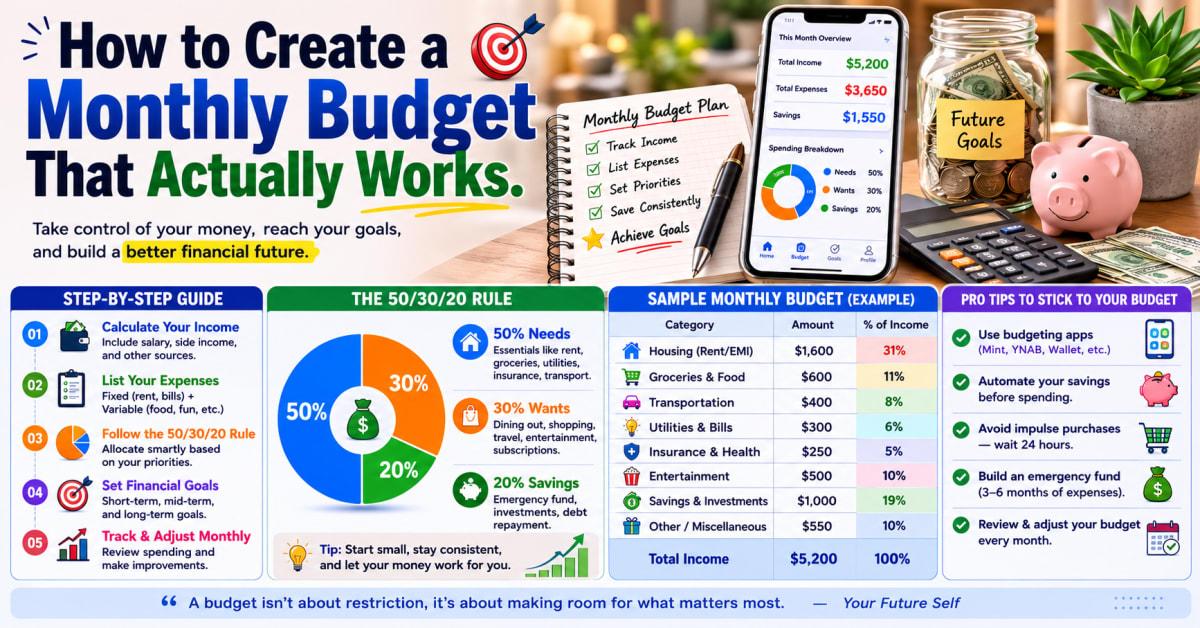
How to Create a Monthly Budget That Actually Works
Most people don't fail at budgeting because they lack discipline. They fail because their budget was unrealistic from the very first week, built around who they wished they were instead of how they actually spend.
Building a monthly budget that actually works means designing something flexible enough to survive contact with real life. This guide walks through a practical, step-by-step approach to budgeting in 2026, covering how to track your real spending, where most budgets break down, and a few advanced tweaks that make the whole system easier to stick with long term.
Monthly Budgeting — What It Is and Why It Matters
A monthly budget is a plan for where your income goes each month, broken down into categories like housing, food, debt payments, and savings. Done well, it's not a restriction. It's a decision-making tool that tells your money what to do before the month starts, instead of wondering where it went after it's gone.
Budgeting matters because it's the foundation every other financial goal sits on top of. You can't build an emergency fund, pay off debt faster, or invest consistently without first knowing exactly what you can afford to put toward each of those goals.
Why This Is Important Right Now
Picture someone who downloaded a budgeting app, set aggressive category limits on day one, and abandoned the whole system within three weeks because the numbers never matched reality. That pattern is extremely common, and it usually comes from starting with guesses instead of actual data.
With household costs still elevated compared to a few years ago, the margin for error in a monthly budget has gotten thinner for a lot of families. A realistic, flexible budget matters more now than it did when costs were more predictable.
Key Facts About Building a Monthly Budget
A few core principles separate a budget that survives from one that gets abandoned within the first month. These facts shape every step that follows.
- Tracking past spending beats guessing future spending — reviewing two to three months of actual transactions gives a far more accurate baseline than estimating from memory.
- Fixed and variable expenses need different treatment — fixed costs like rent stay consistent, while variable costs like groceries need a flexible range, not a rigid number.
- A buffer category prevents small overspends from breaking the whole system — building in a miscellaneous cushion absorbs the inevitable surprise expense without derailing your plan.
- Automating savings and bill payments reduces reliance on willpower — a budget that runs partly on autopilot is far more durable than one requiring constant manual discipline.
- Budgets need regular revisions, not permanence — a plan that worked in January may need adjusting after a rent increase or a new bill in June.
What the Industry Data Shows
Industry data suggests that budgeting methods emphasizing flexible spending ranges rather than rigid category caps tend to see better long-term adherence, since a rigid system tends to break down the first time real life doesn't match the plan exactly.
Financial behavior research covered in outlets like Forbes and NerdWallet has consistently found that people who automate savings transfers save more consistently than those relying on manual transfers at the end of the month, regardless of income level.
Benefits and Real Opportunities
A budget that actually works creates value well beyond simply tracking numbers in a spreadsheet or app.
- Reduced financial anxiety — knowing exactly where your money is going removes a major source of everyday stress.
- Faster progress toward goals — a clear plan makes it obvious how much you can realistically put toward debt payoff or savings each month.
- Fewer impulsive financial decisions — having a plan in place makes it easier to pause before an unplanned purchase.
- Better conversations about money — a shared household budget gives couples or families a common reference point instead of vague assumptions.
Costs and What to Expect
Budgeting itself costs nothing beyond your time, though many people choose to use a budgeting app to simplify tracking. Free options exist with solid core features, while premium budgeting apps often range from around $5 to $15 per month for more advanced tools like automatic categorization or shared household access.
The real "cost" of budgeting well is the time investment upfront, typically a few hours reviewing past bank and credit card statements to build an accurate baseline. After that initial setup, maintaining a budget usually takes just ten to twenty minutes a week if most of the process is automated.
Some people also invest in a one-time session with a financial coach or planner to help set up their first realistic budget, which can range widely in cost depending on the professional, though this is optional and many people build an effective budget entirely on their own.
Zero-Based Budgeting vs 50/30/20 Budgeting vs Envelope Budgeting: Which One Is Right for You?
| Option | Best For | Pros | Cons |
|---|---|---|---|
| Zero-Based Budgeting | People who want every dollar assigned a specific job | Maximum control and visibility over every category of spending | More time-intensive to set up and maintain each month |
| 50/30/20 Budgeting | Beginners who want a simple, broad framework to start with | Easy to understand and quick to set up with minimal tracking | Less precise for people with irregular income or unusual expenses |
| Envelope Budgeting | People who overspend easily with cards and want a hard stop | Physical or digital spending limits that are hard to accidentally exceed | Can feel rigid and less convenient for digital-first spenders |
Who Should Actually Care About Building a Better Monthly Budget?
This matters for anyone who's tried budgeting before and quit within a few months, households juggling multiple financial goals like debt payoff and saving at the same time, and people with variable or irregular income who find rigid budgeting frameworks especially frustrating. It's equally useful for anyone with a stable income who simply wants more intentionality around where their money actually goes.
Mistakes Most People Make
A handful of habits derail budgets again and again, and each one is fixable.
Setting overly strict category limits based on guesswork rather than real spending data leads to a budget that breaks within the first week. Reviewing actual past transactions before setting any limit avoids that mismatch entirely.
Forgetting to budget for irregular expenses, like car maintenance or annual subscriptions, means those costs feel like emergencies when they're actually predictable. Building a sinking fund category for irregular expenses smooths this out.
Abandoning the entire budget after one bad month treats a single setback as total failure. Adjusting the plan and continuing, rather than starting over from scratch, keeps momentum intact.
Relying entirely on willpower to stay within limits ignores how much easier automation makes the whole process. Automating savings transfers and bill payments removes decision fatigue from the equation.
What Most Articles Won't Tell You
Most budgeting guides present one method as the definitive answer, but the specific framework matters far less than whether you actually stick with it. A loosely followed "perfect" system often performs worse than a simpler one you actually maintain consistently.
There's also a detail often missed: building in a deliberate "guilt-free spending" category, even a small one, tends to make the entire budget easier to sustain, since it removes the all-or-nothing mentality that causes people to abandon budgeting after one indulgent purchase.
Advanced Moves Worth Knowing
Running a mid-month check-in, not just an end-of-month review, lets you catch an overspent category early enough to adjust the remaining weeks instead of discovering the problem after it's too late to fix.
Assigning specific savings goals their own named sub-accounts, rather than one generic savings bucket, makes it easier to track progress toward multiple goals at once without constantly recalculating from a single total.
Frequently Asked Questions
What's the easiest budgeting method for a beginner?
The 50/30/20 method is generally the easiest starting point, since it uses broad categories rather than requiring detailed tracking of every single expense right away.
How do I budget with an irregular or variable income?
Basing your budget on your lowest expected monthly income, rather than an average, provides a safer baseline. Any income above that baseline in a good month can go directly toward savings or debt payoff instead of being built into fixed monthly expectations.
How often should I review or adjust my budget?
A quick weekly check-in helps catch overspending early, while a more thorough monthly review lets you adjust categories based on how the past month actually went. Major life changes, like a new bill or income change, warrant an immediate revision.
Do I need a budgeting app, or can I just use a spreadsheet?
Either works well, and the right choice depends on your comfort level. A spreadsheet offers full customization at no cost, while an app can automate transaction categorization and save time if you're comfortable linking your accounts.
What should I do if I keep failing to stick to my budget?
Revisit whether your category limits are based on actual past spending or just guesses, since unrealistic limits are the most common reason budgets fail. Building in a small buffer or guilt-free spending category often makes a rigid budget far easier to maintain.
The Bottom Line on Building a Monthly Budget That Works
A monthly budget that actually works isn't built on discipline alone. It's built on realistic numbers, a little flexibility, and enough automation that the system doesn't fully depend on willpower every single day. Start by reviewing your last two or three months of real spending, not a guess, and build your categories from there. Adjust as life changes, and the budget will keep working long after the motivation from day one has worn off.
Read Next

Lumentum's Stock Soars: What This Hot Index Reveal Means for You

Shock Layoffs: Cloudflare Cuts 1,100 Jobs as Stock Takes a Hit!

Shock Surges: Nasdaq and S&P 500 Record Highs Amid Iran Hopes

Memory Stocks Boom: Micron and Sandisk's Surprising Rise

S&P 500 and Nasdaq Soar Amid Chip Stock Boom and Jobs Data Surge