Money Market vs High-Yield Savings: Which Wins in 2026?
Both accounts pay around 4% APY in 2026. Here's the real difference: check-writing access, minimum balances, and tiered rates that actually determine which one wins for you.
Money Market vs High-Yield Savings: Which Wins in 2026?
Both a money market account and a high-yield savings account can pay you over 4% APY right now, which makes the rate itself almost a tie. The real decision comes down to something most comparisons skip entirely: how you actually plan to access and use the money.
Money market account vs high-yield savings account isn't really a question of which pays more, since the gap in 2026 is often just a fraction of a percentage point. It's a question of structure: minimum balances, check-writing access, and whether a tiered rate rewards a larger balance more than a flat-rate account would. This guide breaks down exactly where each one wins.
Money Market Account vs High-Yield Savings Account — What They Are and Why the Difference Matters
A high-yield savings account is a basic savings product paying significantly more interest than a traditional bank savings account, typically offered by online banks with no branch overhead to cover. A money market account is a similar interest-bearing deposit account, but it often comes with check-writing privileges or a linked debit card, along with tiered interest rates that can reward larger balances.
Both are FDIC-insured deposit accounts, not investments, which means your principal is protected the same way regardless of which one you choose. The real difference sits in access and structure, not risk.
Why This Is Important Right Now
Picture someone with $50,000 in savings who defaults to a standard high-yield savings account without checking whether a tiered money market account would pay more at that specific balance level. Depending on the institution, that oversight could mean leaving real money on the table simply because they didn't compare both account types for their actual balance.
Rates on both account types have been gradually trending downward since their peak, following Federal Reserve rate decisions, which makes comparing current offers more important than relying on outdated advice about which account type "always" pays more.
Key Facts About Money Market Accounts vs High-Yield Savings Accounts
A few core facts explain how these two account types actually differ heading into the rest of 2026.
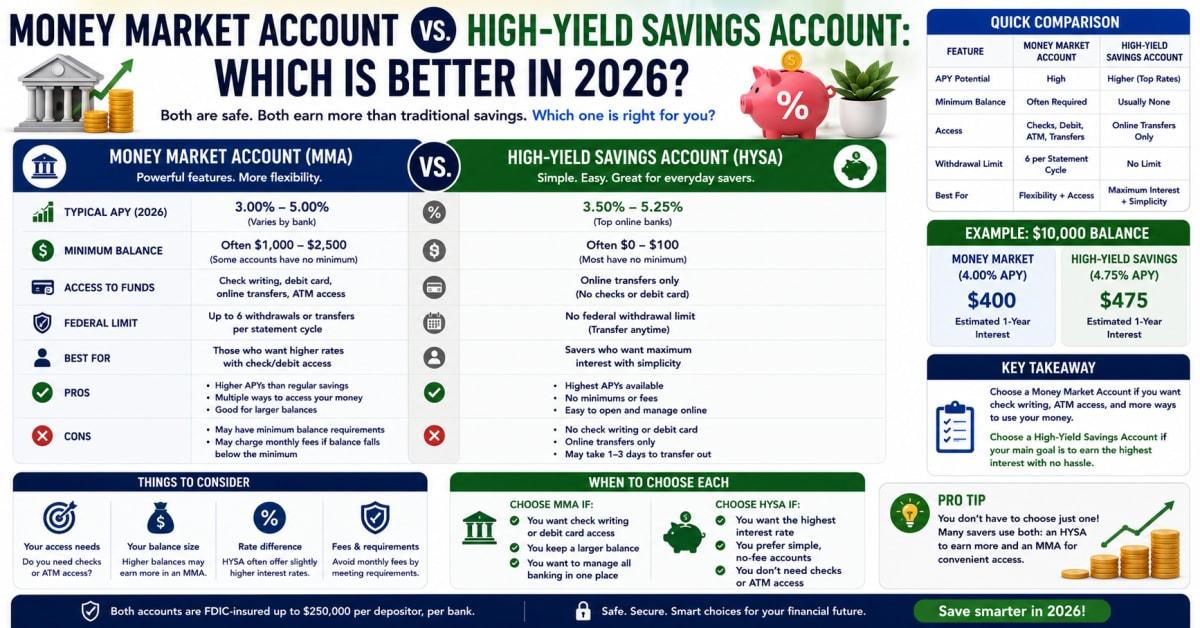
- Top rates on both account types commonly range from 4.00% to 4.50% APY — far above the national average savings rate of roughly 0.38% to 0.6%.
- Money market accounts often use tiered interest rates — meaning a larger balance, such as $50,000 or more, can sometimes earn a higher rate than a standard high-yield savings account offers.
- Minimum balance requirements differ meaningfully — high-yield savings accounts are typically zero or very low, while money market accounts commonly require $500 to $2,500 to open or avoid a fee.
- Money market accounts often include check-writing or debit card access — a feature standard high-yield savings accounts typically don't offer.
- Both are variable-rate accounts — unlike a CD's fixed rate, both APYs can rise or fall with Federal Reserve rate decisions, so a $10,000 balance's annual earnings can shift by $100 or more as rates move.
What the Industry Data Shows
Industry data suggests that in 2026, high-yield savings accounts remain highly competitive largely because online banks use them to attract deposits without the overhead cost of physical branches, while money market accounts can still win for savers with larger balances due to tiered rate structures that reward higher deposits.
Analysis from outlets like CBS News and CNBC has consistently found that the earnings gap between a high-yield savings account and a money market account on a typical $5,000 to $10,000 balance is often marginal, sometimes just a dollar or two difference over several months, which means account features often matter more than the rate itself for most savers.
Benefits and Real Opportunities
Choosing the right account for your specific balance and access needs creates real value beyond just chasing the highest advertised rate.
- Both options far outpace traditional bank savings rates — either choice puts your money to work meaningfully harder than the national average.
- Money market accounts add payment flexibility — check-writing or debit card access lets you use the account for occasional larger payments without transferring funds first.
- High-yield savings accounts keep things simple — no minimum balance and no check-writing complexity, ideal for a straightforward emergency fund.
- Tiered money market rates reward larger savers — a bigger cash position can sometimes unlock a better rate than a flat high-yield savings account offers.
Costs and What to Expect
High-yield savings accounts at competitive online banks typically charge no monthly fee and require no minimum balance at all. Money market accounts more commonly require a minimum balance, often $500 to $2,500, and may charge a monthly fee if your balance drops below that threshold, though many top accounts waive this fee entirely once the minimum is met.
Interest earned on both account types is taxed identically, as ordinary income on your federal return, with your bank issuing a 1099-INT for any year you earn more than $10 in interest. Some states also tax this interest income, so it's worth checking your specific state's rules. Neither account type carries an early withdrawal penalty, unlike a CD, though some money market accounts still cap the number of certain transactions per statement cycle.
Both account types carry variable rates, which means the advertised APY isn't locked in. A rate cut from the Federal Reserve typically shows up in your account within a few weeks, so the exact annual return on either account can shift meaningfully over a twelve-month period.
High-Yield Savings Account vs Standard Money Market Account vs Tiered Money Market Account: Which One Is Right for You?
| Option | Best For | Pros | Cons |
|---|---|---|---|
| High-Yield Savings Account | Savers with a modest balance who want simplicity | No minimum balance and typically no monthly fee | No check-writing or debit card access at most banks |
| Standard Money Market Account | Savers wanting check-writing or debit access to their savings | Added payment flexibility with competitive rates | Usually requires a minimum balance to avoid a fee |
| Tiered Money Market Account | Savers with $50,000 or more looking to maximize their rate | Can outpace a standard high-yield savings rate at larger balances | Lower balances may not qualify for the top advertised tier |
Who Should Actually Care About This Comparison?
This matters for anyone deciding where to park an emergency fund, short-term savings goal, or a larger cash position earning minimal interest at a traditional bank. It's especially relevant for savers with $50,000 or more who could benefit from a tiered money market rate, and for anyone who occasionally needs to write a check or use a debit card directly from savings rather than transferring funds first.
Mistakes Most People Make
A handful of habits lead savers to the wrong account for their situation.
Assuming a money market account always pays more because it sounds more sophisticated overlooks that a standard high-yield savings account frequently matches or beats it at typical balance levels. Comparing actual current rates for your specific balance, not assumptions about account type, avoids this mismatch.
Opening a money market account without checking the minimum balance requirement can lead to an unexpected monthly fee if your balance dips below the threshold. Confirming the exact minimum and any associated fee before opening the account prevents that surprise.
Chasing the single highest advertised APY without checking whether it applies only to a specific balance tier or promotional period can leave you earning far less than expected. Reading the full rate structure, not just the headline number, avoids that letdown.
Ignoring how quickly both account types respond to Federal Reserve rate cuts means being caught off guard when your actual earnings drop faster than anticipated. Checking your rate periodically rather than assuming it's fixed like a CD keeps expectations realistic.
What Most Articles Won't Tell You
Most comparisons focus purely on APY, but the earnings gap between these two account types at typical balances is often just a few dollars over several months, which means it's rarely worth switching banks for rate alone. Structure and access usually matter more than the rate itself for most savers.
There's also a detail worth knowing: pairing a money market account for a larger cash cushion with a separate no-fee high-yield savings account for your core emergency fund lets you capture the best of both without forcing one account to do everything.
Advanced Moves Worth Knowing
Checking whether your specific balance qualifies for a money market account's top tier before opening one can reveal whether the advertised rate actually applies to you, since many tiered structures only reward balances above $25,000 or $50,000.
Splitting funds between a money market account for occasional check-writing needs and a high-yield savings account for your untouched emergency cushion avoids paying a minimum balance fee on money you don't need frequent access to.
Frequently Asked Questions
Is a money market account safer than a high-yield savings account?
No, both are equally safe when FDIC-insured, covering up to $250,000 per depositor. The safety is identical; the difference lies in access features and rate structure, not risk.
Do money market accounts always pay more than high-yield savings accounts?
No, not always. In 2026, both account types commonly pay similar rates around 4% to 4.5% APY, and a money market account only tends to pull ahead for savers with larger balances that qualify for a top tiered rate.
Can I write checks from a high-yield savings account?
Generally, no. Check-writing privileges are typically a money market account feature, not a standard high-yield savings account feature, which is one of the clearest structural differences between the two.
Will my money market or high-yield savings rate change if the Fed cuts rates?
Yes, both account types have variable rates that typically follow Federal Reserve rate changes within a few weeks, unlike a CD's fixed rate that stays the same until maturity.
Is it worth switching banks to get a slightly higher rate?
For most typical balances, the earnings difference between competitive accounts is often marginal, sometimes just a few dollars over several months. It's usually more worthwhile to switch if your current account pays close to the national average rather than to chase a fractional rate improvement between two already competitive options.
The Bottom Line on Money Market vs High-Yield Savings Accounts in 2026
Money market account vs high-yield savings account isn't really a battle over rate in 2026, since both commonly pay similarly competitive APYs. The real decision comes down to your balance size and whether you need check-writing or debit access built into your savings. Compare current rates for your specific balance tier, confirm any minimum balance requirements, and choose based on how you'll actually use the account, not just which one has the flashier headline number.
Read Next

Jim Cramer’s Shocking AI Call: Will Stocks Surge or Collapse?

Jim Cramer’s Shocking Warning on Gold: Investors Beware of the Collapse!

Uncover the Hidden AI Stocks Set to Surge in 2026!

Shock as Stock Futures Plunge Amid Iran War Crisis: Live Updates

Shocking AMD Stock Surge: Analysts Reveal Bold New Forecast!