FinCEN AML/CFT Program Reform 2026: Complete Compliance Guide
FinCEN's 2026 AML/CFT program reform replaces the outdated four-pillar checklist with a modern risk-based effectiveness framework. Learn what's changing, who's affected, and how to prepare for the new compliance landscape.
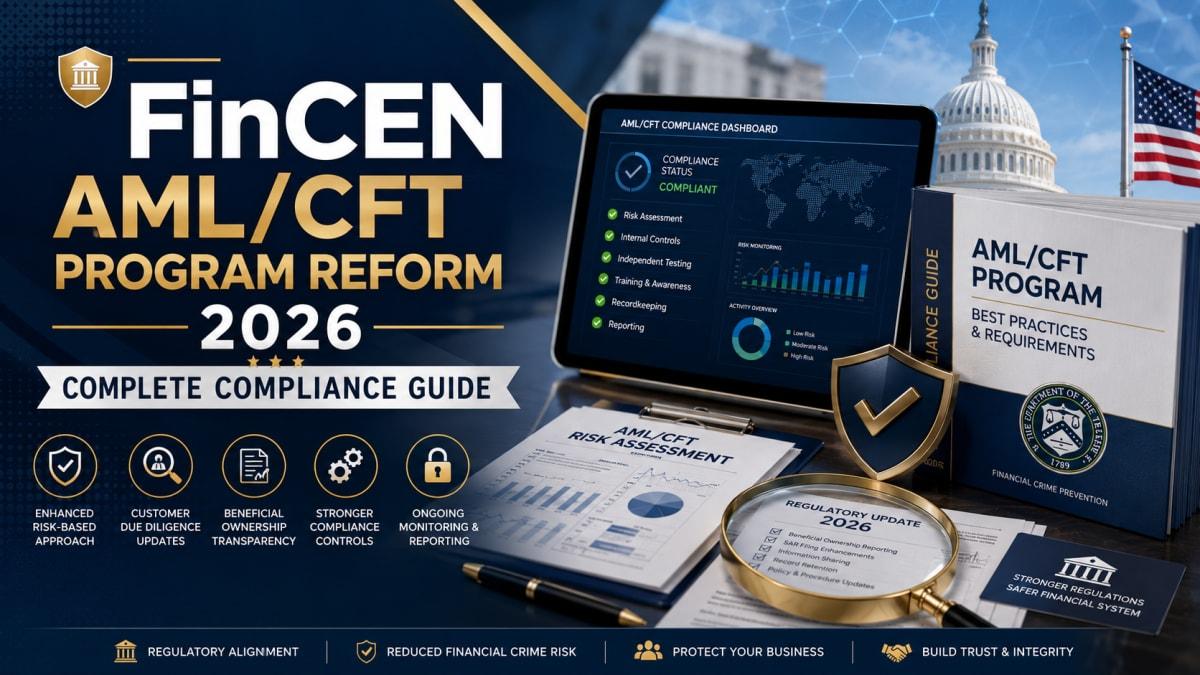
FinCEN AML/CFT Program Reform 2026: Complete Compliance Guide
The days of checking boxes to prove AML compliance are officially numbered.
On April 7, 2026, the Financial Crimes Enforcement Network (FinCEN) dropped a proposed rule that fundamentally rewrites how financial institutions must approach anti-money laundering and countering the financing of terrorism programs. The reform, years in the making, implements key provisions of the Anti-Money Laundering Act of 2020 and represents the most significant shift in BSA compliance since the USA PATRIOT Act.
The core change is simple but profound: instead of asking whether your program meets a fixed set of requirements, regulators will now ask whether your program is actually effective at combating financial crime.
Here's everything financial institutions, compliance officers, and risk managers need to know about FinCEN's 2026 AML/CFT program reform proposal.
What Is FinCEN's AML/CFT Program Reform?
The proposed rule modernizes AML/CFT program requirements under the Bank Secrecy Act. It implements the Anti-Money Laundering Act of 2020, which directed FinCEN to strengthen and modernize the AML/CFT regulatory framework for financial institutions.
The proposal replaces the traditional four AML program pillars—policies and procedures, independent testing, a designated compliance officer, and employee training—with a single standard: an \"effective\" AML/CFT program that is reasonably designed to achieve compliance in a risk-based, outcomes-oriented manner.
The rule applies to a broad spectrum of financial institutions, including banks, savings associations, credit unions, money services businesses (MSBs), broker-dealers, mutual funds, insurance companies, futures commission merchants, dealers in precious metals, and loan or finance companies.
Why This Reform Matters Now
Here's the thing: the current AML framework was designed for a different era. Financial crime has evolved. Technology has evolved. But compliance programs have often remained stuck in a rigid, process-oriented mindset that prioritizes documentation over detection.
The Canaccord Genuity case illustrates the stakes. In March 2026, FinCEN imposed an $80 million penalty—the largest BSA enforcement action against a broker-dealer—for willful failure to implement an effective AML program. The firm allegedly failed to file at least 160 suspicious activity reports involving fraud schemes that harmed innocent investors.
The reform aims to prevent such failures by focusing institutions on what actually works, not what generates the most paperwork.
Key Facts About the 2026 AML/CFT Program Reform
Here are the essential facts defining the proposed AML/CFT program reform.
- Effectiveness Standard — The proposal introduces \"effectiveness\" as the new compliance benchmark. Programs must be \"effective\" in combating money laundering and terrorist financing, not merely \"reasonably designed.\"
- Two-Tiered Framework — The reform formally distinguishes between program establishment (design) and program maintenance (implementation). Once established, only significant or systemic implementation failures would trigger enforcement.
- Risk-Based Resource Allocation — Institutions must direct more compliance resources to higher-risk customers, products, and activities, consistent with their documented risk assessments.
- Mandatory Risk Assessments — The proposal codifies risk assessment as a regulatory requirement, including explicit consideration of FinCEN's national AML/CFT priorities.
- Expanded FinCEN Oversight — Federal banking agencies must consult with FinCEN before taking significant AML/CFT supervisory actions against banks.
- Innovation Incentives — The proposal recognizes innovative technology use and law enforcement cooperation as mitigating factors in enforcement decisions.
What the Industry Data Shows
Industry analysis consistently suggests that the current AML framework imposes massive compliance costs with diminishing returns. The Treasury Department's 2026 National Money Laundering Risk Assessment identified broker-dealers, representing approximately 3,300 firms with total assets of roughly $6.4 trillion, as having significant exposure to illicit finance risks.
Research in this field shows approximately 80% of AML compliance spending is directed at low-risk activities. The reform aims to rebalance resource allocation toward genuine threats, potentially freeing billions for reinvestment in innovative detection technologies.
The timing also reflects broader financial crime trends. Illicit financial flows have become more sophisticated, with criminal networks exploiting gaps between traditional financial institutions and emerging fintech platforms. The reform seeks to close those gaps through a more flexible, risk-responsive framework.
Core Components of the AML/CFT Program Reform
The proposed rule introduces several fundamental changes to the AML compliance framework. Here's what's actually changing.
- Program Establishment Requirements — To establish an effective program, institutions must maintain four core elements: risk-based policies and controls, independent testing, a U.S.-based AML/CFT officer, and ongoing employee training. But the focus shifts from checking boxes to demonstrating real effectiveness.
- Program Implementation — Once established, programs must be maintained \"in all material respects.\" The proposal raises the threshold for supervisory action based on implementation deficiencies. Isolated or technical failures would not trigger significant enforcement.
- Risk Assessment Codification — The proposal would codify risk assessment as a regulatory requirement. Institutions must document their risk assessment procedures and incorporate FinCEN's government-wide AML/CFT priorities, which include corruption, cybercrime, terrorist financing, and drug trafficking.
- AML/CFT Priorities Integration — FinCEN's priorities must inform program design and resource allocation. Institutions that ignore these priorities risk regulatory criticism regardless of their overall program effectiveness.
- FinCEN Consultation — For banks, federal agencies must provide FinCEN at least 30 days' notice and opportunity to consult before initiating significant AML/CFT supervisory actions. This gives FinCEN a direct role in bank supervision.
- Mitigating Factors — The proposal explicitly recognizes innovative technology use, provision of highly useful information to law enforcement, and cooperation with regulatory inquiries as mitigating factors in enforcement decisions.
What This Means for Compliance Officers
For compliance officers, the shift from check-the-box to effectiveness is both liberating and demanding. The opportunity: less time spent on low-value documentation, more focus on actual risk. The challenge: proving effectiveness requires better data, better analytics, and better documentation of risk judgments.
Compliance officers should view this as a chance to transform AML programs from cost centers into strategic assets. The institutions that embrace this shift will gain competitive advantages in efficiency and regulatory reputation.
Who Should Actually Care About AML/CFT Program Reform?
If your institution is subject to the Bank Secrecy Act, you should care deeply. This includes banks, credit unions, MSBs, broker-dealers, mutual funds, insurance companies, casinos, and more.
But the reform matters beyond compliance officers. Senior leadership, boards of directors, and risk management committees all have responsibilities under the new framework. The effectiveness standard implicates governance, resource allocation, and strategic decision-making.
Fintech companies and digital asset firms should pay particular attention. The reform applies to money services businesses, which includes many cryptocurrency platforms and payment processors. The innovation incentives could benefit firms that deploy advanced detection technologies.
Mistakes Most People Make
A common mistake is assuming the proposal is just a minor update. It's not. The shift from \"reasonably designed\" to \"effective\" changes the entire compliance calculus. Institutions that treat this as business as usual will be caught off guard.
Another mistake is waiting for the final rule before taking action. Comments are due June 9, 2026, and FinCEN proposes a 12-month implementation period following final rule issuance. Smart institutions are already reviewing their current AML/CFT program governance, risk-assessment processes, and escalation frameworks.
Some institutions also underestimate the importance of documented risk assessments. The proposal would codify risk assessment as a regulatory requirement. Without robust documentation, institutions risk regulatory criticism regardless of how effective their programs actually are.
What Most Articles Won't Tell You
Most coverage focuses on the reduced compliance burden, but here's what gets overlooked: the proposal expands FinCEN's role in bank supervision significantly. For banks, federal agencies must now consult with FinCEN before significant supervisory actions. That means FinCEN—not just the primary regulator—will have a say in enforcement decisions.
Also worth noting: the Federal Reserve did not join the joint banking agency proposal issued by the OCC, FDIC, and NCUA. This creates potential inconsistency in how different banks are supervised. Institutions should monitor whether the Fed ultimately aligns with the proposed changes.
Advanced Moves Worth Knowing
For compliance leaders looking to get ahead, the proposal's recognition of innovative technology as a mitigating factor is significant. Institutions that proactively deploy AI, machine learning, and advanced analytics for AML monitoring could benefit in two ways: better detection of actual illicit activity, and potential leniency if enforcement actions arise.
Another advanced move: engaging proactively with FinCEN through the FinCEN Exchange Program or responding to 314(a) requests. The proposal explicitly recognizes that providing \"highly useful information to law enforcement or national security officials\" serves as a mitigating factor.
Consider also reviewing your institution's escalation procedures. The proposal emphasizes the importance of escalation frameworks for significant suspicious activity. Institutions with clear, documented escalation paths will be better positioned to demonstrate program effectiveness.
Frequently Asked Questions
What is FinCEN's 2026 AML/CFT program reform?
It's a proposed rule issued April 7, 2026, that would fundamentally reform AML/CFT program requirements under the Bank Secrecy Act. The proposal replaces the traditional four-pillar checklist with a risk-based effectiveness standard, implements the Anti-Money Laundering Act of 2020, and introduces a two-tiered enforcement framework.
Who does the proposed rule apply to?
The rule applies to a broad range of financial institutions: banks, credit unions, casinos, money services businesses, broker-dealers, mutual funds, insurance companies, futures commission merchants, dealers in precious metals, operators of credit card systems, and loan or finance companies.
What is the difference between program establishment and implementation?
Program establishment refers to designing and documenting the AML/CFT program with the required elements: risk-based policies, independent testing, a designated compliance officer, and employee training. Program implementation means maintaining that program in all material respects on an ongoing basis. The two-tiered framework sets a higher threshold for enforcement based on implementation failures.
What are FinCEN's AML/CFT priorities?
FinCEN publishes government-wide AML/CFT priorities that include corruption, cybercrime, terrorist financing, drug trafficking, and other illicit finance threats. The reform requires institutions to incorporate these priorities into their risk assessments and program design.
When does the reform take effect?
The proposal is currently in the comment period, which ends June 9, 2026. FinCEN proposes an effective date of 12 months following issuance of a final rule. Institutions should not wait—the compliance trajectory is clear, and early preparation is wise.
The Bottom Line on FinCEN AML/CFT Program Reform 2026
FinCEN's 2026 AML/CFT program reform is the most significant change to U.S. anti-money laundering compliance in decades. It replaces the old checklist mentality with a single, powerful question: is your program actually effective at combating financial crime?
For financial institutions, the message is clear: stop counting boxes and start focusing on risk. The institutions that embrace this shift—investing in better risk assessments, better technology, and better data—will find themselves ahead of the curve. Those that wait will face an uphill battle when the final rule takes effect.
The comment period ends June 9, 2026. Smart compliance leaders are already reviewing their programs and preparing for the new effectiveness standard. The era of check-the-box AML is ending. The era of risk-based effectiveness is beginning.
The question isn't whether your program meets the old requirements. The question is whether it actually works. That's the future of AML compliance, and it starts now.
Read Next

Shock Surge: U.S. Stock Futures Climb as Iran Crisis Unfolds, Jobs Data Awaits

Redfin's Shocking Warning: Mortgage Rates Could Trigger Housing Market Crisis!

Shock Alert: U.S.-Iran Tensions Rise as Key April Jobs Data Approaches!

Entrada's Stock Collapses as DMD Data Fails, Boosting Novartis' Edge

Datadog Stock Surges After Earnings: Discover This Surprising Software Boom!