Digital Wallets vs Credit Cards 2026: Which Is Better?
Digital wallets now account for half of global e-commerce transaction value. Here's whether that makes them genuinely better than a credit card, or just faster.
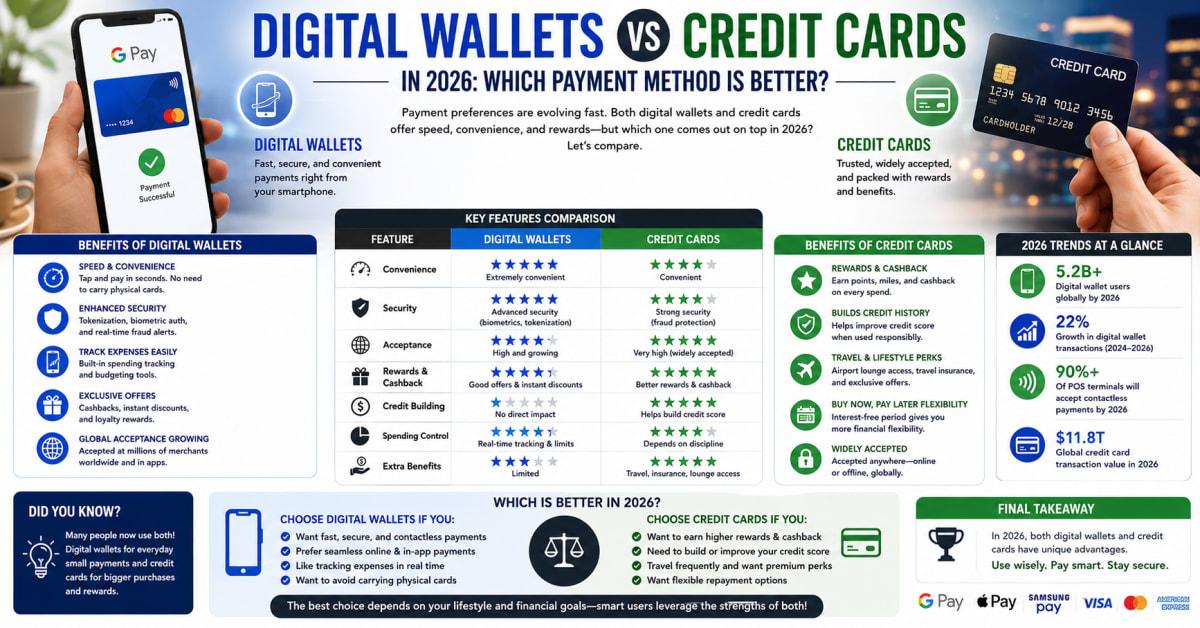
Digital Wallets vs Credit Cards 2026: Which Is Better?
Digital wallets now account for roughly half of all global e-commerce transaction value, more than double what credit cards handle directly. That shift happened fast, and it raises a real question for anyone still tapping a physical card out of habit.
Digital wallets vs credit cards isn't really a battle to the death, since one typically funds the other behind the scenes. But there are genuine differences in security, rewards, and acceptance worth understanding before deciding how much you should actually rely on each one. This guide breaks down where each method wins in 2026.
Digital Wallets vs Credit Cards — What They Are and Why the Comparison Matters
A digital wallet, like Apple Pay or Google Pay, stores your credit or debit card information securely on your phone and uses tokenization to process payments without transmitting your actual card number to the merchant. A credit card is the physical card itself, or the underlying credit line that often funds the digital wallet in the first place.
This distinction matters because the two aren't really competitors in the way headlines suggest. Wallets and cards are largely complementary, wallets need a funding source, and cards gain a more secure payment mechanism and rewards infrastructure through the wallet.
Why This Is Important Right Now
Picture someone tapping their phone to pay for coffee, unaware that Apple Pay just generated a one-time token instead of transmitting their actual card number to the merchant's payment system, the same card number that would be exposed in a traditional swipe or a merchant data breach.
Global digital wallet users are projected to reach over 5 billion in 2026, representing more than 60% of the world's population, and younger generations in particular now trust mobile wallets for security more than older ones do. That generational shift is reshaping how merchants and card networks design the entire payment experience.
Key Facts About Digital Wallets vs Credit Cards in 2026
A few core facts explain how these two payment methods actually compare heading into the rest of 2026.
- Digital wallets account for roughly 50% of global e-commerce transaction value — with credit cards following at around 22%, according to recent global payments data.
- Digital wallets use tokenization for added security — generating a unique, single-use code for each transaction rather than transmitting your actual card number to the merchant.
- Wallet trust varies significantly by generation — a clear majority of Gen Z and Millennials consider mobile wallet payments secure, compared to a much smaller share of Gen X and Baby Boomers.
- Credit cards still lead in acceptance breadth and global reach — particularly for larger purchases, international travel, and merchants without contactless payment infrastructure.
- Most digital wallets are funded by an underlying credit or debit card anyway — meaning the rewards, credit-building benefits, and liability protections of the funding card still apply to wallet transactions.
What the Industry Data Shows
Industry data suggests that a large majority of consumers now trust digital wallets for everyday payments, with security cited as a primary reason for adoption, particularly among younger demographics who've grown up with mobile-first financial tools.
Analysis from payment industry researchers has found that in certain developed markets, including parts of Australia and the Asia-Pacific region, digital wallets have already surpassed or are projected to soon surpass credit card usage directly, driven by high smartphone penetration and expanding contactless infrastructure at the point of sale.
Benefits and Real Opportunities
Each payment method offers distinct, genuine advantages depending on the specific transaction and context.
- Digital wallets add a real security layer — tokenization means your actual card number is never exposed to the merchant, reducing your exposure in the event of a data breach.
- Faster checkout experiences — tapping a phone or watch is typically quicker than inserting or swiping a physical card, especially at contactless-enabled terminals.
- Credit cards retain broader global acceptance — particularly useful for larger purchases, international travel, or merchants lacking modern contactless infrastructure.
- You often get the best of both by using them together — a credit card funding a digital wallet captures the wallet's security benefits alongside the card's rewards and credit-building history.
Costs and What to Expect
Neither digital wallets nor credit cards typically carry a direct cost to the consumer for basic use, since most digital wallet apps are free and simply interface with your existing card. Any fees, like a credit card's annual fee or interest charges, come from the underlying card itself, not from using it through a digital wallet.
Merchants, on the other hand, do face costs tied to accepting digital wallet payments, since interchange and processing fees apply similarly to how they would with a traditional card transaction, which is part of why fewer than 60% of small businesses currently accept digital wallets despite widespread consumer adoption. This acceptance gap is a real practical consideration, since it means a digital wallet alone isn't yet universally usable everywhere a physical card would be.
There's no meaningful cost difference in fraud liability either, since a digital wallet transaction funded by a credit card typically carries the same zero-liability fraud protections as a standard credit card purchase made in person or online.
Digital Wallets vs Physical Credit Cards vs Using Both Together: Which Approach Is Right for You?
| Option | Best For | Pros | Cons |
|---|---|---|---|
| Digital Wallets (e.g., Apple Pay, Google Pay) | Everyday purchases where speed and security are top priorities | Tokenized security and faster checkout at contactless terminals | Not accepted everywhere, especially at smaller merchants |
| Physical Credit Cards | International travel and merchants without contactless setups | Near-universal acceptance and a physical backup when your phone dies | Exposes your actual card number at swipe or insert terminals |
| Using Both Together | Most consumers wanting maximum flexibility and security | Captures wallet security for daily use and card acceptance as backup | Requires carrying and managing two payment methods |
Who Should Actually Care About This Comparison?
This matters for anyone deciding how much to rely on mobile payments day to day, frequent international travelers who need to understand acceptance gaps before relying solely on a digital wallet, and small business owners deciding whether to invest in contactless payment infrastructure given the significant share of consumers who now expect it.
Mistakes Most People Make
A handful of misunderstandings show up often in this comparison.
Assuming a digital wallet and its funding credit card are entirely separate products overlooks that the wallet is typically just a more secure interface for the same underlying card, meaning your existing rewards and credit-building benefits still apply. Understanding this relationship clarifies why using a wallet doesn't sacrifice your card's benefits.
Relying exclusively on a digital wallet while traveling internationally can lead to frustration at merchants without contactless infrastructure. Carrying a physical backup card, especially abroad, avoids getting stuck without a working payment method.
Assuming digital wallets are inherently less secure than physical cards, an older but still common assumption, ignores that tokenization typically makes wallet transactions more secure than a traditional swipe, since your actual card number is never shared with the merchant.
Small business owners delaying investment in contactless payment acceptance risk falling behind consumer expectations, given how significant digital wallet adoption already is among online adults, even though a notable share of small businesses still don't accept it.
What Most Articles Won't Tell You
Most comparisons frame this as a competition, but the more accurate framing is complementary infrastructure: wallets need cards as funding sources, and cards gain rewards distribution and payment security through wallets. Neither fully replaces the other in the current ecosystem.
There's also a detail worth knowing: trust in digital wallet security varies meaningfully by both generation and gender, with younger users and men reporting higher confidence in mobile wallet security than older users and women in recent surveys, a gap that likely reflects both familiarity and marketing exposure rather than any actual difference in the underlying technology's security.
Advanced Moves Worth Knowing
Funding your digital wallet with your highest-rewards credit card, rather than a debit card, captures cash back or points on every tap-to-pay transaction without changing your daily payment habits at all.
Keeping a physical version of your primary card as backup, even if you use a digital wallet for the vast majority of transactions, protects against the specific scenario of a dead phone battery or an unfamiliar merchant terminal that only accepts a swipe or insert.
Frequently Asked Questions
Are digital wallets actually safer than credit cards?
In most cases, yes, when the wallet is funded by a credit card, since tokenization means your actual card number is never transmitted to the merchant, unlike a traditional swipe or insert transaction.
Do digital wallet transactions still earn credit card rewards?
Yes, generally. Since a digital wallet typically processes payment through your underlying credit card, the same rewards, cash back, or points you'd earn from a physical swipe usually still apply to wallet transactions.
Can I use a digital wallet everywhere a credit card is accepted?
Not always. While adoption has grown significantly, a meaningful share of smaller merchants still don't accept digital wallets, making a physical card a useful backup, especially while traveling.
Does using a digital wallet affect my credit score?
No, not directly. Since the wallet is simply a payment interface for your underlying credit card, your credit score is affected by your card usage and payment history exactly as it would be without the wallet involved.
Will digital wallets eventually replace credit cards entirely?
It's unlikely in the near term, since digital wallets and credit cards function more as complementary technologies than direct competitors. Credit cards still provide the underlying credit line, rewards infrastructure, and broad acceptance that digital wallets depend on and extend.
The Bottom Line on Digital Wallets vs Credit Cards in 2026
Digital wallets vs credit cards isn't really a contest with one clear winner, since the two are more complementary than competing in practice. Digital wallets offer genuine security and speed advantages for everyday spending, while credit cards still provide broader global acceptance and the underlying credit line and rewards infrastructure wallets depend on. The smartest approach for most people is using both together: a digital wallet for daily convenience and security, backed by the physical card for the merchants and situations a wallet alone can't yet cover.
Read Next

Shock Collapse: Korean Stocks Plunge as Foreign Investors Exit!

Warning: Michael Burry Reveals Stocks on Brink of Major Collapse!

Stock Market Surges: S&P 500 Hits Record Amid Trump’s Iran Crisis Warning

Michael Burry's Shocking Warning: Reduce Stocks Now or Face a Collapse!

Shock Waves: Dow Dips as Oil Surges Amid Iran Crisis