Credit Card Tips to Save Money and Build Your Score
The everyday credit card habits that quietly cost you hundreds a year—and the simple fixes that save money while building a stronger score.
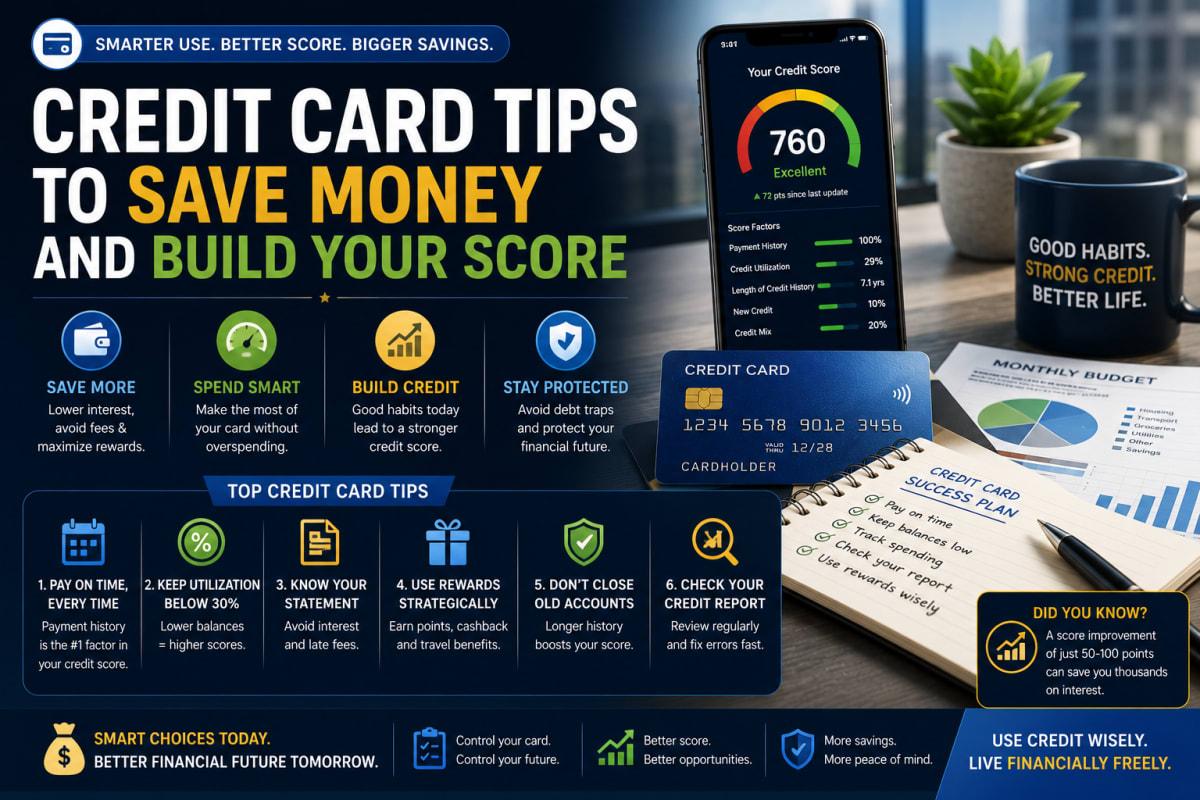
Credit Card Tips to Save Money and Build Your Score
Most people don't lose money to big financial mistakes. They lose it to small habits repeated fifty times a year—one missed due date, one unused reward, one balance carried a month too long.
These credit card tips focus on the everyday decisions that actually move your bank account and your credit score at the same time. You'll see where the hidden costs come from, which habits build your score fastest, and a few moves that most people never think to try. None of this requires a higher income. It just requires a plan.
Credit Card Tips — What They Are and Why They Matter
Credit card tips are practical habits that reduce interest costs and strengthen your credit profile at the same time. They cover how you pay, how much you borrow relative to your limit, and how you choose which card to use for what.
Your credit score influences far more than loan approvals. It affects your insurance premiums, your apartment applications, and even some job screenings. That's why these habits carry weight well beyond your monthly statement.
Why This Is Important Right Now
Think about someone who spends normally but carries a small balance most months without realizing how fast interest compounds. Over a year, that "small" balance can quietly cost hundreds of dollars in interest alone.
With average card APRs still sitting well above 20%, the cost of casual borrowing has never been higher. Building better habits now protects you from a problem that gets harder to unwind the longer it continues.
Key Facts About Credit Card Tips
A few core facts explain why these habits work. Understanding the mechanics behind your score makes every tip below easier to apply with confidence.
- Payment history carries the most weight — it's typically the single biggest factor in most scoring models.
- Utilization resets every billing cycle — a high balance one month doesn't permanently damage your score if you correct it.
- Interest is calculated daily on most cards — the sooner you pay, the less you owe in total.
- Authorized user status can help build credit — adding a trusted person to your account can boost their history too.
- Score dips from inquiries are usually temporary — most recover within a few months if no new negative activity appears.
What the Industry Data Shows
Industry data suggests that consumers who automate their payments miss due dates far less often than those who pay manually. Even one automated minimum payment can prevent the late fees and penalty rates that do the most long-term damage.
Analysts at outlets like Reuters and the Wall Street Journal have pointed out that utilization and payment consistency together explain most of the variation in everyday consumer credit scores. That's useful context when deciding where to focus your effort first.
Benefits and Real Opportunities
Getting these habits right pays off in ways that compound over years, not just months. Lower interest costs today translate into better loan terms and stronger financial flexibility later.
- Reduced interest paid — even modest habit changes can save hundreds of dollars annually.
- Stronger loan approval odds — a healthier score often means better terms on future mortgages or auto loans.
- More usable rewards — cash back and points actually add value when you're not paying interest to earn them.
- Less financial stress — knowing your balance is under control removes a recurring source of anxiety.
Costs and What to Expect
Standard credit card APRs commonly range from the high teens into the high twenties depending on your credit profile. Store-branded cards often sit at the higher end of that range, sometimes exceeding 30%.
Late payment fees usually fall between $30 and $41, and a single missed payment can trigger a penalty APR that lasts for months even after you catch up. Annual fees on premium rewards cards can range from $95 to several hundred dollars, so it's worth calculating whether the perks outweigh the cost for your actual spending pattern.
Cash advance fees are another overlooked cost, often 3% to 5% of the amount withdrawn, plus a higher APR that starts accruing immediately with no grace period.
Automatic Payments vs Manual Payments vs Calendar Reminders: Which One Is Right for You?
| Option | Best For | Pros | Cons |
|---|---|---|---|
| Automatic Payments | People who forget due dates easily | Removes the risk of a missed payment entirely | Requires enough funds in the account every cycle |
| Manual Payments | People who want full control over payment timing | Lets you time payments around your statement date | Higher risk of forgetting during busy periods |
| Calendar Reminders | People who prefer manual payments but want a safety net | Combines control with a backup reminder system | Still relies on you to actually act on the reminder |
Who Should Actually Care About Credit Card Tips?
This applies to anyone who uses a credit card regularly, whether you carry a balance or pay in full every month. It matters most for people building credit for the first time, anyone recovering from past missed payments, and households trying to free up monthly cash flow without cutting spending drastically.
Mistakes Most People Make
A few patterns show up again and again, and each is easy to fix once you notice it.
Treating a credit limit like available spending money leads to balances that outpace what you can comfortably pay off. Thinking of your limit as a safety net, not a budget, keeps utilization in check.
Applying for multiple cards in a short window to chase sign-up bonuses can trigger several hard inquiries at once. Spacing out applications protects your score while you still capture the rewards over time.
Skipping the fine print on promotional 0% APR offers often means missing the date interest starts accruing retroactively. Marking that end date the day you open the offer prevents an unpleasant surprise.
Using only one card for everything can limit your rewards potential and concentrate risk if that card is ever compromised. Spreading spending across two well-chosen cards often works better long term.
What Most Articles Won't Tell You
Most guides tell you to "pay on time," but few explain that paying early, before your statement even closes, can lower your reported balance and boost your score faster than waiting for the due date.
There's also a lesser-known detail about credit mix: having a healthy combination of revolving credit and installment loans, like a car payment, can support your score more than adding another credit card ever will.
Advanced Moves Worth Knowing
Asking your issuer for a lower APR is worth trying, especially if you've had the card for a while and have a solid payment history. Many issuers will grant a modest reduction just for asking, since retaining a reliable customer costs them less than losing one.
Pairing a rewards card for planned purchases with a low-interest card for unplanned expenses lets you optimize both sides of your spending without carrying a balance on the wrong card.
Frequently Asked Questions
Can you actually save money just by changing credit card habits?
Yes, absolutely. Avoiding interest charges and late fees alone can save hundreds of dollars a year for the average cardholder, without any change to how much you actually spend.
Does asking for a lower interest rate hurt your credit score?
No, it doesn't. Requesting a rate reduction from your existing issuer typically doesn't involve a credit check, so it carries no risk to your score.
How long does it take to see a credit score improve?
Noticeable changes can appear within one to two billing cycles, especially if the improvement comes from lowering utilization or fixing a reporting error. Larger gains from consistent payment history build over six months to a year.
Is it better to have one credit card or several?
Several well-managed cards can help more than one, since they lower your overall utilization ratio and diversify your credit mix. The key word is well-managed—more cards only help if you can track and pay each one responsibly.
What's the fastest way for a beginner to build credit?
Opening a starter or secured card, keeping the balance low, and paying on time every month is typically the fastest path. Becoming an authorized user on a trusted family member's account can also help build history quickly.
The Bottom Line on Credit Card Tips
The best credit card tips aren't complicated tricks—they're small, repeatable habits that protect your money and your score at the same time. Automate what you can, pay before your statement closes when possible, and treat your credit limit as a boundary, not a budget. Do that consistently, and the savings and score improvements follow on their own. Pick one habit from this guide and start it with your very next payment cycle.
Read Next

How to Find the Best Mortgage Rates in the USA in 2026

Tech Stocks Stumble: S&P 500, Nasdaq Pause After Micron Shock

Best Online Banks in the US for 2026

Best Debt Consolidation Loans for Bad Credit (2026 Guide)

Mortgage Rates Collapse to 1-Month Low Amid Iran Deal Surge