Credit Card Management Tips That Save You Real Money
Simple credit card habits that boost your score, cut interest costs, and put you back in control of your money—starting this month.
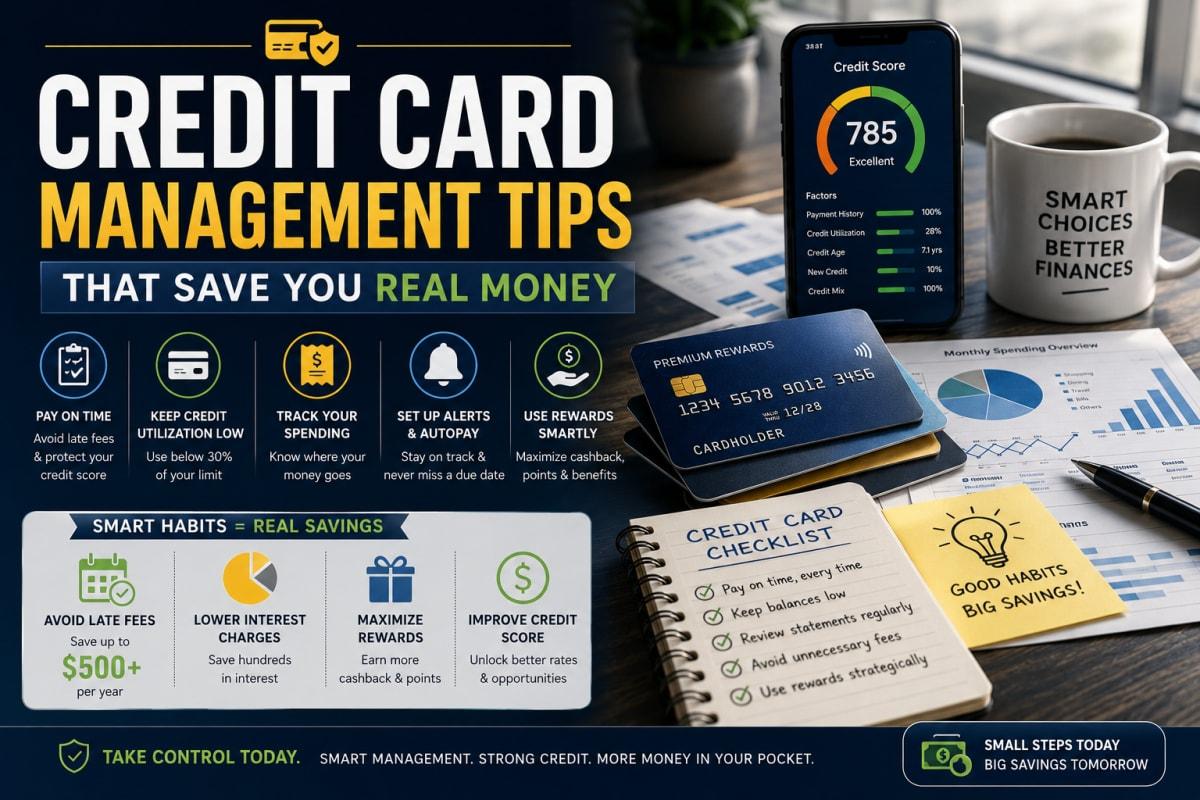
Credit Card Management Tips That Save You Real Money
The average American household carries thousands of dollars in credit card debt, and most of it comes from habits nobody ever taught them to fix. That's not a coincidence—it's a design flaw in how most people use plastic.
Good credit card management tips aren't complicated, but they do require intention. This guide walks you through the exact habits that lower your interest costs, protect your credit score, and turn your card into a tool that works for you instead of against you. We'll cover the mistakes that quietly drain your wallet, the strategies that actually move the needle, and a few advanced moves most articles skip entirely.
Credit Card Management Tips — What They Are and Why They Matter
Credit card management means using your card in a way that avoids interest, protects your credit score, and keeps your spending aligned with your budget. It's not about avoiding credit cards—it's about controlling them.
In 2026, interest rates on revolving credit remain high, and even a small unpaid balance can snowball fast. Lenders reward consistent, low-risk behavior with better rates and higher limits down the road. That's why the habits you build now matter more than the card you happen to be holding.
Why This Is Important Right Now
Picture someone who carries a $2,000 balance at a 24% APR. Without a repayment plan, that balance can take years to clear and cost more in interest than the original purchases were worth. This happens quietly, one minimum payment at a time.
Rising living costs have pushed more households toward revolving credit just to cover everyday expenses. That makes disciplined card management less of a nice-to-have and more of a financial survival skill. Small adjustments—like automating payments or tracking due dates—can prevent months of unnecessary stress.
Key Facts About Credit Card Management
Before diving into strategy, it helps to know the basics that shape every decision you'll make with a credit card. These facts form the foundation for everything else in this guide.
- Grace periods only apply to new purchases — if you carry a balance, interest usually starts accruing immediately on new charges.
- Credit utilization affects your score directly — keeping balances under 30% of your limit is widely considered healthy, and under 10% is even better.
- Minimum payments are designed to maximize interest — paying only the minimum can stretch a balance out for years.
- Multiple hard inquiries can lower your score temporarily — applying for several cards in a short window signals risk to lenders.
- Card issuers report to all three bureaus — one missed payment can show up on Equifax, Experian, and TransUnion simultaneously.
What the Industry Data Shows
Industry data suggests that consumers who pay their balance in full each month carry significantly lower average debt levels than those who make only minimum payments. This gap tends to widen over time as interest compounds on unpaid balances.
Financial analysts at outlets like Bloomberg and Forbes have repeatedly noted that utilization ratio and payment history are the two heaviest factors in most scoring models. Understanding that hierarchy helps you prioritize which habits to fix first.
Benefits and Real Opportunities
Strong credit card habits do more than avoid fees—they open doors. Better scores unlock lower mortgage rates, better insurance premiums, and stronger negotiating power with lenders.
- Lower borrowing costs — a higher credit score can mean meaningfully lower rates on auto loans and mortgages.
- Reward optimization — cash back and travel points become genuinely valuable when balances are paid in full.
- Fraud protection — most major issuers offer zero-liability policies that outperform debit card protections.
- Emergency flexibility — a well-managed card acts as a safety net without becoming a debt trap.
Costs and What to Expect
Annual percentage rates on standard credit cards commonly range from the high teens to the high twenties, depending on your credit profile and the issuer. Rewards cards sometimes carry annual fees between $95 and $695, so the value only makes sense if you actually use the perks.
Late fees typically fall between $30 and $41 per occurrence, and some issuers apply a penalty APR after a missed payment that can push your rate above 29%. Balance transfer fees usually run 3% to 5% of the transferred amount, which matters when comparing consolidation options.
Foreign transaction fees, often around 3%, can quietly add up for frequent travelers. Reading your card's terms once a year helps you catch fee changes before they catch you.
Debt Avalanche vs Debt Snowball vs Balance Transfer: Which One Is Right for You?
| Option | Best For | Pros | Cons |
|---|---|---|---|
| Debt Avalanche | People who want to minimize total interest paid | Saves the most money mathematically over time | Slower emotional wins can make it harder to stay motivated |
| Debt Snowball | People who need quick wins to stay motivated | Fast psychological momentum from clearing small balances first | Usually costs more in total interest than the avalanche method |
| Balance Transfer | People with strong credit who can pay off debt within a promo window | 0% intro APR periods can eliminate interest temporarily | Transfer fees and a return to high rates if not paid off in time |
Who Should Actually Care About Credit Card Management?
This matters most for anyone carrying a balance month to month, anyone planning a major purchase like a home or car in the next few years, and young adults building credit history for the first time. It also matters for high earners who assume their income protects them from bad habits—it doesn't. A strong score and low utilization benefit everyone, regardless of paycheck size.
Mistakes Most People Make
These errors show up again and again, and each one is fixable once you see it clearly.
Paying only the minimum feels manageable in the moment, but it maximizes the interest you'll pay over time. The fix is simple: pay more than the minimum whenever possible, even if it's just an extra $20.
Closing old cards to "simplify" finances often backfires because it shortens your credit history and can spike your utilization ratio. Keeping an old card open with occasional small purchases usually helps your score more than closing it.
Ignoring due dates leads to late fees and penalty rates that stick around for months. Setting up autopay for at least the minimum protects you even during busy weeks.
Chasing rewards without paying the balance in full turns "free" points into expensive debt. The math only works in your favor when the statement gets paid off every cycle.
What Most Articles Won't Tell You
Most guides focus on utilization percentage but skip how issuers actually report that number—usually on your statement closing date, not the day you pay. That means you can pay in full and still show a high utilization ratio if you don't time it right.
There's also a quiet trick worth knowing: making a payment before your statement closes, rather than just before the due date, can lower the balance that gets reported to the bureaus. This one adjustment can nudge your score upward without changing your spending at all.
Advanced Moves Worth Knowing
Requesting a credit limit increase—without adding new spending—instantly lowers your utilization ratio, since the math is based on balance divided by limit. Many issuers allow this request online without triggering a hard inquiry.
Setting two payments per month, one mid-cycle and one before the due date, keeps your reported balance consistently low and prevents any single large purchase from spiking your utilization at the wrong moment.
Frequently Asked Questions
Does paying off a credit card early hurt your credit score?
No, paying early doesn't hurt your score. It typically helps by keeping your reported utilization lower. The only time timing matters is around your statement closing date, since that's when your balance gets reported to the bureaus.
Will closing a credit card hurt my credit score?
Yes, in most cases it can. Closing a card shortens your average account age and can raise your utilization ratio if the closed card had a high limit. Keeping the account open with occasional light use is usually the safer move.
How much does a balance transfer typically cost?
Most balance transfer fees fall between 3% and 5% of the amount moved. That cost is often worth it if the promotional 0% APR period gives you enough time to pay off the balance before the standard rate kicks back in.
Is the debt avalanche method better than the debt snowball method?
Mathematically, yes, the avalanche method saves more money since it targets the highest interest rate first. That said, the snowball method often wins for people who need quick psychological wins to stay consistent.
What credit utilization ratio should a beginner aim for?
Aim to keep your utilization under 30%, and under 10% if you're working toward an excellent score. Beginners often find it easier to hit this target by requesting a credit limit increase rather than cutting spending drastically.
The Bottom Line on Credit Card Management
Credit card management tips work best when they become automatic instead of something you think about every month. Set up autopay, watch your utilization around your statement closing date, and pay more than the minimum whenever you can. These habits compound just like interest does, except they work in your favor. The reward isn't just a better score—it's lower borrowing costs, stronger financial flexibility, and one less thing to worry about every month. Start with one change this billing cycle, and let the rest build from there.
Read Next

Shock as Stock Futures Plunge After Dow Hits 50,000: Live Updates
Shock Collapse: Korean Stocks Plunge as Foreign Investors Exit!

Warning: Michael Burry Reveals Stocks on Brink of Major Collapse!

Stock Market Surges: S&P 500 Hits Record Amid Trump’s Iran Crisis Warning
Michael Burry's Shocking Warning: Reduce Stocks Now or Face a Collapse!