Best Passive Income Ideas That Still Work in 2026
Most passive income content sells a fantasy. Here's what actually works in 2026, honestly ranked by how much upfront effort each one really takes.
Best Passive Income Ideas That Still Work in 2026
Roughly 27% of American adults already earn some kind of side income, averaging $885 a month, though the median is a far more modest $200. That gap matters, because it tells you passive income is real, but it's rarely the effortless windfall the internet makes it sound like.
The best passive income ideas in 2026 aren't secret hacks. They're a mix of investment-based strategies and digital assets that trade real upfront effort for income that keeps flowing with less ongoing work later. This guide breaks down what actually still works, ranked honestly by effort and realistic earnings, so you can skip the ideas built more for clicks than for your actual bank account.
Passive Income Ideas — What Actually Qualifies and Why the Distinction Matters
Passive income means money earned with minimal ongoing effort after an initial setup, whether that setup is investing capital, building a digital product, or creating content that keeps earning after the work is done. It's not the same as doing nothing. Every idea on a legitimate passive income list still requires real time, money, or skill upfront.
This distinction matters because so much online content blurs passive income with "get rich quick" schemes, setting expectations that lead people to abandon genuinely solid strategies when they don't produce overnight results.
Why This Is Important Right Now
Picture someone who invests $10,000 into a dividend ETF expecting to quit their job within months, only to earn $300 to $500 a year, a real but modest return that takes years of consistent investing to meaningfully compound. Disappointment here usually comes from mismatched expectations, not a bad strategy.
With interest rates still elevated in 2026, dividend yields on quality stocks and high-yield savings accounts remain genuinely attractive compared to a few years ago, making low-effort, investment-based passive income more rewarding right now than it's been in some time.
Key Facts About Passive Income in 2026
A few core facts set realistic expectations before diving into specific ideas.
- About 27% of American adults already have some form of side income — averaging $885 a month, though the median is a more modest $200, reflecting that a smaller number of high earners skew the average upward.
- Dividend ETFs currently yield around 3% to 5% annually — meaning a $10,000 portfolio might realistically generate $300 to $500 a year in passive income.
- High-yield savings accounts currently pay around 4% to 5.1% APY — on a $20,000 balance, that's roughly $800 to $1,020 a year with zero ongoing effort.
- Digital products and content-based income typically take 6 to 12 months to reach $1,000 a month — based on real creator earnings data, not the "overnight success" stories that dominate social media.
- REITs offer real estate income without hands-on landlord responsibilities — though returns still carry market risk and fluctuate with interest rates and property conditions.
What the Industry Data Shows
Industry data suggests that the passive income ideas producing the most reliable, verifiable results in 2026 fall into a handful of categories: dividend and index fund investing, high-yield cash accounts, real estate exposure through REITs, and digital products or content with genuine ongoing demand.
Analysis based on real creator earnings data, including platform payout reports and seller analytics, has found that most successful digital product creators reach meaningful, consistent income only after months of upfront work, directly contradicting the instant-results framing common in passive income marketing.
Passive Income Ideas Ranked by Effort and Realistic Earnings
These ideas are grouped from lowest to highest effort, so you can match a strategy to how much time and capital you actually have available right now.
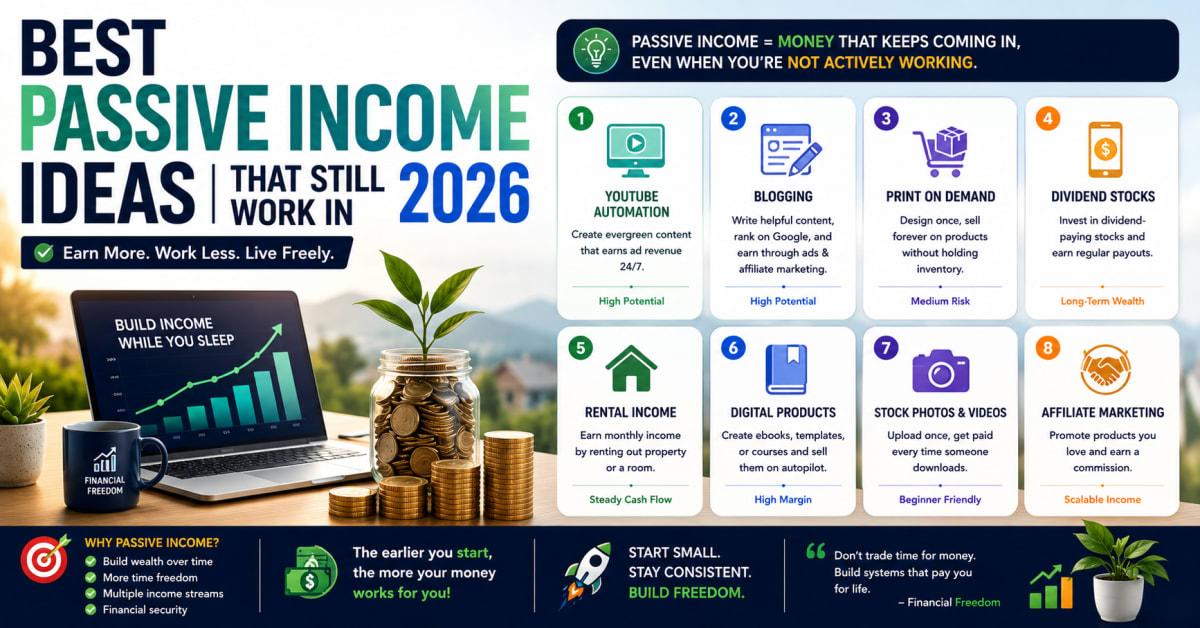
- High-yield savings account — The lowest-effort option on this list. Move existing cash into a competitive account earning 4% to 5.1% APY with zero ongoing work. Realistic earnings: $800 to $1,020 a year on a $20,000 balance.
- Dividend stocks and ETFs — Buy shares of dividend-paying companies or a broad ETF like VYM or SCHD and collect regular payouts. Realistic earnings: 3% to 5% annual yield, or $300 to $500 a year on a $10,000 portfolio.
- REITs (Real Estate Investment Trusts) — Gain exposure to income-producing real estate, apartments, warehouses, retail, without directly owning or managing property. Returns fluctuate with interest rates and the broader property market.
- Certificates of deposit (CDs) — A fixed-rate, low-risk option for cash you don't need immediate access to, offering predictable interest over a set term.
- Digital products — Templates, printables, or niche tools sold through platforms like Gumroad or Etsy. Requires real upfront creation effort but can produce recurring sales with minimal ongoing work once established.
- Online courses — Package existing expertise into a course on a platform like Teachable, generating income from each new student without repeating the creation work.
- Affiliate marketing — Earn commissions recommending products through content or a niche audience. Success in 2026 depends heavily on genuine authenticity, since audiences increasingly detect generic, uninspired recommendations.
- Rental property — The highest-effort, highest-capital option, requiring real management, maintenance, and tenant relations, but potentially one of the strongest income and appreciation combinations for those with sufficient capital and patience.
Benefits and Real Opportunities
Building even one or two of these income streams creates genuine financial benefits beyond the dollar amount alone.
- Reduced reliance on a single income source — even a modest passive stream adds a layer of financial resilience if your primary income is disrupted.
- Compounding growth over time — reinvested dividends and consistent small contributions can grow meaningfully over a decade or more.
- Low barrier to entry for beginners — options like high-yield savings accounts and dividend ETFs require no special skills and very little starting capital.
- Skills and assets that keep producing value — a digital product or course, once created, can continue generating income long after the initial work is finished.
Costs and What to Expect
Investment-based passive income, high-yield savings, dividend ETFs, and REITs, typically involves minimal direct cost beyond the capital invested itself, since most major brokers now offer commission-free trades. Expect modest, realistic returns: a few hundred dollars a year on a modest portfolio, scaling up meaningfully only as your invested capital grows over time.
Digital products, online courses, and content-based income require a real time investment upfront, often weeks to months of creation work, plus ongoing costs for platform fees, typically a percentage of each sale. Most creators don't reach $1,000 a month until six to twelve months in, based on real earnings data across popular platforms, so budgeting patience alongside any monetary cost matters just as much.
Rental property carries by far the highest cost and risk profile, requiring significant capital for a down payment plus ongoing expenses for maintenance, insurance, and potential vacancy periods, though it also offers the potential for both income and property appreciation for those able to absorb that higher barrier to entry.
Investment-Based Passive Income vs Digital Product Income vs Real Estate Income: Which One Is Right for You?
| Option | Best For | Pros | Cons |
|---|---|---|---|
| Investment-Based Income (HYSA, Dividends, REITs) | People with existing capital wanting genuinely hands-off income | True passivity with minimal ongoing effort required | Returns scale directly with how much capital you have to invest |
| Digital Product Income | People with a skill or expertise but limited starting capital | Low financial barrier to entry, scalable without much added cost | Requires real upfront time and typically 6-12 months to see meaningful income |
| Real Estate Income (Direct Rental Property) | People with significant capital wanting income plus appreciation | Potential for both rental income and long-term property value growth | Requires significant capital and genuine hands-on management effort |
Who Should Actually Care About Passive Income Ideas?
This matters for anyone with idle cash sitting in a low-interest account who could be earning more with zero added effort, people with a marketable skill considering a digital product or course, and investors looking to diversify beyond just growth stocks into income-generating assets. It's also relevant for anyone wanting to build financial resilience against the risk of relying on a single paycheck.
Mistakes Most People Make
A handful of habits lead people to abandon genuinely solid passive income strategies too early.
Expecting immediate, life-changing income from a modest investment misunderstands how these strategies actually work. A $10,000 dividend portfolio earning a few hundred dollars a year is a real, valid start, not a failure, and compounds meaningfully only over many years.
Chasing the flashiest, most hyped idea instead of one that matches your actual skills, capital, and available time often leads to abandoning the project before it has a chance to work. Starting with an idea genuinely suited to your situation improves the odds of sticking with it.
Ignoring platform and transaction costs when estimating digital product or affiliate income can lead to overestimating actual take-home earnings. Factoring in fees from the start gives a more accurate picture of real profitability.
Treating any of these ideas as entirely risk-free, even the more conservative investment options, overlooks that dividend stocks and REITs still carry genuine market risk, and diversification remains important regardless of how "passive" the label sounds.
What Most Articles Won't Tell You
Most passive income roundups lead with the highest hypothetical earnings numbers, but real earnings data from actual creators shows the median outcome is far more modest than the headline examples suggest. Setting expectations around median, not top-performer, outcomes avoids unnecessary disappointment.
There's also a detail worth knowing: affiliate marketing success in 2026 depends heavily on authenticity, since audiences have become sophisticated enough to detect generic, uninspired recommendations almost immediately. Genuine, specific expertise now outperforms broad, surface-level content in this category.
Advanced Moves Worth Knowing
Reinvesting dividend payouts automatically, rather than withdrawing them, meaningfully accelerates long-term compounding compared to simply collecting the cash payout each quarter.
Combining a low-effort investment stream, like a high-yield savings account or dividend ETF, with one higher-effort digital income project spreads your risk across genuinely different income types rather than concentrating entirely in one category.
Frequently Asked Questions
Is passive income actually realistic for the average person in 2026?
Yes, though expectations matter. Roughly 27% of American adults already earn some side income, with a median of $200 a month, a modest but genuinely real amount that reflects realistic outcomes rather than the extreme examples often highlighted online.
What's the easiest passive income idea to start with no experience?
Moving existing savings into a high-yield savings account is the lowest-effort starting point, requiring no special skill or ongoing work, though the earnings potential is naturally more modest than higher-effort options.
How long does it take to earn meaningful passive income from a digital product?
Based on real creator earnings data, most successful digital product creators take six to twelve months to reach around $1,000 a month, not the overnight results often implied in social media content.
Are REITs a safer alternative to owning rental property directly?
REITs remove the hands-on landlord responsibilities of direct property ownership, but they still carry genuine market risk, and returns can rise or fall with interest rates and broader real estate conditions, so they're not risk-free.
Do I need a lot of money to start building passive income?
Not necessarily. Options like dividend ETFs and high-yield savings accounts can start with modest amounts, while digital products and content-based income require more time investment than money, making passive income accessible across different starting budgets.
The Bottom Line on Best Passive Income Ideas in 2026
The passive income ideas that still work in 2026 aren't secrets, they're the same fundamentals that have always worked: consistent investing, genuinely useful digital products, and real estate exposure suited to your actual capital and risk tolerance. What separates people who succeed from those who give up isn't the idea itself, but realistic expectations about the upfront effort and time required before the "passive" part actually kicks in. Pick one idea that matches your current skills, capital, and available time, commit to it for months rather than weeks, and let the real, if modest, results build from there.
Read Next
High-Yield Savings Accounts 2026: Best Rates & How to Pick
How to Build an Emergency Fund in 2026: Step-by-Step
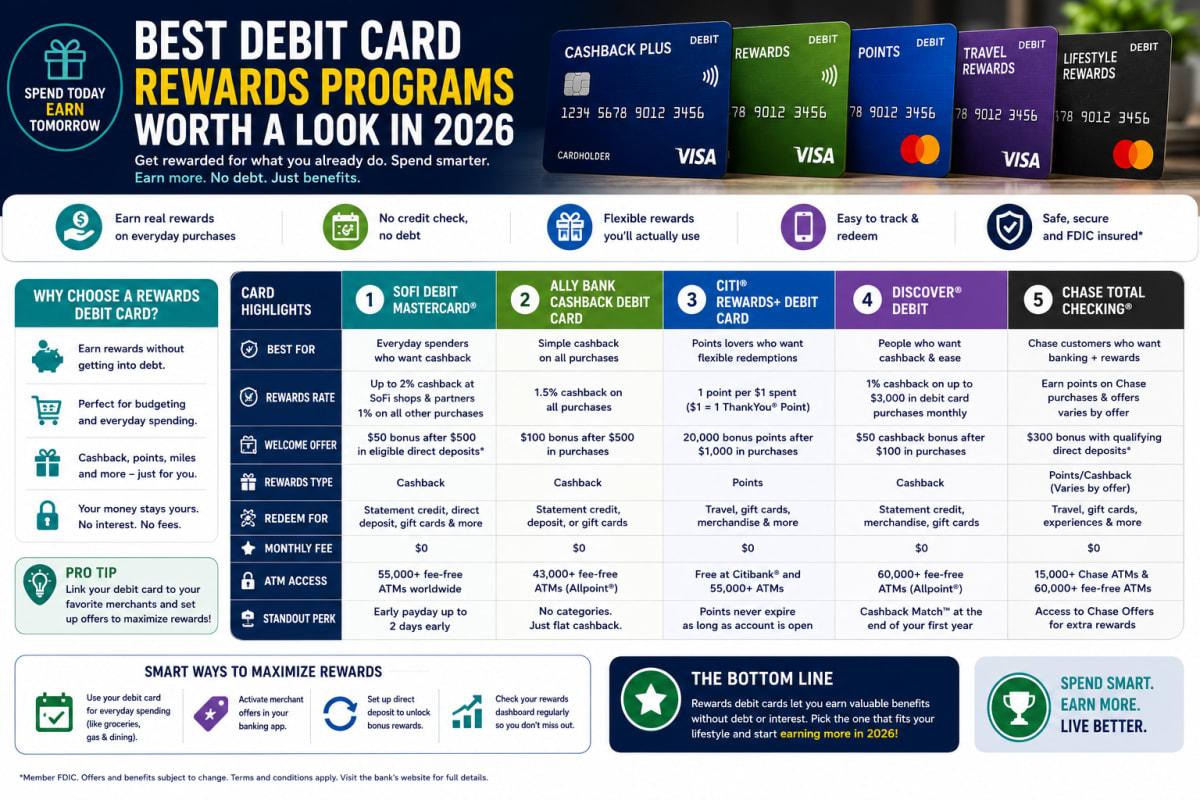
Best Debit Card Rewards Programs Worth a Look in 2026
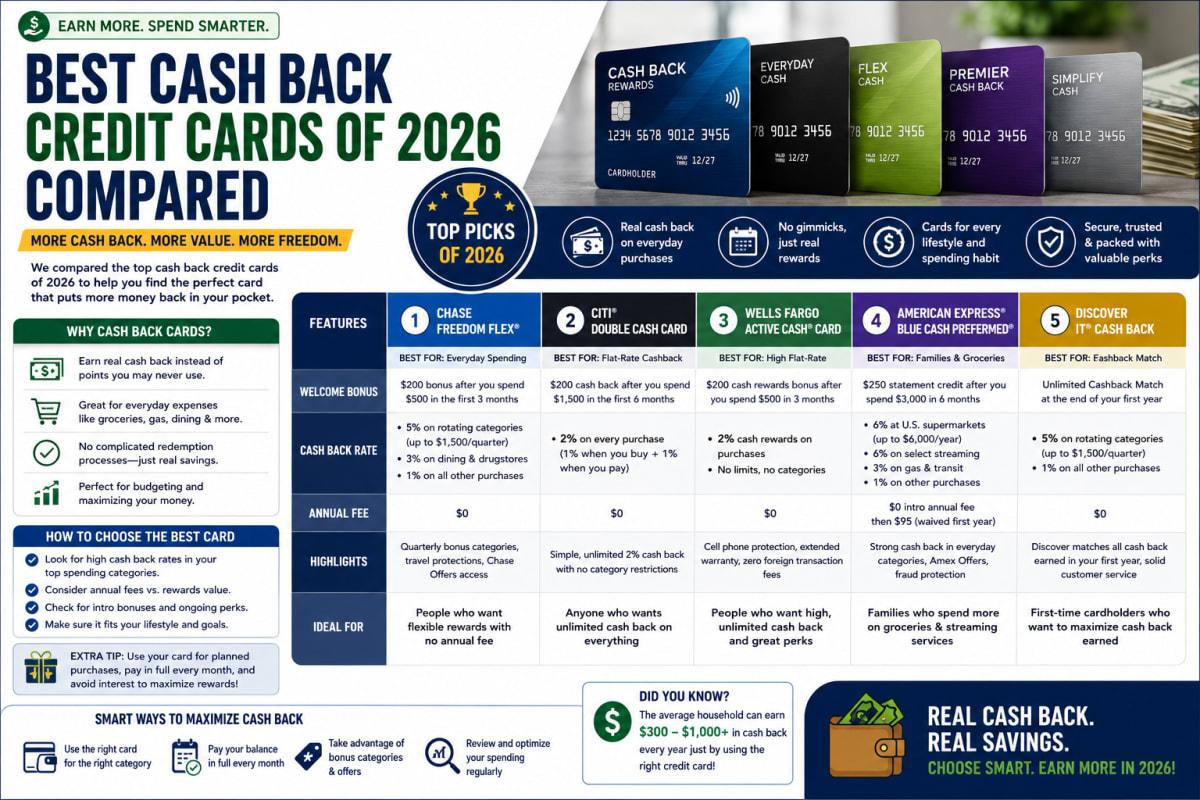
Best Cash Back Credit Cards of 2026 Compared
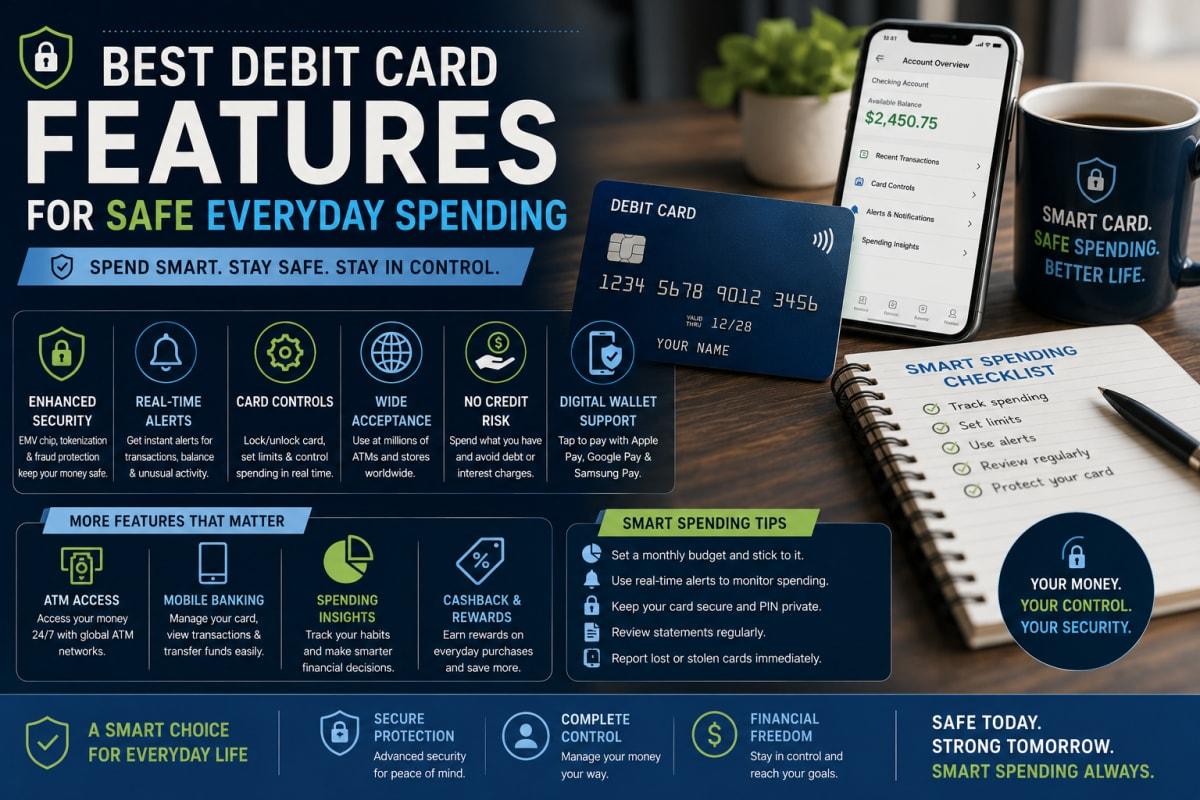
Best Debit Card Features for Safe Everyday Spending