Best Online Banks in 2026: Low Fees & High APYs Compared
Online banks are offering record savings rates and zero monthly fees in 2026. Here's how the top digital-first banks actually compare on fees, APY, and features.
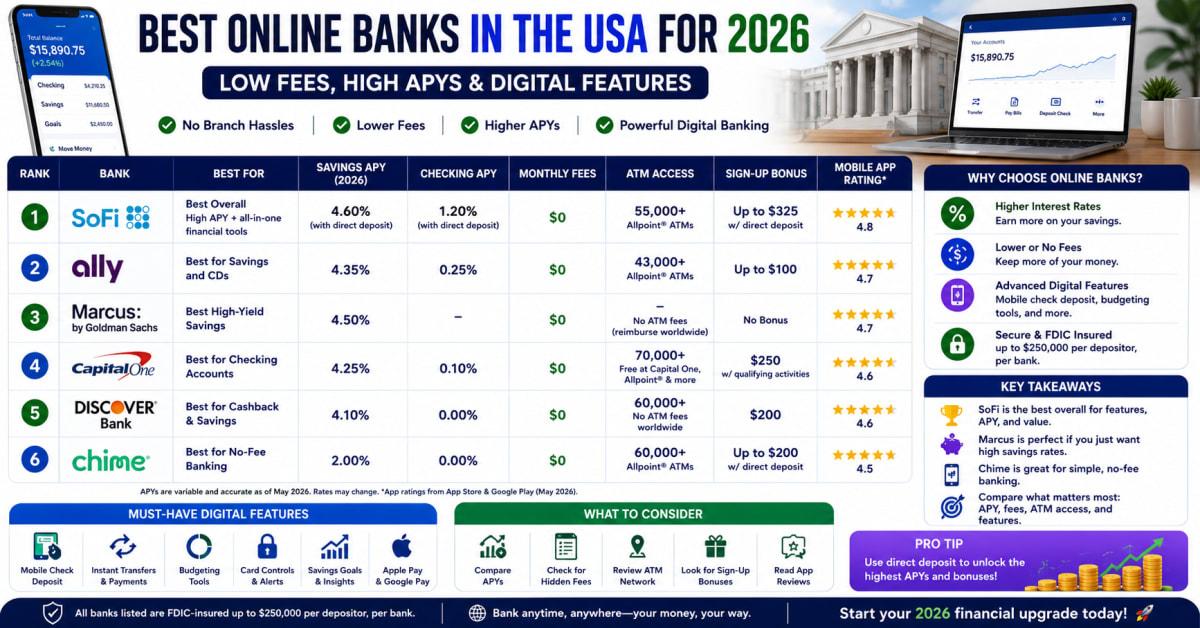
Best Online Banks in 2026: Low Fees & High APYs Compared
Switching from a traditional bank to an online one can save you hundreds of dollars a year in fees and earn you up to ten times more interest on your savings, and yet most people never make the switch simply out of habit.
The best online banks in 2026 have pushed savings rates to some of their highest levels in years while continuing to strip away the fees traditional banks still charge. This guide compares the leading digital-first banks on what actually matters, APY, fees, ATM access, and mobile features, so you can pick the right one for how you actually bank, not just whichever has the flashiest homepage.
Best Online Banks — What Actually Defines "Best" in 2026
An online bank operates entirely through a website or mobile app rather than physical branches, which removes the overhead cost of maintaining locations and lets these institutions pass more value back to customers. What separates a genuinely strong online bank in 2026 comes down to four factors: APY, monthly fees, ATM network size, and how capable the mobile app actually is.
This distinction matters because "online bank" covers a wide range of institutions, from full-service digital banks with checking, savings, and CDs, to narrower neobanks focused on one or two products. Matching the right type to your actual banking habits is more important than picking whichever name is most recognizable.
Why This Is Important Right Now
Picture someone who's kept the same traditional bank account for a decade, quietly earning close to nothing in interest and occasionally paying a monthly maintenance fee, simply because switching felt like a hassle. Over that decade, the gap between what they earned and what a competitive online bank would have paid likely adds up to a meaningful sum.
Online banks in 2026 are offering some of the highest savings rates in recent memory alongside mobile apps packed with features traditional banks still haven't matched, from early direct deposit to automated savings tools. That combination makes the switch more compelling than it's been in years.
Key Facts About the Best Online Banks in 2026
A few core facts explain what actually separates the strongest online banks from the rest of the market this year.
- Top online savings rates commonly reach 4.00% to 4.50% APY — dramatically higher than the traditional bank average of roughly 0.38% to 0.6%.
- Most leading online banks charge no monthly maintenance fee — and many require no minimum balance to open or maintain an account at all.
- ATM network size varies significantly between banks — some, like Ally, offer networks exceeding 75,000 fee-free ATMs, while others rely more heavily on reimbursement for out-of-network fees.
- Some of the highest advertised rates require meeting specific conditions — such as a minimum number of monthly debit card purchases or a direct deposit requirement, and rates can drop dramatically if those conditions aren't met.
- Not all online banks support cash deposits — a genuine tradeoff worth checking if you regularly handle cash, since some digital-first banks have no mechanism for depositing it directly.
What the Industry Data Shows
Industry data suggests that comprehensive rankings evaluating dozens of online banks across product offerings, APY, fees, and digital experience have consistently found that the strongest overall performers combine competitive rates with low or no fees and a broad ATM network, rather than excelling in just one category alone.
Coverage from outlets like Forbes Advisor and Bankrate has repeatedly noted that customer satisfaction scores for online banks now rival or exceed those of many traditional banks, reflecting how far digital banking tools and support have matured in recent years.
How the Top Online Banks Compare
Rather than one universal winner, these banks each stand out for a different strength depending on what matters most to you.
- Ally Bank — A well-rounded pick with no monthly fees, no overdraft fees, and a large fee-free ATM network exceeding 75,000 locations. Strong for savers who also want money market and CD options in one place. One tradeoff: no cash deposit option.
- SoFi — Combines high-yield savings with checking and a broader suite of financial products, appealing to customers who want banking and other financial tools consolidated under one platform.
- Chime — Known for a genuinely fee-free checking model and early direct deposit, making it a strong fit for everyday spending accounts rather than as a primary savings destination.
- American Express (Rewards Checking and Savings) — Rated highly for interest checking specifically, though it doesn't offer money market accounts, making it a better fit for those prioritizing checking rewards over broader account variety.
- Varo — Offers fee-free checking with no minimum balance and some of the highest savings APYs in online banking, though the top rate requires meeting monthly activity requirements.
- UFB Direct — Strong on digital tools, including SMS banking, with no minimums on checking or savings, though its money market account does charge a fee if balance requirements aren't met.
- Vio Bank — A straightforward, no-frills high-yield savings option with a low $100 minimum to open and competitive rates across all balance levels.
Benefits and Real Opportunities
Choosing the right online bank creates value well beyond simply avoiding fees.
- Meaningfully higher interest earnings — the gap between an online bank's APY and a traditional bank's rate can add up to hundreds of dollars a year.
- Fewer or no monthly fees — most leading online banks have eliminated maintenance fees entirely, unlike many traditional accounts.
- Stronger mobile-first tools — features like automated savings buckets, spending roundups, and early direct deposit are increasingly standard at top online banks.
- Large ATM networks despite no branches — several online banks now offer fee-free ATM access that rivals or exceeds many traditional banks' networks.
Costs and What to Expect
Most top-ranked online banks charge no monthly maintenance fee and require no minimum opening deposit, though a handful of accounts, particularly money market products, may require $500 to $2,500 to avoid a fee. Out-of-network ATM fees, where they apply, are frequently reimbursed up to a monthly limit at the strongest banks, though policies vary meaningfully between institutions.
Some of the highest advertised APYs come with specific conditions attached, such as a set number of monthly debit card purchases, a direct deposit requirement, or maintaining paperless statements. Failing to meet these conditions can drop your rate dramatically, sometimes to a fraction of a percent, so it's worth reading the exact requirements rather than assuming the headline rate applies automatically.
Interest earned at any online bank is taxed as ordinary income on your federal return, the same as at a traditional bank, with a 1099-INT issued for any year you earn more than $10 in interest.
Full-Service Online Banks vs Savings-Focused Online Banks vs Neobank Checking Apps: Which One Is Right for You?
| Option | Best For | Pros | Cons |
|---|---|---|---|
| Full-Service Online Banks (e.g., Ally, SoFi) | People wanting checking, savings, and CDs all in one place | Broad product range with competitive rates across accounts | May lack cash deposit options at some institutions |
| Savings-Focused Online Banks (e.g., Vio, UFB Direct) | Savers prioritizing the highest possible APY with minimal complexity | Strong, straightforward rates with low minimums | Fewer additional banking features beyond core savings |
| Neobank Checking Apps (e.g., Chime, Varo) | Everyday spenders wanting fee-free checking and early direct deposit | No monthly fees and modern, feature-rich mobile apps | Top savings rates often require meeting monthly activity conditions |
Who Should Actually Care About Choosing the Best Online Bank?
This matters for anyone currently paying monthly fees at a traditional bank, earning close to nothing on their savings balance, or frustrated by limited digital tools at their current institution. It's especially relevant for people comfortable banking entirely through an app, since the biggest tradeoff with online banks is giving up in-person branch access.
Mistakes Most People Make
A handful of habits lead people to pick the wrong online bank or miss out on its full value.
Chasing the single highest advertised APY without checking the conditions required to earn it can lead to disappointment once you realize the top rate only applies if you meet a monthly debit spend or direct deposit requirement. Reading the exact conditions before opening the account avoids that letdown.
Assuming all online banks support cash deposits the same way a traditional bank does can create a real inconvenience for anyone who regularly handles cash. Checking this specific feature before switching, if it matters to your routine, prevents a frustrating surprise.
Overlooking ATM network size in favor of the highest interest rate alone can backfire for people who frequently need cash access. Comparing the actual ATM network, not just the APY, matters if you withdraw cash often.
Sticking with a familiar traditional bank purely out of inertia, despite paying fees and earning minimal interest, is one of the most common and costly habits. Comparing your current account against a top online bank takes just a few minutes and often reveals a clear opportunity to switch.
What Most Articles Won't Tell You
Most roundups rank online banks by a single headline feature, but the institution that actually saves you the most money depends entirely on your specific habits, how often you need cash, whether you carry a large balance that could benefit from a tiered rate, and how many banking products you want consolidated in one place.
There's also a detail worth knowing: some online banks impose transaction limits on savings and money market accounts, often around 10 per statement cycle, though most no longer charge an excessive transaction fee if you exceed that limit, a meaningful change from stricter policies of past years.
Advanced Moves Worth Knowing
Pairing a full-service online bank for your core checking and savings with a separate, higher-rate savings-focused bank for a larger cash cushion can maximize interest without sacrificing the convenience of one primary account for daily use.
Reviewing your current bank's rate and fees against the top online options at least once a year, rather than assuming your initial choice remains competitive, ensures you're not quietly earning below-market rates as this space continues to shift.
Frequently Asked Questions
Are online banks as safe as traditional banks?
Yes, as long as the bank is FDIC-insured, your deposits are protected up to $250,000 per depositor, identical to the protection at any traditional brick-and-mortar bank.
Can I deposit cash at an online bank?
It depends on the specific bank. Some online banks have no mechanism for direct cash deposits, while others partner with retail locations or allow cash loading through specific methods, so it's worth checking this feature if you handle cash regularly.
Why do online banks offer higher interest rates than traditional banks?
Online banks avoid the overhead cost of maintaining physical branches, which allows them to pass more of that savings back to customers in the form of higher APYs and lower fees.
Do I need good credit to open an online bank account?
Generally, no. Most online checking and savings accounts don't require a credit check to open, though some banks may review your banking history through a separate reporting agency before approval.
What's the biggest downside of switching to an online bank?
The main tradeoff is giving up in-person branch access for face-to-face service. For most routine banking needs, this is a minor sacrifice given the fee savings and higher interest rates online banks typically offer.
The Bottom Line on Best Online Banks in 2026
The best online banks in 2026 combine strong APYs, low or no fees, and mobile tools that many traditional banks still haven't matched. The right pick depends on your specific habits: whether you need a broad ATM network, cash deposit access, or simply the highest possible savings rate. Compare your current bank's fees and rate against a few top online options, and you may find switching takes only a few minutes to set up while saving real money every single month going forward.
Read Next

Stellantis CEO's Shocking Turnaround Plan: Will It Save the Company?

Stock Markets Shocked: Trump's Iran Rhetoric Sparks Crisis Warnings!
Asian Stocks Plummet Following US Inflation Warning: Market Shockwaves

Trump's Shocking Stock Trades: Directly Tied to His Policies!

Shock Collapse: Stock Market Plunges as Inflation Fears Fuel Bond Selloff