Best High-Yield Checking Accounts 2026: APYs & Fees
Most checking accounts pay 0.07% APY. These pay up to 5%, if you meet the requirements. Here's what those requirements actually cost you, with a calculator to run your own numbers.
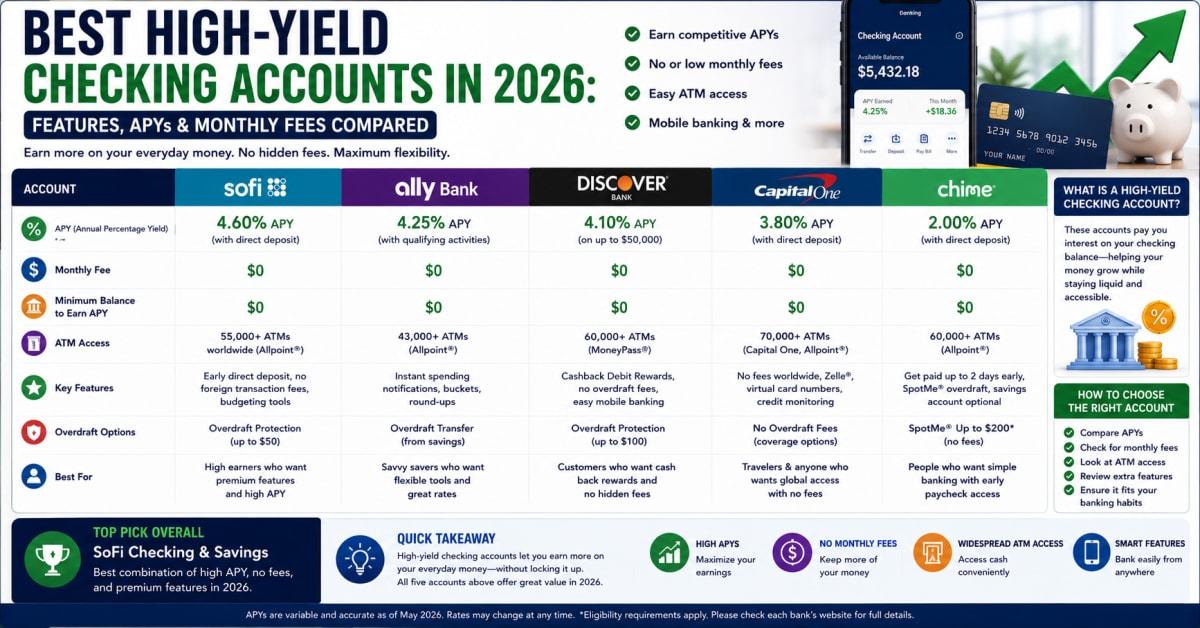
Best High-Yield Checking Accounts 2026: APYs & Fees
The national average checking account pays 0.07% APY, according to the FDIC. On a $5,000 balance, that's $3.50 a year. Some high-yield checking accounts pay up to 5.00% APY on that same balance instead, but only if you clear a specific list of monthly requirements first.
High-yield checking accounts in 2026 can genuinely rival savings account rates, but the fine print matters more here than with almost any other account type, since most top rates apply only up to a capped balance and only if you complete specific monthly activity. This guide compares the leading accounts, walks through a real case study, and includes a calculator so you can see exactly what a given account would earn you.
Best High-Yield Checking Accounts — What They Are and Why the Fine Print Matters More Here
A high-yield checking account pays meaningful interest on your everyday transaction balance, unlike a standard checking account that typically pays nothing at all. Unlike high-yield savings accounts, though, most of these accounts require you to actively "earn" the top rate each month through specific qualifying activity, like a set number of debit card purchases or a minimum direct deposit.
This distinction matters because the advertised APY on a high-yield checking account is often conditional in a way a savings account's rate isn't. Missing a single requirement in a given month can drop your rate to a fraction of a percent for that entire cycle.
Why This Is Important Right Now
Picture someone who opens an account advertising 5.00% APY, deposits $15,000, and assumes the whole balance earns that rate. In reality, many of these accounts cap the bonus rate at $10,000 or less, with everything above that capped amount earning closer to 0.10% to 0.20%, a detail that only shows up if you read past the headline number.
High-yield checking rates have shifted slightly even within recent weeks, per rate-tracking services monitoring thousands of institutions, which means the "best" account today can change within a matter of months as banks adjust their offers to stay competitive.
Top APYs at a Glance
Here's how several leading accounts compare on their top advertised APY, shown visually so the gap against the 0.07% national average is easy to see.
Top advertised APY as of August 2026. Most rates apply only up to a capped balance and require monthly qualifying activity. FDIC data via U.S. News.
Key Facts About High-Yield Checking Accounts in 2026
A few core facts explain how these accounts actually work and what separates a genuinely strong offer from a misleading headline rate.
- The national average checking account APY is just 0.07% — meaning even a modest high-yield account represents a meaningful improvement.
- Top rates commonly apply only up to a capped balance, often $5,000 to $10,000 — with any amount above that cap typically earning a fraction of a percent instead.
- Most high-yield checking accounts require monthly qualifying activity — commonly a set number of debit card purchases, a minimum direct deposit, or e-statement enrollment, to earn the advertised top rate.
- Credit unions frequently offer some of the highest advertised rates — with a small number of credit union accounts advertising rates well above 5%, though these often come with the strictest qualifying requirements and lowest balance caps.
- Failing to meet monthly requirements typically drops your rate dramatically — often to as low as 0.01% to 0.10% for that billing cycle, rather than simply losing the bonus portion.
What the Industry Data Shows
Industry data suggests that while high-yield checking rates aren't as universally available as high-yield savings rates, a growing number of online banks and credit unions now offer checking APYs that genuinely rival what dedicated savings accounts pay, a shift from just a few years ago when checking accounts rarely paid meaningful interest at all.
Rate-tracking services monitoring thousands of institutions have found that high-yield checking rates fluctuate week to week, generally in a narrower band than headline "best of" lists suggest, since most everyday consumers qualify for accounts in the 3% to 5% range rather than the more extreme double-digit outlier rates that come with very low balance caps.
Case Study: What the Fine Print Actually Costs You
Here's a real-style example of how the balance cap changes the math. Jordan opens a rewards checking account advertising 5.00% APY on balances up to $10,000, with anything above that capped amount earning 0.20% instead.
Jordan keeps a $10,000 balance and meets every monthly requirement. At 5.00% APY, that balance earns approximately $500 over a full year, a genuinely strong return matching many high-yield savings accounts.
Six months later, Jordan's balance grows to $18,000 after a bonus at work. Assuming the same 5.00% rate applies to the full amount, Jordan expects roughly $900 a year. In reality, only the first $10,000 earns 5.00%, while the remaining $8,000 earns just 0.20%, bringing the real total closer to $516 a year, a difference of nearly $400 from what the advertised rate implied for a larger balance.
The lesson: these accounts work best as a home for a specific, capped amount of cash, like an emergency fund up to the balance limit, not as a place to park growing savings indefinitely.
Step-by-Step: How to Evaluate a High-Yield Checking Account
Follow this sequence before opening any account, regardless of how attractive the advertised APY looks.
Step 1: Find the actual balance cap. Look specifically for the dollar amount the top APY applies to, not just the percentage itself.
Step 2: List every monthly requirement. Common conditions include a set number of debit card purchases, a minimum direct deposit amount, and e-statement enrollment. Confirm you can realistically meet all of them every single month.
Step 3: Check the fallback rate. Find out what you'd earn in a month you miss a requirement, since this is often a fraction of a percent rather than a partial reduction.
Step 4: Confirm FDIC or NCUA insurance. Verify the institution is properly insured before depositing any funds, regardless of how competitive the rate looks.
Step 5: Compare against a high-yield savings account for the same balance. If your balance regularly exceeds the checking account's cap, a high-yield savings account without a balance cap might earn more overall.
Calculate Your Real Annual Earnings
Enter your actual balance and a given account's terms to see what you'd realistically earn, factoring in the balance cap most headline rates don't fully explain.
Benefits and Real Opportunities
Choosing the right high-yield checking account creates genuine value beyond what a standard checking account offers.
- Interest on money you'd otherwise earn nothing from — everyday transaction balances that typically sit idle can now earn a meaningful return.
- Rates that rival dedicated savings accounts — the best checking APYs in 2026 genuinely compete with high-yield savings rates, a shift from previous years.
- Full transaction flexibility — unlike a savings account, these accounts support unlimited debit card use, checks, and bill pay without transaction limits.
- Often no monthly fee — many of the top-ranked accounts charge no maintenance fee regardless of whether you meet the interest-earning requirements.
Costs and What to Expect
Most leading high-yield checking accounts charge no monthly maintenance fee, even if you don't meet the requirements to earn the top APY in a given month. The real cost consideration isn't a fee, it's the opportunity cost of missing a requirement, since your rate can drop to a fraction of a percent for that entire billing cycle if you fall short of the monthly activity threshold.
Meeting requirements like 10 to 15 monthly debit card transactions or a minimum direct deposit amount isn't free in terms of effort, even if there's no direct dollar cost. It's worth honestly assessing whether your existing spending habits already satisfy these conditions naturally, or whether you'd need to change your behavior specifically to chase the rate.
Interest earned is taxed as ordinary income, the same as savings account interest, with your bank issuing a 1099-INT for any year you earn more than $10.
Requirement-Based High-Yield Checking vs No-Requirement Checking vs Combined Checking-and-Savings: Which One Is Right for You?
| Option | Best For | Pros | Cons |
|---|---|---|---|
| Requirement-Based High-Yield Checking (e.g., Consumers CU) | People who can consistently meet monthly debit and deposit requirements | Highest advertised APYs, sometimes up to 5% or more | Rate drops sharply if requirements aren't met in a given month |
| No-Requirement Checking (e.g., Axos ONE) | People wanting simplicity without tracking monthly activity | Consistent rate with no risk of dropping due to unmet requirements | Typically lower APY than requirement-based accounts |
| Combined Checking-and-Savings (e.g., NBKC, SoFi) | People wanting one simplified account for everyday and saved funds | Simplifies banking to a single account with a moderate, consistent rate | APY typically lower than the top requirement-based options |
Who Should Actually Care About High-Yield Checking Accounts?
This matters for anyone keeping several thousand dollars in a checking account earning close to nothing, people whose spending habits already naturally meet common requirements like frequent debit card use, and anyone who wants their day-to-day transaction account to do more than simply sit idle. It's especially relevant for people with a balance that fits comfortably under a typical account's cap, since that's where these accounts deliver their strongest relative value.
Mistakes Most People Make
A handful of habits lead people to overestimate what they'll actually earn.
Assuming the advertised top APY applies to your entire balance, regardless of size, is the single most common misunderstanding, as Jordan's case study above illustrates. Checking the exact balance cap before opening the account avoids that costly assumption.
Underestimating how strict monthly requirements can be, like a specific number of debit card purchases, leads some people to miss the top rate more often than they expect. Reviewing your typical spending pattern honestly against the requirement avoids repeated missed months.
Chasing an extreme double-digit advertised rate without checking the balance cap can be misleading, since those outlier rates often apply only to a very small capped amount, sometimes just a few hundred or thousand dollars.
Keeping a balance well above the cap in a high-yield checking account, rather than moving the excess to an uncapped high-yield savings account, leaves real interest on the table.
What Most Articles Won't Tell You
Most roundups lead with the single highest advertised APY, but the balance cap attached to that rate is often the more important number for anyone with a meaningful checking balance. A 5% rate capped at $10,000 can actually earn less in total dollars than a 4.5% rate with a $20,000 cap, depending on your actual balance.
There's also a detail worth knowing: rate-tracking services that monitor thousands of institutions show these rates shift week to week, sometimes by several tenths of a percentage point, which means the specific "best" account can change within a matter of months even without any major economic shift.
Advanced Moves Worth Knowing
Splitting funds between a requirement-based high-yield checking account, kept right at or below its balance cap, and an uncapped high-yield savings account for any excess, captures the strongest possible blended rate across your full cash position.
Setting up automatic small transfers or scheduled bill payments through your checking account can help you passively satisfy debit transaction requirements without needing to manually track them each month.
Frequently Asked Questions
What happens if I don't meet the monthly requirements for a high-yield checking account?
Your rate typically drops dramatically for that billing cycle, often to as low as 0.01% to 0.10%, rather than simply losing a portion of the bonus rate. Checking the specific fallback rate before opening the account avoids a surprise.
Is a high-yield checking account better than a high-yield savings account?
It depends on your balance. Checking accounts often have a balance cap for the top rate, while savings accounts typically don't. For balances comfortably under the checking account's cap, the checking account can offer comparable or better returns with more transaction flexibility.
Are high-yield checking accounts FDIC insured?
Yes, as long as the institution is FDIC-insured, or NCUA-insured for credit unions, your deposits are protected up to $250,000 per depositor, the same as any standard checking account.
Why do some high-yield checking accounts advertise such high rates, like 7% or more?
These extreme rates typically apply only to a very small capped balance, sometimes a few hundred or thousand dollars, and often come with the strictest monthly qualifying requirements, so the actual dollar amount earned is usually modest despite the eye-catching percentage.
Can my balance exceed the cap and still earn the top rate on the portion within it?
Yes, typically the tiered structure means the portion of your balance up to the cap earns the top rate, while anything above it earns a separate, lower rate, as shown in the case study and calculator above.
The Bottom Line on Best High-Yield Checking Accounts in 2026
High-yield checking accounts in 2026 can genuinely rival savings account rates, but the balance cap and monthly requirements matter more here than the headline APY does. Use the calculator above to see what an account would actually earn you at your real balance, not the advertised maximum, and confirm you can realistically meet the monthly requirements before committing. For most people, the best setup pairs a capped high-yield checking account for everyday funds with an uncapped high-yield savings account for anything above that limit.
Read Next

S&P 500 and Nasdaq Soar Amid Chip Stock Boom and Jobs Data Surge

Shock Warning: What Toyota's Earnings Reveal About Tesla's Stock Boom
Intel Stock Surges to Shocking New High as Apple Excitement Booms!
Amazon Stock Faces Crisis: Another Outage Raises Urgent Concerns!

Tesla Stock Shock: Toyota Earnings and AI Trade Impact Revealed!