AI for Personal Finance: 20 Ways to Save and Grow Money
78% of Americans already use AI-driven financial tools weekly without realizing it. Here are 20 specific, concrete ways AI can save and grow your money in 2026.
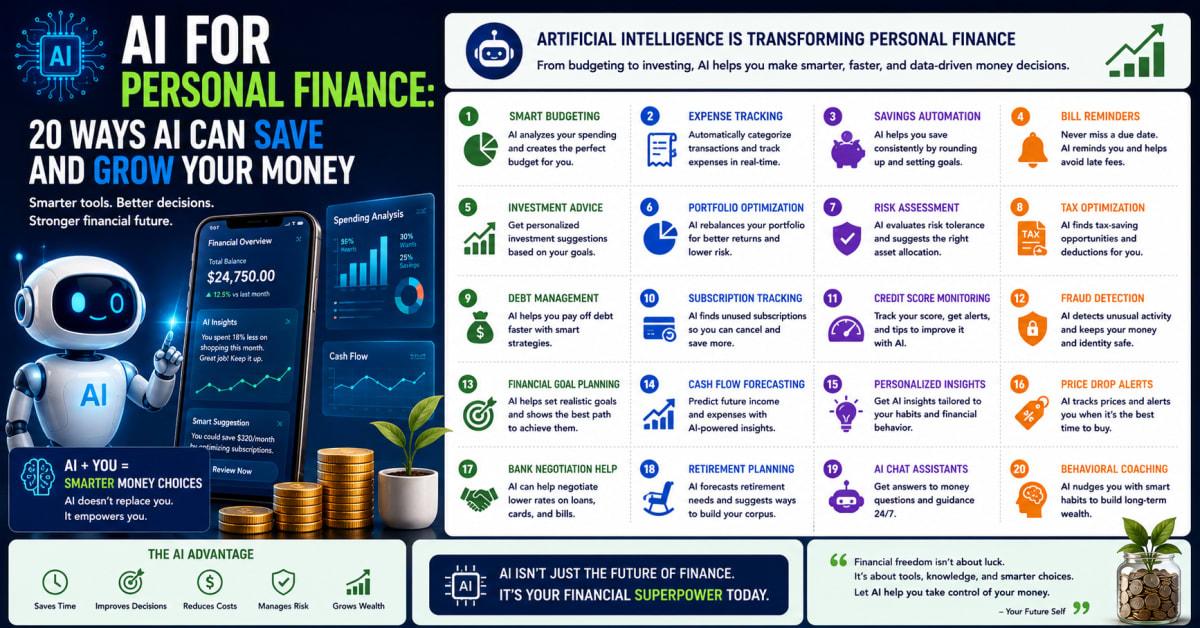
AI for Personal Finance: 20 Ways to Save and Grow Money
A recent survey found that 78% of Americans already interact with AI-driven financial tools at least weekly, through fraud alerts, spending insights, or automated investment rebalancing, often without realizing that's what's happening behind the scenes.
AI for personal finance has moved well past chatbots answering basic money questions. In 2026, specific tools now handle everything from tax-loss harvesting to subscription cancellation on your behalf. This guide breaks down 20 concrete, currently available ways AI can save and grow your money, organized by category so you can find the ones that actually fit your situation.
AI for Personal Finance — What's Actually Available and Why It Matters
AI for personal finance refers to tools that use machine learning and automation to handle tasks that used to require manual effort or a paid advisor, categorizing spending, rebalancing an investment portfolio, or spotting a forgotten subscription. What's changed recently is how specific and capable these tools have become, moving from generic tips to real, executable actions on your actual accounts.
This matters because features once reserved for wealthy clients with a dedicated financial advisor, tax-loss harvesting, personalized asset allocation, real-time cash flow forecasting, are now built into free or low-cost apps available to anyone.
Why This Is Important Right Now
Picture someone who's paid for a streaming service they haven't used in three months, unaware that an AI-powered subscription tracker could have flagged and canceled it automatically. That kind of small, recurring waste adds up quietly over a year, and it's exactly the type of problem these tools are built to catch.
The global robo-advisor market alone was valued at $1.4 trillion in 2024 and is projected to reach $3.2 trillion by 2033, reflecting how quickly these tools have shifted from optional novelty to a genuinely mainstream part of managing money.
20 Ways AI Can Save and Grow Your Money
These are grouped by category, budgeting, investing, debt, taxes, and protection, so you can identify which areas offer the most value for your specific situation.
Budgeting and Everyday Spending
- 1. Automatic transaction categorization — Apps like Monarch and Cleo sort every purchase into a budget category without manual entry, saving hours of spreadsheet work each month.
- 2. Spending anomaly alerts — AI flags unusual patterns, like "you spent 40% more on dining this month," surfacing insight a manual review would likely miss.
- 3. Forgotten subscription detection — Tools scan recurring charges and flag subscriptions unused for months, some even canceling them automatically with one tap.
- 4. Bill negotiation services — AI-powered services can negotiate lower rates on bills like internet or insurance on your behalf, taking a cut only if they succeed.
- 5. Round-up savings automation — Small amounts get swept into savings automatically on days your balance is healthy, building a cushion without noticeable impact on spending.
- 6. Dynamic budget adjustment — Tools like an updated YNAB automatically adjust your spending plan when income changes, rather than requiring a manual redo each time.
- 7. Real-time cash flow forecasting — AI predicts upcoming bills and low-balance risk days before they happen, letting you plan transfers proactively instead of reactively.
Investing and Wealth Building
- 8. Automated portfolio rebalancing — Robo-advisors like Betterment and Wealthfront automatically adjust your holdings back to your target allocation as markets shift.
- 9. Tax-loss harvesting — AI identifies opportunities to sell losing positions to offset gains, with Wealthfront claiming this can add 1% to 2% in annual after-tax returns.
- 10. Goal-based investing — Separate AI-managed portfolios for retirement, a house down payment, or an emergency fund, each with its own risk profile and timeline.
- 11. Low-cost automated management — Robo-advisors typically charge just 0.25% annually on assets managed, far below the 1% to 2% a traditional human advisor often charges.
- 12. Asset location optimization — AI can determine which investments belong in taxable versus tax-advantaged accounts to minimize your overall tax burden.
Taxes and Debt
- 13. Real-time Roth conversion analysis — AI models the tax impact of converting funds to a Roth account at different amounts, helping identify an optimal conversion strategy.
- 14. Missed deduction identification — Tools scan your spending and income to surface commonly overlooked tax deductions before filing season.
- 15. Quarterly tax estimate calculation — Freelancers and self-employed users get automated estimates for quarterly payments based on real income patterns, not rough guesswork.
- 16. Debt payoff orchestration — AI tools model different payoff strategies, like avalanche versus snowball, against your actual balances and interest rates to recommend the fastest, cheapest path out of debt.
Protection and Credit
- 17. Real-time fraud detection — AI-driven fraud alerts on credit cards and bank accounts catch suspicious activity faster than older, rule-based systems, saving consumers billions industry-wide.
- 18. Credit score monitoring and improvement tips — AI analyzes your specific credit factors and suggests targeted actions, like a utilization adjustment, more useful than generic advice.
- 19. Financial education chatbots — Generative AI tools can explain complex concepts conversationally, and some even gamify financial education to make learning stick.
- 20. Fully automated money systems — Stacking direct deposit splitting, automated transfers, robo-advisor investing, and bill autopay together creates a system that runs with minimal manual intervention.
Benefits and Real Opportunities
Using even a handful of these tools together creates value that compounds over time.
- Measurable savings from budgeting apps — AI-powered budgeting tools are commonly reported to help users save an additional $300 to $600 a year on average.
- Investment management at a fraction of traditional advisor costs — 0.25% annual fees versus the 1% to 2% typical of human financial advisors.
- Expanded access to sophisticated strategies — tax-loss harvesting and asset location optimization, once exclusive to wealthy clients, are now built into everyday apps.
- Reduced manual effort across nearly every money task — categorization, rebalancing, and bill monitoring all run largely without your direct involvement once set up.
Costs and What to Expect
Many AI budgeting tools offer a genuinely usable free tier, with premium versions typically running $10 to $15 per month for deeper forecasting or unlimited account connections. Robo-advisors commonly charge around 0.25% annually on assets managed, meaning $25 a year on a $10,000 portfolio, a fraction of traditional advisory fees.
Bill negotiation and subscription-cancellation services often work on a success-fee model, taking a percentage of whatever savings they secure rather than charging a flat subscription cost. Tax-related AI tools vary more widely in cost depending on complexity, with basic deduction-finding features often included in existing tax software and more advanced planning tools carrying a separate fee.
The often-overlooked cost is data privacy: connecting your financial accounts to any of these tools means sharing meaningful account access, so it's worth reviewing a platform's security practices before granting that connection, regardless of how compelling the feature set looks.
Free AI Budgeting Tools vs Low-Cost Robo-Advisors vs Premium AI Financial Planning Platforms: Which One Is Right for You?
| Option | Best For | Pros | Cons |
|---|---|---|---|
| Free AI Budgeting Tools (e.g., Cleo, Monarch free tier) | People wanting better everyday spending visibility at no cost | No cost with genuinely useful core categorization and alerts | Limited advanced forecasting or unlimited account connections |
| Low-Cost Robo-Advisors (e.g., Betterment, Wealthfront) | People wanting hands-off investing with tax optimization built in | Low 0.25% annual fee with automatic rebalancing and tax-loss harvesting | Less personalized than a human advisor for complex financial situations |
| Premium AI Financial Planning Platforms | People wanting comprehensive planning across budgeting, taxes, and investing | Deeper, more integrated features across every area of personal finance | Higher subscription cost than using separate free or low-cost tools |
Who Should Actually Care About AI for Personal Finance?
This matters for anyone who currently manages money manually and wants to reclaim hours of tracking and categorizing spending, first-time investors intimidated by the cost or complexity of a traditional advisor, and freelancers or self-employed workers who could benefit from automated quarterly tax estimates and deduction tracking. It's genuinely relevant across income levels, since many of these tools now serve modest budgets just as effectively as larger ones.
Mistakes Most People Make
A handful of habits keep people from getting full value out of these tools.
Using only one AI tool and expecting it to handle everything overlooks that the real power comes from stacking several together, budgeting, investing, and bill monitoring combined into one connected system.
Treating AI-generated insights as passive notifications to ignore, rather than acting on them, wastes the tool's core advantage. Reviewing and responding to flagged anomalies or subscription alerts promptly captures the actual value these features are built to provide.
Connecting financial accounts to a new AI tool without checking its security practices skips an important due diligence step, since data privacy and algorithmic bias remain genuine considerations across this category.
Treating AI tools as a full replacement for human judgment on complex decisions, like estate planning or business ownership structuring, overlooks that these situations still benefit meaningfully from a human advisor's strategic and emotional input.
What Most Articles Won't Tell You
Most roundups highlight individual tools in isolation, but the real transformation happens when they're layered together into a system: direct deposit splitting funds the moment your paycheck arrives, automated transfers fund savings, a robo-advisor invests on schedule, and a budgeting app flags anything unusual, all running with minimal manual intervention.
There's also a detail worth knowing: the future of this space looks increasingly hybrid, AI handling routine execution like rebalancing and categorization, while human advisors remain genuinely valuable for complex, high-stakes decisions that benefit from strategic and emotional judgment AI doesn't fully replicate.
Advanced Moves Worth Knowing
Building a fully automated stack, paycheck splitting, automatic savings transfers, scheduled robo-advisor contributions, and autopay bills monitored for price creep, turns good financial habits into a system that runs largely without daily willpower.
Reviewing your AI tool stack every few months, rather than assuming your initial setup remains optimal, ensures you're capturing new features as this space continues to evolve quickly.
Frequently Asked Questions
Are AI personal finance tools actually safe to connect to my bank account?
Reputable tools use secure, encrypted connections rather than storing your login credentials directly. It's still worth reviewing a specific app's security and data usage practices before connecting your accounts.
Can AI really replace a human financial advisor?
For routine tasks like budgeting and portfolio rebalancing, largely yes. For complex situations like estate planning or business ownership, a human advisor still adds meaningful value that current AI tools don't fully replicate.
How much can AI budgeting tools actually save me?
Users of AI-powered budgeting apps commonly report saving an additional $300 to $600 a year on average, largely through better spending visibility and catching forgotten subscriptions or overlooked fees.
Do I need to pay for a robo-advisor, or can I use one for free?
Most robo-advisors charge a small annual fee, commonly around 0.25% of assets managed, rather than being entirely free, though this remains far lower than a traditional human advisor's typical 1% to 2% fee.
Which AI personal finance tool should I start with?
A free AI budgeting app is typically the easiest starting point, since it requires minimal setup and gives you immediate visibility into spending patterns before expanding into investing or debt-focused tools.
The Bottom Line on AI for Personal Finance in 2026
AI for personal finance has moved from novelty to genuine utility in 2026, with specific, executable tools now handling everything from subscription cancellation to tax-loss harvesting. The real value comes from combining several of these 20 approaches into one connected system rather than relying on a single app to do everything. Start with whichever area feels like your biggest current pain point, budgeting, investing, or debt, and layer in more tools as you get comfortable with how they work together.
Read Next

Shock Move by Fed Chair Powell: What It Means for Your Money!

Rocket Lab Stock Soars 30%—How Does It Compare to Space Rivals?

Warning: Federal Debt Soars as Cash Flow Crisis Hits!

Shock Announcement: Education Department’s New Rule Could Surge Student Loan Costs!

Shocking Surge: 12 Commandments of EVDC Revive Ford Stock (NYSE:F)