How AI Is Changing Personal Budgeting in 2026
AI budgeting apps now predict a car repair before you remember to save for it. Here's what's actually changed, with a real app comparison and a calculator to find your fit.
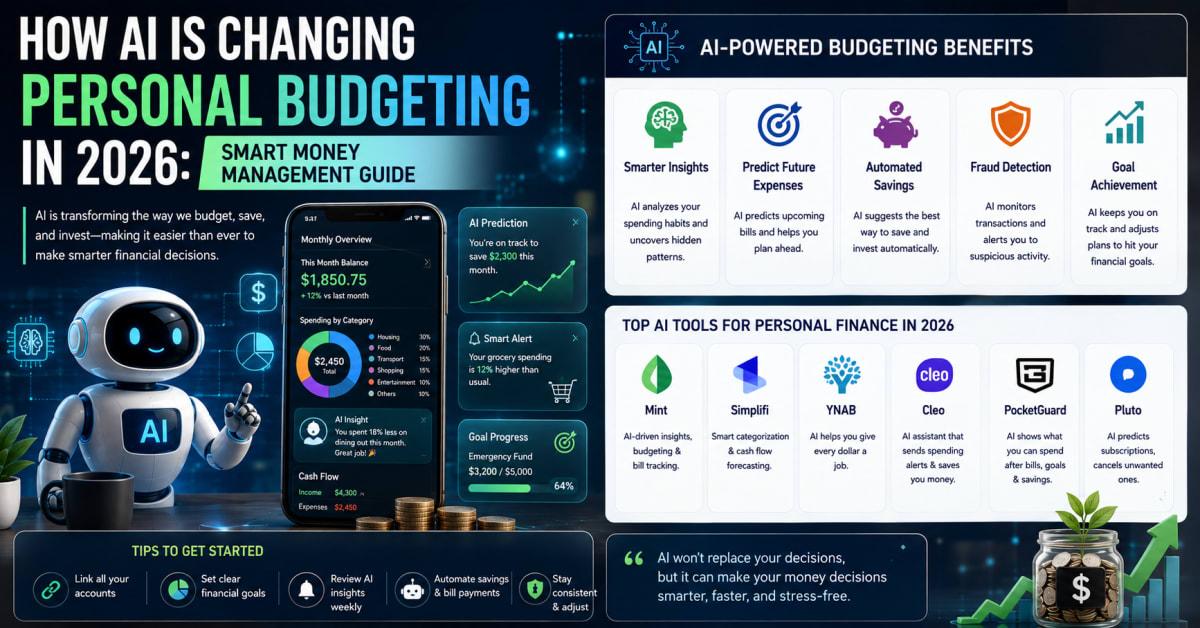
How AI Is Changing Personal Budgeting in 2026
A budgeting app that predicts a car repair before you remember to save for it sounds like a stretch. In 2026, that's a genuine, tested feature, not marketing copy. AI budgeting apps have moved from simple expense trackers into tools that actually see patterns coming before you do.
AI personal budgeting in 2026 means something specific and testable: predictive cash flow, automatic categorization that doesn't need constant correction, and plain-language answers about your own spending. This guide breaks down what's genuinely changed, compares the leading apps head to head, and walks through a real case study so you can see whether this is worth switching for.
AI Personal Budgeting — What's Actually Different From a Regular Budgeting App
A regular budgeting app lets you categorize transactions, set spending limits, and view reports, but it's fundamentally passive. You still have to interpret the data and catch problems yourself. An AI budgeting app goes further: it flags unusual spending before you notice it, predicts your end-of-month balance based on real cash flow patterns, and answers plain-language questions like "how much did we spend on restaurants last month?"
This distinction matters because the word "AI" gets attached loosely across this category. Some apps use it only for receipt scanning or basic categorization, while others genuinely forecast your finances forward. Knowing which kind of AI a specific app actually offers determines whether it solves your real problem.
Why This Is Important Right Now
Picture someone who's tried three different budgeting apps over the years, always quitting within a few weeks because manual categorization felt tedious. A genuinely predictive AI app removes exactly that friction, since it learns your patterns automatically instead of requiring you to tag every transaction by hand.
With household credit card debt having climbed past $1.28 trillion nationally, the pressure to actually stick with a budgeting system, not just start one, has never mattered more. Apps built specifically to reduce the friction that causes people to quit are addressing a real, measurable problem.
How the Leading AI Budgeting Apps Compare
Here's a visual breakdown of where four widely used apps land on predictive depth, based on independent testing across this category.
Relative predictive-AI depth based on independent 2026 testing across categorization accuracy, forecasting, and natural-language features. Not an endorsement of any single product.
Key Facts About AI Personal Budgeting in 2026
A few core facts separate genuine AI budgeting capability from apps simply using the label as a marketing term.
- Predictive cash flow is the defining feature, not categorization alone — the strongest apps forecast your end-of-month balance and flag upcoming bills before they're due, not just after a transaction posts.
- Automatic categorization accuracy varies significantly by app — with leading tools reporting accuracy above 95%, while weaker implementations still require frequent manual correction.
- Natural-language querying has become a genuine feature, not a gimmick — asking an app "how much did we spend on groceries in June" and getting an accurate, instant answer is now common among leading tools.
- Some apps live inside messaging platforms rather than requiring a separate download — letting users log expenses and get budget updates directly through a chat interface they already use daily.
- AI-assisted subscription and bill negotiation has become a standard add-on — with several apps now automatically flagging or even canceling unused recurring charges on your behalf.
What the Industry Data Shows
Industry data suggests that AI budgeting tools can cut manual tracking work by a significant margin for busy users, largely by removing the categorization and data-entry friction that historically caused people to abandon budgeting apps within weeks.
Research cited by major financial institutions has found that AI is meaningfully reshaping everyday money management, with predictive spending pattern tools helping users save more effortlessly than traditional, manual-entry budgeting methods.
Case Study: Two Months, One Household
To show what this actually looks like in practice, here's how a hypothetical household of two, Priya and Sam, used an AI budgeting app differently in two consecutive months.
Month one: baseline. Priya and Sam connect their accounts to an AI budgeting app for the first time. The app automatically categorizes three months of past transactions with roughly 95% accuracy, requiring only a handful of manual corrections. It immediately flags two subscriptions neither of them remembered signing up for, totaling $34 a month.
Month two: prediction in action. Based on their car's maintenance history and seasonal spending patterns, the app flags a likely upcoming repair cost before either of them thinks about it, suggesting a small weekly transfer into a dedicated fund. Three weeks later, the car does need a $420 repair. Because the app nudged them early, the money is already set aside instead of becoming a surprise expense.
Neither outcome required Priya or Sam to manually track anything beyond the initial account connection. The value came from the app noticing patterns they wouldn't have caught on their own, which is the actual distinction between AI budgeting and a traditional spreadsheet.
Step-by-Step: How to Choose the Right AI Budgeting App
Follow this sequence to match an app to your actual problem, rather than picking whichever one has the most marketing buzz.
Step 1: Identify your real friction point. Is it forgetting to log expenses, not checking your budget often enough, drowning in forgotten subscriptions, or simply wanting a plain-language answer about your spending?
Step 2: Match the AI type to that problem. Input friction points toward apps with easy logging, like chat-based entry. Categorization friction points toward apps with the highest automatic accuracy. Engagement friction points toward a conversational, coaching-style app.
Step 3: Test the free tier with real data. Connect your actual accounts, not a demo, and see how accurately it categorizes your genuine spending history over the first week.
Step 4: Check for household or shared features if relevant. If you share finances with a partner, confirm the app supports true shared visibility rather than requiring two separate logins that create blind spots.
Step 5: Commit to at least one full budgeting cycle. Give the app a full month before judging its predictive accuracy, since forecasting improves as it learns more of your actual patterns.
Calculate Your Potential Annual Savings
Estimate what switching to an AI budgeting app could realistically save you, based on time reclaimed and typical forgotten-subscription recovery.
Benefits and Real Opportunities
Genuine AI budgeting features create value that goes beyond simply looking modern.
- Reduced manual tracking burden — automatic categorization with high accuracy removes the tedious data entry that causes most people to abandon budgeting apps.
- Earlier warning on upcoming expenses — predictive cash flow can flag a likely bill or seasonal cost before it becomes an unexpected surprise.
- Instant answers without manual report-building — natural-language querying replaces digging through spreadsheet filters to answer a simple spending question.
- Better household coordination — shared AI budgeting features give both partners the same real-time picture instead of two disconnected views.
Costs and What to Expect
Free tiers across this category typically cover basic tracking and categorization, with genuinely predictive features often reserved for paid plans. Paid AI budgeting apps commonly range from about $6 to $11 a month, with a smaller number of coaching-focused apps offering a limited free daily interaction and a paid tier for unlimited access.
Household or shared-account features sometimes require the higher-tier plan rather than being included in every subscription level, so it's worth confirming this specifically if you're budgeting with a partner. There's no meaningful cost difference in security between these apps and traditional budgeting tools, since reputable platforms use the same established bank-connectivity providers either way.
The real cost consideration is switching time: migrating categorization rules and historical context from an old app to a new one takes some upfront setup, even though ongoing use requires far less manual effort than a traditional spreadsheet.
Predictive Forecasting Apps vs Conversational Coaching Apps vs Rule-Based Apps With AI Add-Ons: Which One Is Right for You?
| Option | Best For | Pros | Cons |
|---|---|---|---|
| Predictive Forecasting Apps (e.g., Monarch, Copilot) | People wanting genuine forward-looking cash flow insight | Catches upcoming expenses before they become surprises | Generally requires a paid tier for full predictive features |
| Conversational Coaching Apps (e.g., Cleo) | People who need engagement and motivation to check their budget | Gamified, chat-first experience keeps engagement higher than static dashboards | Less rigorous predictive forecasting than dedicated analytics-focused apps |
| Rule-Based Apps With AI Add-Ons (e.g., YNAB) | People who prefer a structured, proven methodology with light AI support | Strong underlying framework with growing AI-assisted suggestions | AI features remain less central and less mature than AI-first competitors |
Who Should Actually Care About AI Personal Budgeting?
This matters for anyone who's abandoned a traditional budgeting app or spreadsheet due to manual entry fatigue, couples and families wanting shared visibility without maintaining separate trackers, and anyone who's been caught off guard by a "surprise" expense that a longer-term pattern could have actually predicted.
Mistakes Most People Make
A handful of habits keep people from getting real value from these tools.
Assuming any app labeled "AI budgeting" offers genuine predictive forecasting overlooks that some only apply AI to basic categorization. Checking specifically whether an app forecasts forward, not just categorizes backward, avoids that mismatch.
Ignoring predictive alerts because they feel speculative wastes the tool's core advantage, since the value comes specifically from acting on a warning before the expense happens, as in Priya and Sam's case study above.
Switching apps too quickly before giving the AI enough transaction history to learn accurate patterns can lead to premature judgment. Predictive accuracy typically improves meaningfully after the first full month of connected data.
Using two separate accounts for a shared household budget, rather than a genuinely shared view, recreates the same blind spots AI budgeting apps are specifically designed to eliminate.
What Most Articles Won't Tell You
Most roundups treat "AI budgeting app" as one category, but the underlying AI varies enormously between apps, input-side logging, categorization, predictive forecasting, or conversational coaching. Matching the specific type of AI to your actual friction point, as outlined in the step-by-step guide above, matters far more than picking the most popular name.
There's also a detail worth knowing: predictive forecasting quality depends heavily on how much historical transaction data the app has to learn from, which means the first month with any new app will typically underperform its longer-term accuracy, regardless of which one you choose.
Advanced Moves Worth Knowing
Pairing a predictive forecasting app for your core household finances with a lighter, chat-based logging tool for quick, on-the-go expense capture can close the gaps either tool alone would leave.
Reviewing flagged predictive alerts weekly, rather than only checking your budget at month-end, captures the app's real advantage over a traditional, retrospective spreadsheet.
Frequently Asked Questions
Are AI budgeting apps actually different from regular budgeting apps?
Genuinely predictive ones are, since they forecast upcoming spending and flag anomalies proactively, rather than just letting you view past transactions. Some apps labeled "AI" only apply it to basic categorization, which offers a smaller benefit than true forecasting.
Are AI budgeting apps safe to connect to my bank account?
Yes, when they use reputable, established bank-connectivity providers, the same security standard traditional budgeting apps rely on. It's still worth checking a specific app's data privacy practices before connecting.
How long before an AI budgeting app's predictions become accurate?
Accuracy typically improves noticeably after the first full month of connected transaction history, since the app needs real spending patterns to learn from before forecasting reliably.
Can AI budgeting apps replace a financial advisor?
Not for complex financial planning, but they genuinely automate the routine tracking and predictive insight work that used to require significant manual effort, freeing up attention for bigger financial decisions.
Which AI budgeting app is best for a couple or family?
Apps with genuine shared-account features, rather than two separate logins, tend to work best for couples and families, since they eliminate the blind spots that come from each partner seeing only part of the picture.
The Bottom Line on AI Personal Budgeting in 2026
AI has genuinely changed personal budgeting in 2026, but not every app wearing the label delivers the same value. The real shift is predictive: apps that flag a likely expense before it happens, not just apps that categorize what already occurred. Use the step-by-step guide above to match an app to your actual friction point, test it with real data for a full month, and let the calculator estimate what the switch might realistically be worth to you. The best AI budgeting tool isn't the most talked-about one. It's the one that removes the specific friction that's been derailing your budget all along.
Read Next
Shock CPI Data and Retail Sales Surge: What It Means for Your Wallet

Stocks on Edge: Will Key Players Surge to Record Highs?

Investor Behind Nvidia's Boom Issues Urgent Warning on New Conviction Call!

Elon Musk Reveals Warren Buffett's Shocking 5-Minute Plan to Fix National Debt!

Stocks Shock Investors: Futures Dip Amid Urgent Iran War Negotiations